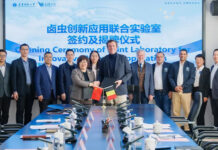


A leading group of scientists from the People’s Republic of China visited the University of Stirling to understand how pioneering new research facilities can shape best practices in the world’s largest aquaculture market.

A party of scientists from the Chinese Academy of Fishery Sciences (CAFS) toured the National Aquaculture Technology and Innovation Hub (NATIH), set up to drive the UK’s ambitions to become a world leader in modern aquaculture practice. The £21 million suite of research and development facilities at the University of Stirling’s Institute of Aquaculture will enable a broader range of academic research and commercial trials to be undertaken, with a focus on responding to critical and emerging challenges in the aquaculture sector.
Aquaculture is one of the world’s fastest growing industries, with a global growth rate of circa 8%. In China, total aquaculture production has seen consistent growth, with the country accounting for almost two thirds of global aquaculture production. However, this growth rate presents challenges for aquaculture producers in a context of climate change, disease management, and changing consumer expectations. As a scientific academy of the Chinese Ministry of Agriculture and Rural Affairs, CAFS is dedicated to promoting excellence in fisheries sciences, playing an influential strategic role in shaping China’s response to this developing landscape.

COLLABORATION WILL MAKE GROWTH SUSTAINABLE
“China is a major player in the global aquaculture industry, and its growth trajectory is set to continue. By working collaboratively to fully utilise the combined strengths of our knowledge and facilities, we can play a critical role in ensuring that the sector is informed by the latest research and development. This will ensure that growth is sustainable and offers the best outcomes for producers, consumers and the environment,” said Professor Trevor Telfer, Acting Head of the Institute of Aquaculture at the University of Stirling. “The visit from the Chinese Academy of Fishery Scientists was a valuable opportunity to explore shared areas of interest, and to highlight how the Institute of Aquaculture’s new National Aquaculture Technology and Innovation Hub can help to support this thriving global marketplace.”
According to the university’s statement, the Institute of Aquaculture’s NATIH development offers a combination of research facilities, capacity and academic expertise unique in Europe, including the capability to replicate freshwater aquaculture environments anywhere in the world. This includes the ability to variate gaseous states of water, and work within temperature parameters of 6-28 degrees Celsius.

A RESEARCH AND INNOVATION–DRIVEN COLLABORATION
China has been the world’s largest producer of aquaculture products since 2002, farming more than 800 species.
Professor Yu Shuzhou, Head of Discipline Inspection Group at the CAFS, said: “As China’s national academy dedicated to fishery sciences, the Chinese Academy of Fishery Sciences is pleased to note that both sides share extensive common interests. We firmly believe that this collaboration will enable us to achieve mutually beneficial outcomes in both research and innovation.”
The National Aquaculture Technology and Innovation Hub (NATIH) is funded by a £17million investment by the UK Government through the Stirling and Clackmannanshire City Region Deal, as well as a £1million Wolfson Foundation grant, and £3million from the University of Stirling.
The Stirling and Clackmannanshire City Region Deal is a £90.2 million investment from the UK Government and Scottish Government in innovation and infrastructure that will drive inclusive economic growth throughout the region.
Regional partners, including Clackmannanshire Council, Stirling Council, and the University of Stirling, will invest up to £123.8million, resulting in a Deal worth more than £214million, to be delivered over 10 to 15 years.