


Swine nutritionists in the US were the first to consider the impacts of leucine on animal performance as many finishing swine diets contain numerous synthetic amino acids to reduce crude protein and high levels of DDGS which is a high leucine ingredient. Researchers at Kansas State University conducted a thorough literature review and meta-analysis of published BCAA data and developed a predictive model which suggested that adjustments to valine and isoleucine ratios should be made based on the diets leucine level…

Product Development Senior Manager at CJ BIO America
PH.D. Poultry Science at Texas A&M University (USA)
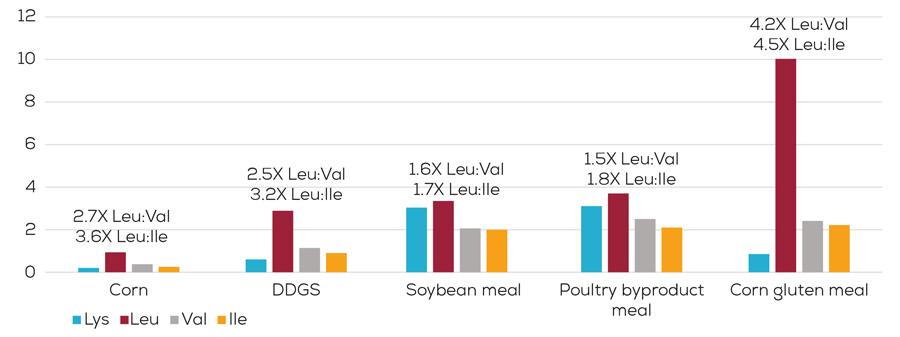
Historically, poultry production nutritionists focused on meeting minimum requirements in their diet formulations especially when focusing on amino acids. Typically, this would include lysine, methionine, total sulfur containing amino acids, threonine (Thr), valine (Val), arginine (Arg) and tryptophan (Trp). In recent years, the use of feed grade amino acids has increased in number and volume with the introduction and expanded use of first L-threonine and more recently with L-valine, L-arginine, and L-isoleucine. The expanded use of synthetic amino acids results in lower crude protein diets which has beneficial impacts on the environment, performance and welfare of the animal. As the crude protein level of the diet decreases, the actual nutrient value of the diet is closer to the minimum specification or requirement of the animal. Most nutritionists do not include a minimum requirement for the essential amino acid leucine, as it is typical in far excess of animal requirement, at least in US diets as many ingredients used in US diets contain elevated levels of leucine in relation to the other branched chain amino acids (BCAA), valine and isoleucine, especially in corn and corn products (Figure 1). Corn and DDGS have 2.5 times the amount of leucine as valine and 3.2 time the amount of leucine as isoleucine. Corn gluten meal has over 4 time the amount of leucine as valine and isoleucine.
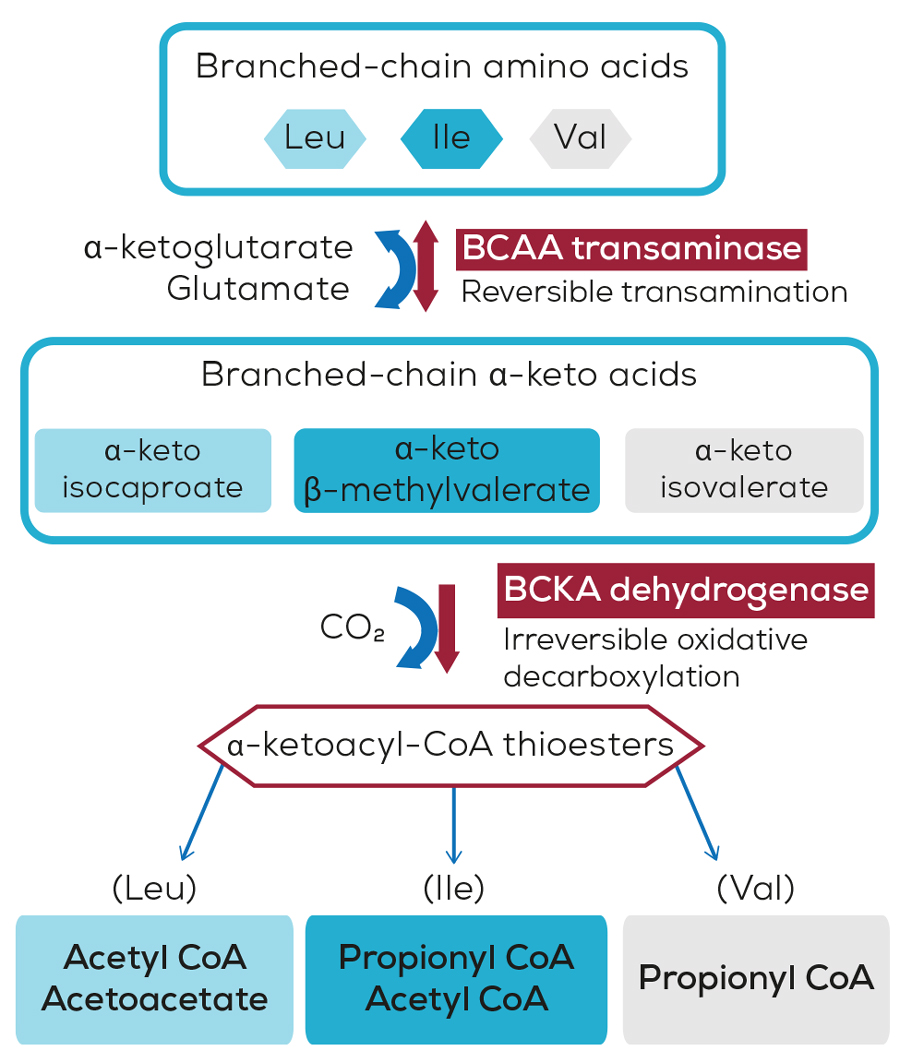
The importance of this relationship and distribution of BCAA in ingredients is due to the common metabolic pathways that BCAA share (Figure 2). All three BCAA share common enzymes in their catabolism to include BCAA aminotransferase (BCAT) and BCAA α-keto acid dehydrogenase (BCKD) complex. The BCAT reaction takes place in muscle and involves a reversible transfer of leucine, valine, and isoleucine to their corresponding branched-chain α-keto acids. The KIC, the α-keto acid of leucine, activates the BCKD complex (Harris et al., 2005), which increases an irreversible catabolism of both Val and Ile. Thus having excessive levels of dietary leucine can cause either a valine or isoleucine inadequacy when these are in the diet at the animal’s requirement which is more common in lower protein diets and diets that are utilizing L-threonine, L-valine, L-isoleucine, and/or L-arginine.
IMPACTS OF LEUCINE ON POULTRY PERFORMANCE
Swine nutritionists in the US were the first to consider the impacts of leucine on animal performance as many finishing swine diets contain numerous synthetic amino acids to reduce crude protein and high levels of DDGS which is a high leucine ingredient. Researchers at Kansas State University conducted a thorough literature search and meta-analysis of published BCAA data and developed a predictive model which suggested that adjustments to valine and isoleucine ratios should be made based on the diets leucine level (Cemin et al., 2019).
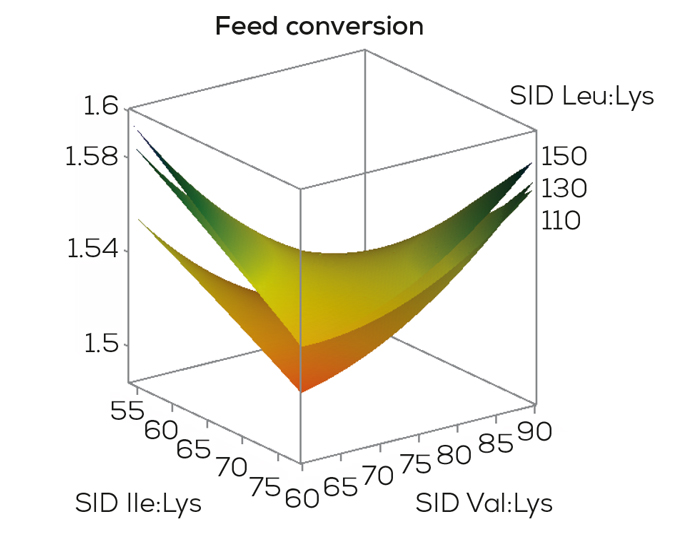
Currently, US broiler diets are higher protein, contain less synthetic amino acids (typically 3 or 4), and lower levels of by-product meals such as DDGS as compared to swine finisher diets. Therefore, it was unclear if the level of leucine in the broiler diets was sufficient to elicit a negative performance response. Maynard et al. (2021) conducted an experiment utilizing a Box-Behnken response surface design investigating increasing levels of dig leucine in a broiler grower diet between 15 and 35 days of age. They reported linear increases in feed conversion ratio with incremental increases in dig leucine from 110% of dig Lysine, to 130% and 150% of dig Lysine (Figure 3). As observed in the figure, the surface curves suggest a plane separation of 4 points in feed conversion ratio between the 110% and 150% leucine diets confirming that in fact, excess dig leucine does result in performance loss of market broilers. Typical US broiler diets will vary in dig leucine ratio usually between 135% and 165% depending on dietary phase and ingredient profile. Digestible leucine will increase in diets as the bird ages and is usually higher in all vegetable diets as compared to diets containing animal protein. Regardless, Maynard et al. (2021) confirms that an increase from 110% to 130% dLeu: dLys will negatively influence feed conversion and thus must be considered in all US broiler diets.
INFLUENCE OF LEUCINE ON THE OTHER BCAA REQUIREMENTS
As previously discussed, excess dietary leucine will increase the catabolism of valine and isoleucine and have a negative impact on animal performance if either or both of these amino acids are at or near the requirement. Cemin’s et al. (2019) model recommended consideration of and potential adjustment (increase) to valine, isoleucine, and tryptophan ratios based on the dietary leucine content. It is unclear currently, if tryptophan will/should be considered in any potential poultry model as tryptophan is typically present in most poultry diets at levels beyond genetic recommendations. Regardless, Maynard et al. (2021) data demonstrates that a valine and isoleucine ratio adjustment may be needed to avoid negative performance influences of high dietary leucine.
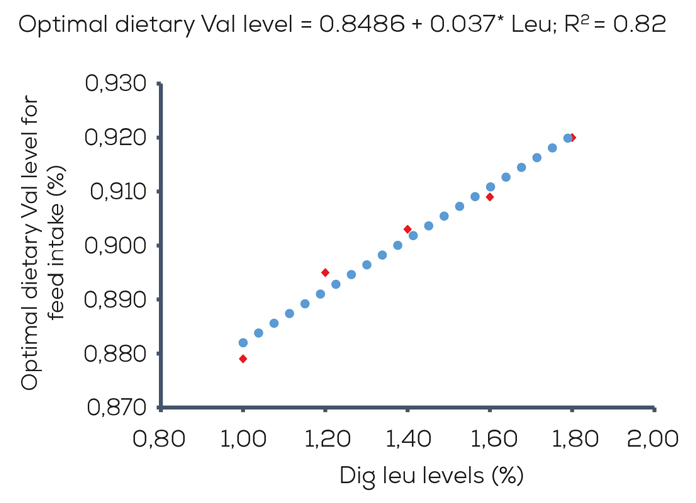
Ospina-Rojas et al. (2017) reported that increasing levels of dig valine were required to optimize feed intake in broilers as dietary leucine increased (Figure 4) confirming that excess leucine stimulates the catabolism of valine. Interestingly, this concept/result is not a new idea nor is it unique to only broiler chickens. Jackson and Potter (1984) reported that increasing dietary leucine had significant stepwise negative effects on turkey poult body weight gain, however, the addition of added valine eliminated the reduction in body weight at all evaluated leucine levels (Figure 5). However, more recently as research has begun to focus on the relationship of dietary leucine on valine and isoleucine requirements, researchers have aimed to not only demonstrate the antagonism but to quantify the valine ratio adjustment necessary based on dietary leucine ratio. While conducting an experiment that included two titration curves in diets containing either 115% dLeu: dLys (low) or 145% dLeu: dLys (High), Kidd (2021) reported that the optimum valine ratio to optimize feed conversion ratio was increased from 74% dVal to 79% dVal when increasing the dietary leucine concentration (Figure 6). Corn based diets will typically have dLeu levels between 140 and 160% depending on available by-product meals.
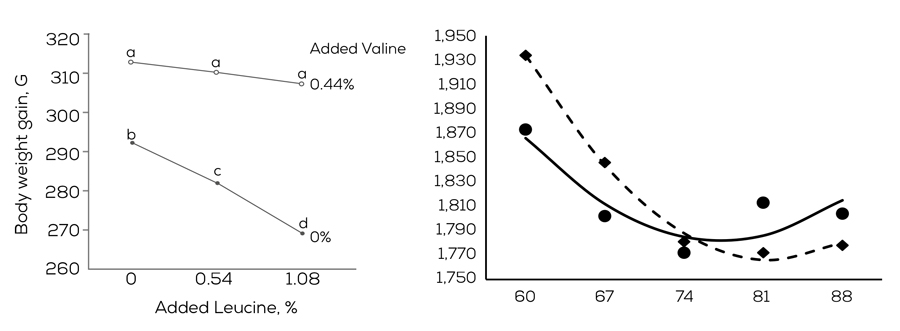
Figure 6. Feed conversion ratio response curves of 28 to 42 d Cobb 500 broilers responses to increasing dietary valine content amid low (solid line -115%) or high (dashed line – 145%) dietary leucine (Adopted from Kidd, 2021).
IMPLICATIONS AND CONCLUSIONS
Prior to adoption of L-threonine use, multiple reports were unable to demonstrate the BCAA antagonism in industry type diets, most likely due to all BCAA being above the actual bird’s requirement allowing for a “proper” balance. However, as the industry continues to adopt the use of additional feed grade amino acids such as L-valine, L-isoleucine, and L-arginine and we continue to understand the benefits of reducing dietary crude protein, valine and isoleucine ratios are at or near the requirement which increases the potential of the presence of an antagonism when leucine is in excess. The presence of an antagonism, specifically with valine, can not only result in reduced animal performance but also impact feather condition and bone density (Farran and Thomas 1992a; Farran and Thomas 1992b).
As we evaluate diets that may fall into this category, broiler and turkey corn-based finisher and withdrawal diets will always have higher leucine ratios as compared to starter and grower diets. Similarly, depending on the ingredient profile, broiler breeder, replacement pullet, and laying hen diets will undoubtedly have excess leucine with some US based diet approaching a dLeu: dLys ratio of 200. Thus, as an industry, we must begin to consider adjusting valine and/or isoleucine ratios used in industry diets based on dLeu, however, additional data is necessary to more accurately identify these ratio adjustments. Regardless, the most recent research demonstrating the BCAA antagonism clearly confirms the needs for BCAA prediction model in poultry similar to the Cemin et al. (2019) model in swine. The only question is must we develop a model based on species or strain?
References
1. Cemin, H.S., M.D. Tokach, S.S. Drits, J.C. Woodworth, J.M. DeRouchey and R.D. Goodband. 2019. Meta-regression analysis to predict the influence of branch-chain and large neutral amino acids on growth performance of pigs. J. Anim. Sci. 97:2505-2514. doi:10.1093/jas/skz118.
2. Farran, M. and O. Thomas. 1992a. Valine deficiency. 1. The effect of feeding a valine-deficient diet during the starter period on performance and feather structure of male broiler chicks. Poultry Science. 71:1879-1884.
3. Farran, M. and O. Thomas. 1992b. Valine deficiency. 2. The effect of feeding a valine-deficient diet during the starter period on performance and leg abnormality of male broiler chicks. Poultry Science. 71:1885-1890.,
4. Harris, R. A., M. Joshi, N. H. Jeoung, and M. Obayashi. 2005. Overview of the molecular and biochemical basis of branched-chain amino acid catabolism. J. Nutr. 135:1527S-1530S.
5. Jackson, S., and L. Potter. 1984. Influence of basic and branched chain amino acid interactions on the lysine and valine requirements of young turkeys. Poultry Science 63:2391-2398.
6. Kidd, M. 2021. Understanding the branched chain amino acid conundrum and how to use it to maximize performance. Poultry Science Association Annual Meeting, July 19-22, 2021.
7. Maynard, C., S. Liu, J. T. Lee. J. Caldas, J. Diehl, S. Rochell, and M. Kidd. 2021. Evaluation of branched chain amino acids in male Cobb MV x 500 broiler chickens by using Box-Behnken response surface design. Animal Feed Science and Technology (in press) doi:10.1016/j.anifeedsci.2020.114710.
8. Ospina-Rojas, I. C., A. E. Murakami, C. R. A. Duarte, G. R. Nascimento, E. R. M. Garcia, M. I. Sakamoto, and R. V. Nunes. 2017. Leucine and valine supplementation of low-protein diets for broiler chickens from 21 to 42 days of age. Poult. Sci. 96:914–922.