

Across the feed-to-food value chain, safety will always be a top priority. Efforts to reduce food-borne illnesses span every sector of the production chain, from ingredients in the field to the retailer’s meat case and restaurant’s menu. As global demand for poultry meat continues to increase, farmers and integrators are constantly seeking approaches to reduce the prevalence of Salmonella in their operations.

Global Product Manager Gut Health
Selko Feed Additives

Technical and Innovation Director
Selko Feed Additives – USA
Each year, Salmonella causes millions of cases of food-borne illness in humans. The challenge of addressing Salmonella risk and protecting human health may be even more challenging in the future as some serotypes are becoming increasingly resistant to antibiotics1.
Across the feed-to-food value chain, safety will always be a top priority. Efforts to reduce food-borne illnesses span every sector of the production chain, from ingredients in the field to the retailer’s meat case and restaurant’s menu. As global demand for poultry meat continues to increase, farmers and integrators are constantly seeking approaches to reduce the prevalence of Salmonella in their operations.
So, how widespread is the challenge within the poultry industry? Researchers have found Salmonella to be highly prevalent, with median prevalence values of Salmonella in broiler chickens, raw chicken meat and in eggs and egg-laying hens upwards of 40%2. Such a significant threat means that the goal of most poultry producers, and regulatory authorities, should be to minimize Salmonella prevalence across the entire production chain. For some particularly high performers, the goal has evolved to keep Salmonella levels as low as possible over successive production cycles.
REDUCING ON-FARM SALMONELLA PREVALENCE BY EMPOWERING THE BROILERS’ NATURAL DEFENCE MECHANISM
Research has shown that multi-functional feed additive blends designed to empower the natural defence mechanisms in the bird’s intestinal tract can complement good biosecurity, farm management and health practices3.
Many potential interventions have been shown to work well under controlled research conditions, but how well do they perform when used in “real world” field conditions, such as those on a poultry farm? To help answer this question, Selko researchers conducted a study to evaluate the effect of two feed additive blends in field conditions. The efficacy of these blends against Salmonella prevalence in broilers was previously demonstrated under controlled conditions4. The field study took place in Brazil, a global powerhouse poultry producer and exporter, with a goal to demonstrate that multi-functional feed additive blends can reduce Salmonella incidence in broiler flocks, when used in actual field conditions.
The study included 30 broiler producers from a Brazilian poultry integrator, managing a total of 39 farm locations and 86 houses. Historically, all farms used a blend of organic acids and essential oils in the feed at 1 kg/ton. An average Salmonella prevalence (assessed by collecting boot swab samples around day 21 of each cycle) of 22.7% was observed across all farms during 3 to 4 production cycles. Farms were then allocated to one of four treatments (according to a pre-determined Salmonella prevalence) and monitored during another 3 consecutive cycles.
Control farms (PC – positive control) continued to use the feed additive blend (organic acids + essential oils, 1 kg/ton) without a water additive. Water farms (W) continued to use the feed additive blend in combination with a buffered organic acid blend in the Water (Selko®-pH at 0.1%). Feed farms (F) switched to a multi-functional blend of selected organic acids and ß-1-4 mannobiose (Fysal® Fit-4 at 3 kg/ton) in feed only. Water + Feed (W+F) farms switched to a combination of Selko®-pH and Fysal® Fit-4 (at the same inclusion levels as aforementioned). No other management changes were implemented.
Results:
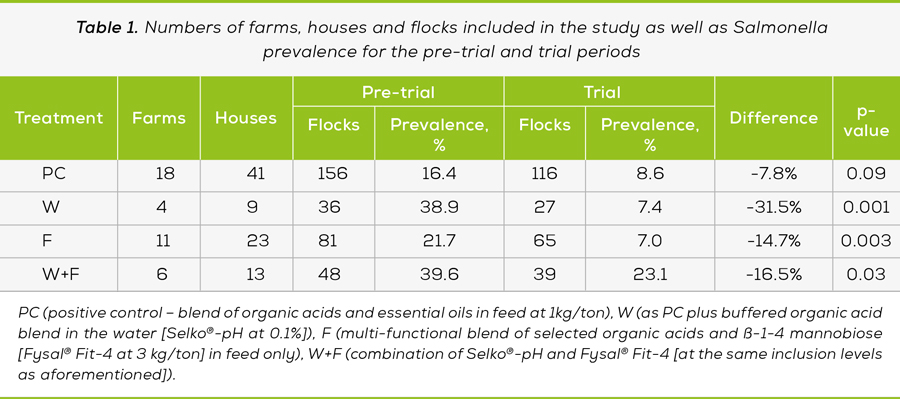
The prevalence of Salmonella was different for the various treatment groups in the pre-trial phase. Farms that were later allocated to treatments W and W+F showed the highest prevalence pre-trial whereas farms allocated to treatment PC showed the lowest pre-trial Salmonella prevalence (Table 1).
There was a statistically significant (P<0.05) reduction in overall Salmonella prevalence for the trial cycles observed for treatments W (-31.5%), F (-14.7%) and W+F (-16.5%), in comparison to their respective pre-trial prevalence. Overall, the groups including W and/or F reduced 20.9% the prevalence of Salmonella (Table 1). Curiously, the reduction of Salmonella prevalence for the combined W+F treatment was not as marked as compared to the individual treatments W and F. However, it must be considered that many factors influence Salmonella prevalence5, not all of which could be controlled in this field study, and that the comparison relates to different farms and houses. Notwithstanding, this study shows that Selko’s feed additive blends, Fysal® Fit-4 and Selko®-pH, are effectively contributing to reducing Salmonella prevalence in flocks.
 FEED IS A SIGNIFICANT SOURCE FOR SALMONELLA CONTAMINATION
Salmonella can enter the production chain through many pathways. However, both pelleted and mashed feed, present a significant risk for contamination. For poultry pelleted feed, a two-element hygiene process typically combines a chemical preservation agent with thermal treatment. In mashed feed production, chemical preservation is the only option to reduce the microbial load. Considering chemical agents, formaldehyde has been shown to be highly effective in reducing Salmonella levels in feeds. However, due to health risks, many countries have banned or restricted the use of formaldehyde, and companies are seeking alternative solutions.
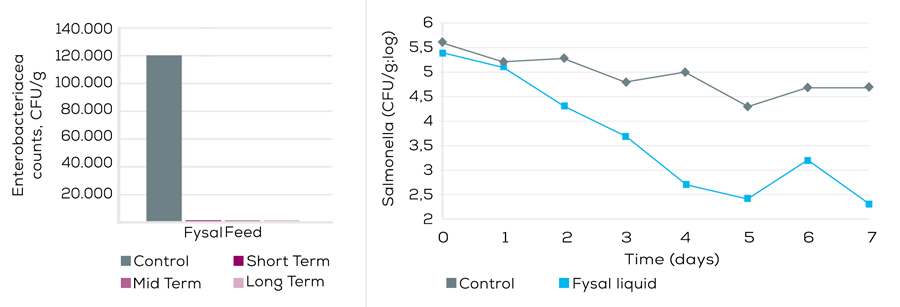
Assuring safe feed is not a “one-and-done” challenge and the risk doesn’t end once hygiene/decontamination efforts are deployed during processing. Feed can potentially be re-contaminated along subsequent steps, and even during storage, transportation and delivery to poultry farms. Inclusion of proper types and levels of organic acids in the feed matrix can reduce the risk of recontamination. Selko offers Fysal®, a product portfolio containing a potent blend of free and buffered organic acids and their salts, with proven efficacy in reducing Enterobacteriaceae (Figure 1a), and specifically, Salmonella (Figure 1b), in animal feed.
CONTROLLING THE SPREAD OF SALMONELLA IN BROILER FLOCKS – SELKO’S 5-STEP APPROACH
Minimising the spread of Salmonella can be difficult due to many factors influencing raw materials, complete feed and water. “Carriers” such as rodents, birds, insects, farm workers, visitors, vehicles, etc. can all introduce Salmonella into an environment. Such complexity demands an integrated and tailored approach that considers how feed, farm and health management can protect flocks from Salmonella colonisation and spread. Achieving the legal and commercial standards to safeguard poultry requires minimising the prevalence of Salmonella in each part of the production chain. Early intervention efforts can help optimise stakeholders’ success, protecting producers’ operations and the consumers who purchase poultry products.
Selko, the feed additive brand of Nutreco, includes feed, farm, and health management in its approach to minimising Salmonella risk. The customisable programme analyses the most critical risk factors that influence contamination and transmission of Salmonella.
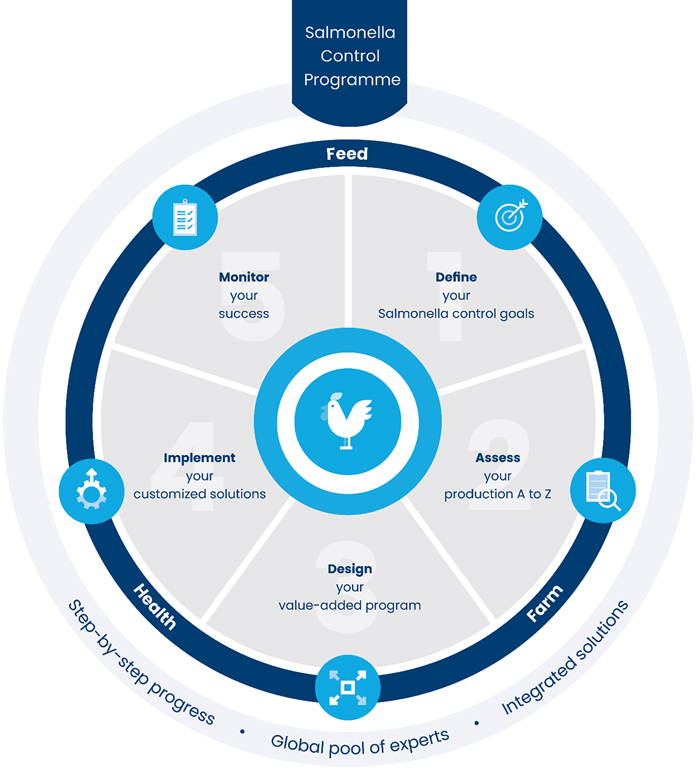
The Selko Salmonella Control Programme 5 step-by-step approach includes (Figure 2):
1. Define: Profile and understand the producer’s objective
2. Assess: An audit assesses the entire production environment
3. Design: A value-added programme is tailored to the producer’s goals and the assessment findings
4. Implement: A team of experts implements the plan
5. Monitor: The team evaluates results and decides on next actions within the programme
CONCLUSION
Optimising the safety of poultry feed and water and strengthening the digestive system of the birds makes it more difficult for Salmonella to enter the feed-to-food chain. Feed hygiene/decontamination, coupled with good manufacturing practices, are effective to reduce Salmonella risk in feed. Additionally, including water additives that strengthen innate defence mechanisms along with specific feed additives can make Salmonella colonization and spread more challenging. This “outside/inside” approach can play a role in reducing food-borne illness and supporting safety across the food chain.
References:
1Nair, D.V.T. et al. 2018. Antibiotic-resistant Salmonella in the food supply and the potential role of antibiotic alternatives for control. Foods.
2Castro-Vargas, R.E. et al. 2020. Antibiotic resistance in Salmonella spp. Isolated from poultry: A global overview. Veterinary World.
3Ruvalca-Gómez, J.M. et al. 2022. Non-antibiotics strategies to control Salmonella infection in poultry. Animals.
4Kuijk, S.J.A. van & Han, Y. 2021. Efficacy of a synergistic blend of organic acids and ß-1,4 mannobiose on cecal Salmonella counts and growth performance in Salmonella challenged broiler chickens: a meta-analysis. Animals.
5Wang, J. et al. 2023. A systematic review and meta-analysis of the sources of Salmonella in poultry production (pre-harvest) and their relative contributions to the microbial risk of poultry meat. Poultry Science.
About Giseli Heim
Giseli Heim is veterinarian and holds a master’s degree in Veterinary Science (Swine Reproduction – Brazil) and a PhD in Animal Science (Swine Nutrition – Ireland). She works for Trouw Nutrition for almost six years, starting from Global Marketing Swine, joining Nutreco Africa as Swine Specialist and finally finding her passion in the Selko Feed Additives , Gut Health Team, as Global Product Manager Gut Health. She has worked at Cargill (Spain), Orffa (Netherlands) and IDEXX (Netherlands). Giseli is originally from Brazil and has been living in Ireland, Spain and finally The Netherlands.About Marcos Rostagno
Marcos Rostagno is a veterinarian, with M.Sc. and Ph.D. in Preventive Veterinary Medicine, focusing his career in the areas of Salmonella ecology and epidemiology, antimicrobial resistance, and gut health in poultry and swine. He has extensive academic and industry global experience. Currently, he is the U.S. Technical and Innovation Director with Selko-USA.