



Researchers from Japan’s Ibaraki University reviewed leptin’s role in female bird reproduction, with mammalian comparisons. The study shows that leptin regulates ovarian development, follicle growth, and hormone production, improving egg-laying in layer birds while potentially causing premature follicle depletion in broiler birds, and highlights its potential as a biomarker for egg production.
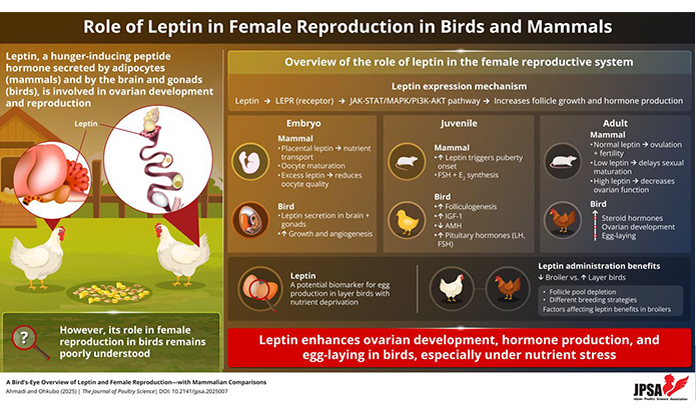
Leptin is an anorexigenic hormone that plays a key role in regulating food intake, ovarian development, and reproduction in mammals. However, its physiological role in birds remains less understood, compared to mammals. A significant knowledge gap exists between leptin levels and reproductive processes in layer and broiler parent stock chickens. A deeper understanding of these mechanisms could aid in optimizing sustainable global meat and egg production, particularly in challenging conditions like nutrient-deficient environments, where the reproductive efficiency may be compromised.
Against this backdrop, Dr. Sadequllah Ahmadi and Dr. Takeshi Ohkubo from the College of Agriculture, Ibaraki University, Japan, conducted a comprehensive review of leptin’s influence on female reproduction in birds, focusing on early folliculogenesis and ovarian development, and compared these mechanisms with those observed in mammals. This review was published in Volume 62 of The Journal of Poultry Science on February 6, 2025.
“In mammals, leptin is secreted by the adipocytes and its role has been clearly elucidated. However, in birds, leptin is primarily expressed in the brain and gonads with its mechanisms being unclear. A deeper understanding of leptin’s role in reproduction could help improve reproductive efficiency and sustainability in poultry production,” says Dr. Ahmadi, as the motivation behind the study.
In mammals, leptin is secreted primarily by adipose tissue, which then circulates in the blood stream, signaling energy sufficiency to the brain and regulating the secretion of reproductive hormones like luteinizing hormone and follicle-stimulating hormone. On the other hand, in birds, leptin is expressed locally in the brain, especially in the pituitary glands and gonads, and not secreted by adipocytes.
Delving into the mechanism of action, leptin binds to LEPR, the leptin receptor, and activates several vital cellular signaling pathways, including JAK/STAT, MAPK, and PI3K-AKT, which activate follicle growth, hormone production, and ovarian development. Dr. Ahmadi notes, “The signaling pathways activated by leptin through its receptor play an important role in cellular processes that are essential for reproductive function.”
Leptin regulates reproductive processes at different developmental stages. During embryonic development, leptin enhances embryonic muscle cell proliferation, supports nutrient transport, and oocyte maturation. In juvenile birds, leptin enhances the formation of primordial follicles by regulating ovarian growth factors such as inducing insulin-like growth factor 1 and reducing anti-Müllerian hormone expression. These mechanisms prepare the ovary for future follicle recruitment and maturation. While in adult birds, leptin promotes embryonic growth and angiogenesis, while stimulating pituitary hormones that are involved in reproduction.
In adult birds, leptin plays a crucial role in maintaining ovarian function and egg production, especially during nutrient-deficient conditions. It supports hormone synthesis and protects follicular development when energy intake is low. “Leptin helps maintain ovarian function and egg production even during times of limited feed availability. This finding indicates that leptin could be used as a potential biomarker for egg production,” remarks Dr. Ahmadi.