

The supplementation of antibacterial copper source (monovalent copper) with lowered hepatic accumulation is less inducing toxicity risks for animals and in the end will protect performance and genetic potentials. Benefiting from the positive effect of copper while maintaining risk of toxicity very low opens new frontiers for the industry from growing to finishing phases.

R&D,
Animine

Marketing
Animine
Copper (Cu) at high dietary levels has been used for a long time as a growth promoter. Several hypotheses on the mode of action have been proposed (pre or post absorption effect), this article will review them. A particular attention will be raised on liver accumulation that does not seem to be connected to performance. Finally, although sulfates form is the most commonly used, different forms exist and can bring improvement to the practice of the use of sulfates targeting precision feeding.
THE PRE-ABSORPTION MECHANISM OF COPPER
The antimicrobial effect has been recognized since Ancient Egypt, where Cu was used to sterilize chest wounds and drinking water. In the pig, this antimicrobial effect would occur once dietary Cu passes through the stomach, dissociated into Cu ion, and reaches the intestine in its ionic form.
Results from several scientific studies (including a recent study from Wageningen University) suggest that prior to absorption, high levels of Cu reduce bacterial populations, resulting in a positive modulation of the intestinal microbiota. This regulation affects the intestinal health and reduces the incidence of diarrhea in piglets. Besides this, the modulation of microbiota has an effect on the dietary utilization and metabolism of energy and protein, which may render available more energy and nutrients for the animal (reducing nutrients competition between microflora and host).
In the small intestine, for example, bacteria can produce the bile salt hydrolase (BSH) enzyme, which is involved in bile acids deconjugation. A reduction of this bacterial enzymatic activity has been reported as effective to enhance feed efficiency and body weight gain in monogastric animals in favor of the host. As Cu is one of the main BSH inhibitors, the modulation of this microbial activity is a good illustration of one of the mechanisms by which Cu improves growth performance in piglets.
LIMIT OF THE HYPOTHESIS OF POST ABSORPTION EFFECT OF COPPER
Once Cu is in the intestine, the Cu(II) form must be reduced at enterocytes membrane level to the Cu(I) form, so it can be absorbed. Then, it is bound to chaperone proteins and/or metallothionein (MT) to avoid cellular toxicity. Cu is then exported via the portal venous system to the liver, which is the central regulatory organ of copper homeostasis. On its entry to the hepatocyte, Cu is again rapidly taken up by cytosolic ligands (MT and glutathione). The main role of MT is the sequestration of any intracellular excess of Cu in response to supra-physiological Cu exposure, which can be potentially toxic. Cu excess is then removed from the liver through biliary excretion.
As around 80% of the absorbed Cu is excreted in the bile, a post absorption antimicrobial activity of Cu has been raised by some authors. Nevertheless, Cu in the bile is in the form of nonabsorbable-stable copper chelates not displaying antibacterial effects.
Also, biliary Cu recycling can be considered negligible in quantity and being mostly excreted in feces. The Cu excreted by the bile (considering the Cu concentration and the bile flow during 28 days) represents less than 0.1% of total Cu intake, biliary Cu excretion cannot exert any relevant antimicrobial impact on microbiota.
LIVER COPPER ACCUMULATION DOES NOT PREDICT PERFORMANCE
The storage of Cu in the liver is a consequence of Cu intake and not the cause of its growth promoter effect. The long-term feeding of high Cu levels leads to an excess of Cu in the organism, which can cause cellular damage through the formation of free radicals and can induce oxidative and inflammatory processes.
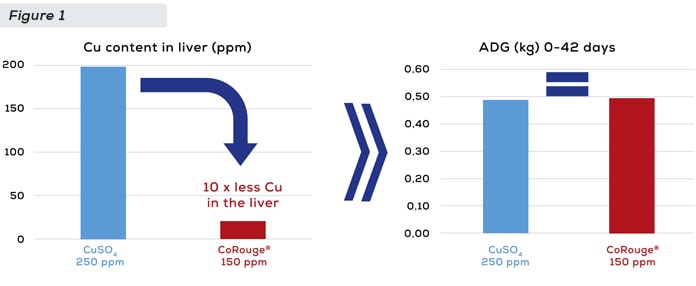
A recent study conducted in Thailand (at the BARC research station) has shown that piglets fed 150ppm of Cu (from monovalent copper) had a liver content accumulation divided by 10 times compared to a group fed 250ppm of Cu sulfates. Nevertheless, performance parameters of both groups (FI, FCR, ADG…) were strictly similar, demonstrating that liver Cu accumulation is not a relevant biomarker to predict potential growth performance improvements (see figure 1).
 LIVER CU ACCUMULATION AND ITS NEGATIVE SIDE EFFECTS ON FATTENERS
The chronic accumulation of Cu in liver negatively interfere with the organ functions and initiate oxidative damage. Oxidation pathways are the first steps to inflammation causing lesions and consuming energy from the host, at the expense of performance.
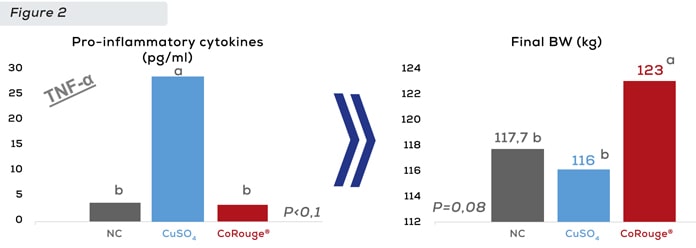
The University of Illinois in collaboration with Animine French company studied the impact of Cu toxicity on long term performance. Feeding 250ppm of sulfates (vs. 250ppm of monovalent copper) all along the feeding phases led to the generation of hepatic oxidative stress markers such as malondialdehyde (MDA) and to the secretion of anti-inflammatory cytokines (TNFα and IL-β, see figure 2) in blood at 63 days of age. As a result the supranutritional dose of sulfates negatively impacted performance at the end of the trial compared to the monovalent form that less accumulated in liver.
 CONCLUSION
According to recent studies, the strongest hypothesis of Cu effects on performance is due to a pre-absorption mechanims with positive impacts on microbiota modulation resulting in the improvement of gut health. The copper accumulation in the liver is a normal consequence of exposure to high Cu levels that cannot predict performance.
The supplementation of antibacterial copper source (monovalent copper) with lowered hepatic accumulation is less inducing toxicity risks for animals and in the end will protect performance and genetic potentials. Benefiting from the positive effect of copper while maintaining risk of toxicity very low opens new frontiers for the industry from growing to finishing phases.