

Fish farming is entering a new phase in which daily decisions must be based on actual data and analytics rather than prior experience, a gut sense, and best predictions. Farmers are saving money, decreasing fatalities, and becoming more efficient by embracing new tools and technologies to better understand their complicated operations.
Assistant Professor
Mandapam Centre for Sustainable Aquaculture (MCeSA),
TNJFU, India
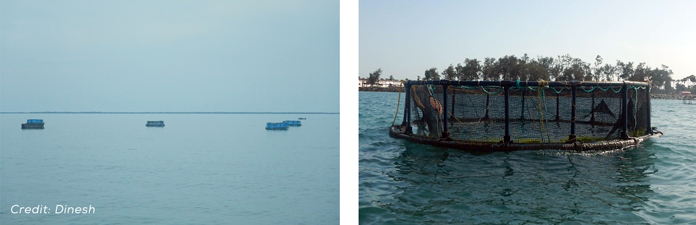
As the world population approaches 10 billion and food preferences to shift toward more protein-rich diets, food consumption will nearly double by 2050. The FAO forecasts a 37% increase in aquaculture production from 2016 to 2030, reaching 109 million tonnes per year. Aquaculture is now and will continue to be a key business in meeting the growing demand for high-quality proteins. Open ocean aquaculture is the future of sustainable seafood production, and sea cage farming is considered as a major option for increasing seafood production, and it has been quickly expanding at the worldwide level in recent years.
The novel, end-to-end solutions and services are being developed ranging from site selection to underwater feeding and high-tech environmental monitoring focusing on ‘Precision aquaculture’, an innovative, comprehensive approach to fish farming that combines emerging technologies to help you optimize operations and make data-driven choices in real time.
 AQUACULTURE MEETS MACHINE LEARNING!
Integrated solutions utilizing a combination of smart sensors, high definition cameras, artificial intelligence, and cloud computing deliver unique insights into how your farm is operating, from monitoring oxygen levels to ensuring fish health to predicting biomass to reduce feed costs.
SOLUTIONS DEVELOPED
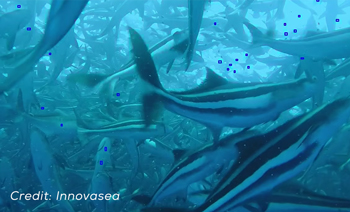 • Appetite / Pellet detection & Feed optimization / satiation – Recommended feed amounts based on your fish size and activity improving rates of feed conversion while reducing waste.
• Biomass data –You have an accurate inventory of your fish stocks.
 • Lice counting – Sea lice detection and counting enables proactive decision making.

 • Unique underwater sensors – Use sound waves to wirelessly report several key factors, such as dissolved oxygen, water temperature and salinity.
• Surface monitoring tools – Keep you informed of tide conditions, wind speed, barometric pressure, and other weather-related information.
• Physical sensors – Monitor mooring line tension and current strength to gain insight into the status of your cage infrastructure.
• Aeration – Control air levels from afar, cage-by-cage or across the entire site.
 • Oxygenation – Remotely monitor and adjust dissolved oxygen levels to guarantee a healthy environment for your fish population, increase growth, and provide a better feed conversion ratio. A first-of-its-kind digital valve system controlled securely through a computer or mobile device.
• Environmental monitoring – Real-time monitoring tools, including wireless sensors, allow quick visibility into environmental conditions.
• Plankton monitoring – Monitor historical trends and current conditions by tracking and analysing plankton data to avoid dangerous algal blooms.
 • Surveillance system – The underwater cameras are remotely operated up to the net wall, allowing them to search along it with horizontal and/or vertical movements.
 • Feed saver system – The feed spreader compensate for high current by remotely controlling and creating countercurrent to the ideal feeding point, allowing the feed to be consumed before being simply carried out through the net wall.
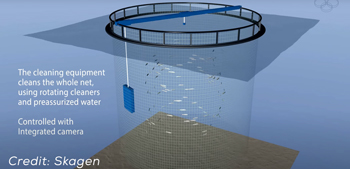 • Washing system – The system is remotely operated adjacent to the net wall, where the washing process begins, and washes the entire net systematically with horizontal and/or vertical movements.
FIRMS INVOLVED
Aquabyte, situated in the United States, has created a software platform that uses cutting-edge computer vision technologies. The software platform enables extreme levels of industry optimization, resulting in higher yields and profits for farm owners. Aquabyte’s holistic software platform outperforms modern farm monitoring systems. The solution provides simple installation, continuous monitoring, and a variety of applications.
AquaManager, Greece, provides a comprehensive, integrated software solution for increasing efficiency in the aquaculture industry. It is a sophisticated fish farming software solution that supports all stages of fish production, from hatchery to harvest.
CageEye is a global firm based in Oslo, Norway, intending to optimise seafood production most ethically and sustainably as possible. They have created a one-of-a-kind hydroacoustic system that provides deep analytical data and converts fish behaviour into knowledge and insights.
Cermaq, Norway, is a leading global salmon producer, spearheading the change of food system toward healthier, more environmentally friendly food. Cermaq’s iFarm (a technical concept developed by BioSort AS) is geared on individual based fish farming. The iFarm sensors use computer vision to detect each individual fish based on the dot pattern. The quantity of fish, fish size, number of sea lice, and various indicators of disease are all recorded in a sensor chamber. As a result, iFarm marks a technological breakthrough in the evolution of cage farming.
Innovasea, USA, with a global presence, offers complete end-to-end solutions for fish farming and aquatic species research, including high-quality equipment, experienced consulting services, and cutting-edge platforms and products that produce incomparable data, information, and insights.
Skagen Engineering in Norway developed a patented cage-based feeding system with an integrated monitoring system and automatic washing system. The firm specializes in aquaculture consultancy with an emphasis on environmental sustainability and profitability.
Fish farming is entering a new phase in which daily decisions must be based on actual data and analytics rather than prior experience, a gut sense, and best predictions. Farmers are saving money, decreasing fatalities, and becoming more efficient by embracing new tools and technologies to better understand their complicated operations. To be successful with this data-driven approach, you must start with correct information, which necessitates effective monitoring tools backed by solid analytic capabilities.
About R. Dinesh
Dinesh has been an Assistant Professor in the Department of Aquaculture at the Mandapam Centre for Sustainable Aquaculture (MCeSA) of Tamil Nadu Dr. J. Jayalalithaa Fisheries University (TNJFU), India since 2021. He undertakes strategic and applied research in the field of Mariculture, offering extension services to farmers as well. Dinesh completed his Master’s degree in Fisheries Science with a special focus on Aquaculture at the Central Institute of Fisheries Education (CIFE) and his undergraduate studies at TNJFU. His research interests lie in Aquaculture and Aquaculture Nutrition. Before joining academics, he was directly involved with the shrimp production industry for five years as a technical officer and aqua feed formulator, working with different corporates. He has won prestigious awards and has authored several books and peer-reviewed articles. Dinesh serves as a reviewer for high-impact journals, and he’s a member of various professional and academic societies.