


At Livestock Philippines 2025, Ecolex Animal Nutrition’s Global Commercial Director Edward Manchester urged the livestock industry to prioritise strong biosecurity measures to combat antimicrobial resistance through improved husbandry practices.
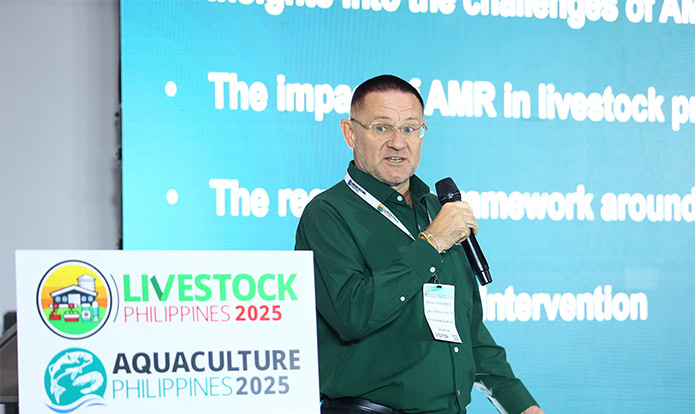
Photo: Courtesy of Ecolex
At the recent “From Policies to Practice – Tackling Antimicrobial Resistance Together” Forum, held during Livestock Philippines 2025 from 25-27 June, Ecolex Animal Nutrition’s Global Commercial Director Edward Manchester delivered a compelling presentation on “Good Husbandry Practices to Reduce AMR”.
Addressing delegates from across the livestock and poultry value chains, Manchester underscored that antimicrobial resistance (AMR) is a critical and growing global crisis that requires urgent action. “Now is the time to act,” he emphasized, posing the pivotal question: “So, what can we do?”
He advocated for a coordinated, multisectoral One Health approach—integrating animal, human, and environmental health—as the most effective way forward in the fight against AMR.
BIOSECURITY: A NON-NEGOTIABLE FOUNDATION
In the first of a four-part series, he detailed how robust biosecurity measures have been demonstrated to protect animal health and significantly reduce the need for antimicrobials.
Manchester asserted that strong biosecurity is essential for preventing the introduction and spread of disease on farms, thereby minimizing the need for antimicrobial interventions. “Biosecurity is not just an option—it’s a non-negotiable foundation for sustainable livestock and poultry production,” he said.
He spotlighted the best practices as:
Designated Biosecurity Zones – establishing clear biosecurity zones and checkpoints with visible signage helps control access and movement on the property. This ensures that only authorized personnel and vehicles enter sensitive areas, further reducing the risk of disease introduction.
Farm Access – restrict access to strictly only necessary visitors, such as emergency repairs and veterinarians. All other visitors, like sales people, should never enter the production site, and be restricted to the office in a low-risk zone, or even better met off-site. Brief all necessary visitors they understand biosecurity measures and are always accompanied by a staff member to ensure they comply with the necessary precautions.
All-In, All-Out Management – implementing an all-in, all-out system for animal groups prevents the mixing of different age groups or cohorts. This approach limits disease transmission and simplifies cleaning and disinfection between batches.
Clean Shower Facilities – shower facilities act as a physical barrier between the “dirty” (outside) and “clean” (inside farm) zones. Staff and visitors must pass through the shower, ensuring that contaminants from outside do not enter the animal environment. Shower areas should have lockers for outside clothes on the dirty side, and dedicated farm-provided clean clothing on the clean side, ensuring no cross-contamination.
The shower area should be maintained in a clean condition at all times, with ample hot water available, enhancing staff compliance with hygiene protocols. Well-designed shower facilities enforce one-way movement, so individuals cannot bypass the cleaning process, further minimizing disease risk.
Separate Tools and Equipment – use dedicated tools for each unit to prevent cross-contamination. Using different colored equipment for each shed makes it easy to identify which tools belong to which shed, reducing the risk of cross-contamination between different areas.
Testing and Quarantine – isolate new animals before introducing them to the main herd/flock. Avoid introducing animals from outside farms without proper testing. For semen, the health status of the source stud should be known and the information regularly updated.
Disease Vectors – rodents, flies, wildlife, and birds are not only common vectors for diseases and resistant bacteria, but can also cause them to spread, making their exclusion a top priority. Regularly inspect and treat the farm premises for pests, using safe and approved methods to avoid harming livestock and poultry, or the environment.
Hygiene Practices – provide facilities for personal hygiene, such as handwashing, clean showers with hot water, and changing areas stocked with clean protective clothing before entering production areas. Personnel should shower and change before entering production areas.
No farm staff should have any contact with livestock or poultry outside of their employment. This should be included in their employment contract.
Training – although comprehensive and regular training program is essential for empowering every team member involved in applying biosecurity measures, it is sometimes overlooked. “Training ensures that staff are not only aware of biosecurity protocols, but are also confident and competent in executing them,” said Manchester.
Train staff to recognize signs of disease, monitor feed consumption (a decrease in feed consumption often precedes visible symptoms of disease), and observe behavior changes.
To further strengthen biosecurity, he recommends designating a biosecurity champion—or champions—within each operation. These individuals are responsible for promoting awareness, implementing best practices, and fostering a strong culture of biosecurity throughout the farm.
Standard Operating Procedures – well-written standard operating procedures (SOPs) provide step-by-step instructions for each task, specify objectives, and clarify personnel responsibilities. They also include critical elements such as record-keeping requirements and review dates to ensure procedures remain current and effective.
“SOPs are not just about telling staff what to do—they should outline exactly how each biosecurity task should be performed, who is responsible, and when it should be reviewed,” explained Manchester. “This clarity is essential for maintaining high standards and continuous improvement.”
Emergency Procedures – develop specific emergency biosecurity procedures to be enacted in the event of a disease outbreak. These procedures should include immediate isolation of affected areas, enhanced monitoring, and communication strategies with veterinary authorities.
PREVENTION PAYS: BIOSECURITY LOWERS ANTIMICROBIAL RELIANCE
Manchester noted that Dutch swine producers have successfully reduced antimicrobial use by an impressive 70% across their operations, through the rigorous implementation of strict biosecurity protocols, which have minimized disease introduction and spread within farms.
In the next edition, Manchester discussed how enhanced animal nutrition can further reduce antimicrobial use and combat resistance.