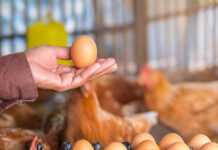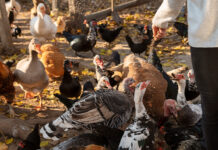


Aarhus University has published a new advisory paper investigating feather pecking among laying hens. The paper emphasises that feather pecking is not only a welfare issue but also has economic consequences due to increased mortality and reduced egg production.

A new paper from Denmark-based Aarhus University sheds light on an often overlooked but serious problem in egg-production: Feather pecking among egg-laying hens, which is a behaviour where hens peck at each other’s feathers. It can range from mild, social behaviour to feather pulling that can cause wounds, stress, and, in the worst cases, cannibalism. Therefore, feather pecking is categorised into two types: Gentle feather pecking and severe feather pecking.
Although organic and free-range systems provide hens with more freedom of movement and better opportunities for natural behaviours, the report shows that these systems also pose a risk for development of feather pecking. This is partly due to larger group sizes, more complex social interactions, and variable environmental conditions.
WELFARE CONSEQUENCES
The report emphasises that feather pecking is not only a welfare issue but also has economic consequences due to increased mortality, reduced egg production, and the need for additional management efforts.
Severe feather pecking can lead to wounds, infections, and, in the worst-case, cannibalism. Hens with feather and skin damage are more vulnerable to disease and parasites. There is a clear link between feather pecking and higher mortality rates.
Hens need intact plumage to regulate their body temperature, and replacing lost feathers demands energy. When feathers are removed, the skin is exposed, which can attract further pecking and lead to bleeding. This can escalate into cannibalistic behaviour. Feather pecking can also spread within the flock, as hens learn the behaviour by observing others – especially during the rearing period.
Feather pecking is not only physically harmful – it can also be psychologically distressing. Hens that are pecked likely experience pain and fear, even if they do not show obvious signs. Many hens respond with passivity and immobility, which may indicate a form of “learned helplessness” – a state where the animal stops trying to avoid repeated negative experiences.
There is a complex relationship between fear and feather pecking. Some hens become more fearful after being pecked, while others may peck because they are fearful. Genetics also play a role – some genetic lines are more prone to both feather pecking and fearfulness.
SIGNIFICANT CHALLENGE
Overall, severe feather pecking represents a significant welfare challenge in egg production, and reducing it requires integrated strategies that address environmental, genetic, and behavioural factors.
The advisory paper was prepared as part of the research-based policy advice that Aarhus University provides to the Ministry for the Green Tripartite Agreement and the Danish Agency for Green Transition and Aquatic Environment.
The advisory paper is available online.