


According to a recent RaboResearch report, the aquaculture industry is experiencing a rise in fish meal and fish oil demand, which is clashing with stagnant marine ingredient availability and increasing vulnerability to supply shocks.
The aquaculture industry is experiencing a surge in demand for fish meal and fish oil, driven by the expansion of high-value species and more intensive farming practices, according to a recent RaboResearch report. However, this demand is clashing with stagnant marine ingredient availability and increasing vulnerability to supply shocks, particularly those linked to climate change and recurring El Niño events.
EXPANSION OF HIGH-VALUE AQUACULTURE SPECIES FUELS AQUAFEED DEMAND
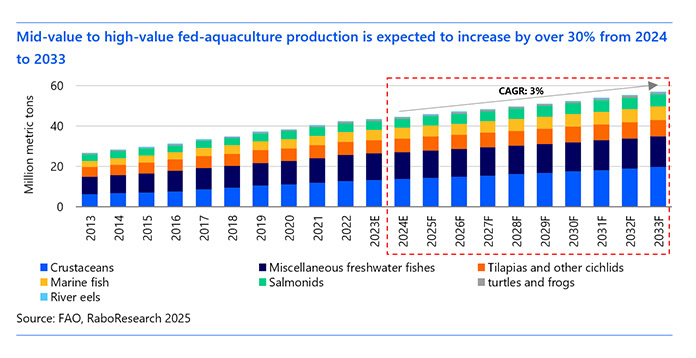
As global aquaculture production continues to rise, the industry faces the significant challenge of ensuring a stable supply of essential omega-3 fatty acids and proteins amid stagnating marine ingredient availability. “From 2024 to 2033, the production of mid-value and high-value fed aquaculture species is projected to grow at a compound annual growth rate of 3%, resulting in an increase of approximately 12 million metric tons over the next decade,” explains Novel Sharma, Seafood analyst for RaboResearch. This growth will be driven primarily by higher-trophic-level finfish and crustaceans, which rely heavily on wild-caught fisheries as their primary dietary sources of protein and lipids. The current supply of commercial feed ingredients, such as fish meal and fish oil, will be insufficient at current inclusion rates for this growth to materialize.
FISH MEAL AND OIL DEMAND IS EXPECTED TO OUTSTRIP SUPPLY, RAISING PRICES
Fish meal and fish oil, sourced from wild-caught fisheries, face limited prospects for supply growth. As supply remains stagnant and demand continues to rise, the gap between supply and demand is expected to narrow. “Given the limited availability of effective substitutes at scale, even modest supply disruptions can lead to sharp price increases,” cautions Sharma.
Indeed, in recent years, supply disruptions have had a more pronounced impact on fish meal and fish oil prices. Looking ahead, fish meal shortages are projected to emerge as early as 2028, while fish oil scarcity is expected to intensify throughout the decade. As shortages deepen, demand inelasticity is likely to increase further, leading to greater price volatility and establishing higher price benchmarks during future supply shocks.
 CLIMATE VARIABILITY IS INCREASING UNPREDICTABILITY OF SUPPLY
Fish meal and fish oil production, ranging from 5.5m-6m metric tons annually, is dependent on commercial fishery harvests and byproducts. Most wild-capture fisheries have reached sustainable limits, and climate variability increases the risk of supply disruptions and price volatility.
RISING UNPREDICTABILITY MAKES IT MORE DIFFICULT TO NAVIGATE PRICE VOLATILITY
Fish meal and fish oil markets are experiencing rising price volatility, exposing a structural vulnerability in the aquaculture value chain. Peru, the world’s leading producer and exporter, plays a pivotal role in shaping global prices. A decline in its output can reduce global supply by up to 20%, making the market highly reactive, according to the announcement. In 2023, a sharp supply shock in Peru – driven by climate-related disruptions and rigid demand – pushed prices to record highs. This event illustrated how concentrated supply and inelastic demand can amplify price movements. While past disruptions were temporary, the growing imbalance between supply and demand suggests that volatility may persist.
STRATEGIC MINDSET AND COOPERATION REQUIRED FOR STABILITY
According to Sharma, to support sustainable growth, the aquaculture sector must adopt proactive strategies to secure access to essential feed ingredients. Novel feed sources, like algal oil or insect meal, will play a critical role – not merely as alternatives, but as essential components of future feed formulations. Embracing these innovations will be key to building resilience and ensuring long-term viability in a resource-constrained environment.