

Starches are macronutrients in aquafeeds and acts as binders and provide inexpensive digestible energy to aquatic animals. It consists of amylopectin (soft amorphous) and amylose (hard semi-crystalline) components, influencing its properties. In extrusion, the quality of starch is enhanced by the process of gelatinization where the structure of amylopectin and amylose melts along with leaching to form a gel matrix in the presence of heat and water. Gelatinized starch can reduce mineral absorption, compromise immunity, and lead to glycogen and lipid deposits, impairing growth and liver function.

Assistant Professor, Department of Fish Nutrition and
Feed Technology, TNJFU

Research Scholar, Department of Fish Nutrition and
Feed Technology, TNJFU
Starch is the most abundant versatile macromolecule with glycosidic linkages which store energy in the form of granules of size ranges from 1-100 µm. Its property is determined by the extent and degree of polymerization. It is characterized by alternative amylopectin (Low density – soft amorphous) and amylose (High density – hard semi-crystalline). In general, the starch molecule is converted either by enzyme or through chemical modifications. In enzyme conversion, the major carbohydrase enzyme called amylase has a crucial role as a catalyst in converting starch into sugar and alcohol whereas, in chemical conversion, starch will be chemically modified to act as binders, emulsifiers, thickeners, or stabilizers through various processes including oxidation, gelatinization, dextrinization, etc. Starch has wide application and is deliberately included in the aquafeed formulation where it has no specific requirement in fish. The inclusion of starch in the fish diet varies among different species. Starch amounts in fish diets vary by species (carnivores: 20%, omnivores: 25-45%, herbivores: 30-50%) due to different feeding habits, digestive capabilities, and utilization efficiency of starch. The primary function of starch is to provide inexpensive energy to the host by sparing protein and lipids from catabolism and to act as binders to improve pellet quality.
SOURCES OF STARCH IN AQUAFEED
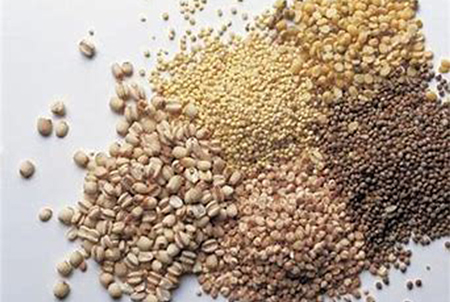
Starch is a common carbohydrate source in aquafeed and can be derived from various ingredients. The commonly used starch ingredients are corn, wheat, rice, barley, and sorghum. In addition, starchy root crops including potatoes, sweet potatoes, and cassava are processed into starch-rich ingredients to use in aquafeed. Certain leguminous plants contain both protein and carbohydrates such as soybeans and peas are also used. Tubers, as well as rhizomes, are also can be incorporated in aquafeed. Starchy by-products from the food processing industry, such as brewers’ grains and distillers’ dried grains are commonly added in aquafeed. In specialized aquafeed, algae, and seaweed are used as alternative starch sources.
STARCH GELATINIZATION
Starch granules consist of water-soluble amylopectin and water-insoluble amylose structures. Gelatinization begins with heating starch at 60°C – 80°C in water leading to absorb water and swelling. This results in gel formation from leached amylose and melting of crystalline regions, losing birefringence. Swelled granules disintegrate into smaller ones. The extent of gelatinization varies according to starch’s amylose-to-amylopectin ratios, location, and strain. On the other hand, non-waxy starches form strong gels upon cooling due to high amylose networks with other ingredients, while waxy starches with low amylose require low temperatures but lack strong gel formation after cooling.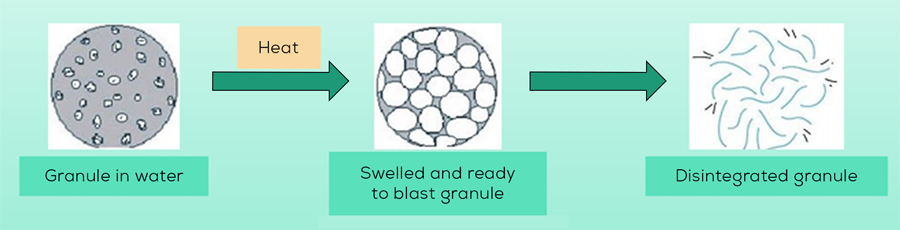
 BIOCHEMICAL MODIFICATION OF STARCH DURING PROCESSING
Studies have reported the influence of starch gelatinization on their subsequent biochemical changes. On top of that, cooking reduces the amylose content in the rice whereas amylose content was unaffected between 83% gelatinized extruded maize flour and 20% gelatinized native maize flour. It was reported that crude protein and crude fiber content was increased with lower crude lipid content in extruded maize flour compared to native maize flour. The resulting decrease in lipid content is due to the process of oxidation during extrusion. In addition, the increase in crude fiber content might be due to elevated β-glucan with no change in arabinoxylan level.
 IMPLICATIONS OF STARCH GELATINIZATION ON PHYSICAL CHARACTERISTICS OF AQUAFEED
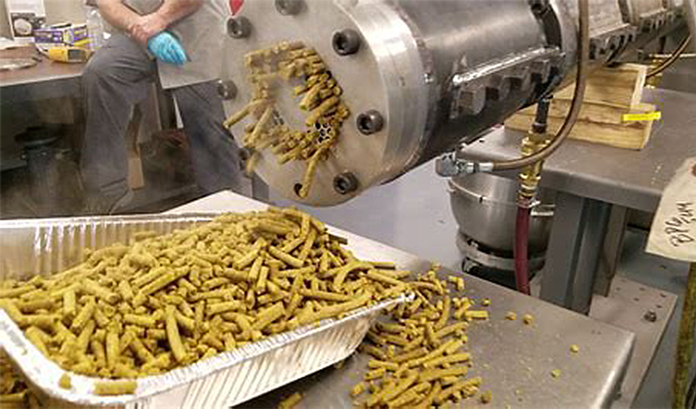
Commercial aquafeeds are generally made by extrusion technology which is highly flexible over the type of pellet (floating or sinking) that can be produced. For floating pellets, high temperature and pressure are required for increased starch gelatinization. In addition, the starch type also has an influence on the type of pellet. For example, waxy starches create less dense and more expanded extrudates because their branched linkages are weaker. Therefore, it is necessary to optimize the extrusion temperature and pressure according to the ingredient. In addition to that, other nutrients in the ingredients also have an important role in the degree of gelatinization. It was also reported that high lipid content in the diet acted as a lubricant and reduced the duration of gelatinization. However, a higher temperature processing might solve this issue, but it would also lead to a chance of increasing lipid oxidation like long-chain PUFA and vitamin C destruction in the diet. Thus, higher temperature gelatinization potentially reduces the nutritional quality of aquafeed with high lipid content.
The inclusion of PG starch has a positive influence on the overall feed quality. The inclusion of PG tapioca starch at 10% increased the feed quality compared to native tapioca starch.
INFLUENCE OF STARCH GELATINIZATION ON GROWTH AND DIGESTIVE EFFECTS
Starch gelatinization generally increases with the degree of digestibility but the influence of growth on the aquatic animals is highly variable. In addition, growth enhancement will also depend upon several factors like species-specific differences, starch type, the ratio of gelatinized starch to native starch, etc.
The ratio of pre-gelatinized starch to native starch has been considered a significant contributor. For instance, better growth was reported when the ratio of PG potato to native potato at 1:1 or 1:2 than individual ingredients in Onchorhynchus mykiss. The same effect was observed in Seabream and European seabass at a 1:1 ratio. Similarly, when it comes to starch type, many findings reported a contradictory effect on growth. For example, gelatinized wheat inhibits growth compared to other gelatinized starch sources due to limited influence on gelatinization in O. mykiss and Cyprinus carpio. Later some authors reported its efficiency in increased digestibility in spite of its above adverse effects. But in the case of pre-gelatinized corn-fed seabream, native starch showed poor growth compared to PG corn starch.
IMPACT OF STARCH GELATINIZATION ON ENZYMES ACTIVITY
The study on the effects of starch gelatinization in enzyme modulation is limited. It was reported that amylase activity occurs when the complex starch source is used as an ingredient and required to metabolize easily digestible gelatinized starch. For example, PG corn starch has increased amylase activity compared to PG wheat or native wheat starch. The reason might be due to the presence of easily digestible or low amylose content in the ingredient. Similarly, trypsin activity was increased in Clarias gariepinus when fed with PG tapioca starch. In addition, protein sparing effect was observed with the decreased protease enzyme activity and increased amylase activity when fed with PG corn flour in Labeo rohita. This effect was detected by the enhanced activity of enzymes (aspartate and alanine aminotransferase) responsible for gluconeogenesis and glycolysis.
IMPACT OF STARCH GELATINIZATION ON WATER QUALITY
The fish waste production either as ammonia or feces is correlated with the amount of feed given and its utilization. There are indications that dietary PG starches can potentially minimize water quality deterioration due to gelatinized starches being better digested and in rare cases, reduce feed intake. It has been observed that fecal production was reduced by PG corn starch as a result of better digestibility of lipids, proteins, and starch, higher viscosity, and reduction in short-chain fatty acids (SCFA) in a controlled Oreochromis niloticus settling tank.
LIMITATIONS
Starch gelatinization results in the formation of indigestible complexes with the minerals and increases the digesta viscosity, and reduces mineral absorption. Enhanced starch digestibility often leads to reduced intestinal short chain fatty acids, potentially compromising immunity and disease resistance. In addition, excess starch digestibility leads to large deposits of glycogen and lipid in the host which results in impaired growth and liver function. The constraint that arises in the utilization of pre-gelatinized starch in aquafeed is its potential to cause gelatinization in feed processing which might lead to reduced feed pellet integrity, increased feed dustiness, and water stability due to its rapid hydration and dissolution characteristics. Additionally, it could affect the overall palatability and digestibility of the aquatic animals due to the alteration in the texture and water-holding capacity.
CONCLUSION
Research on dietary starch and starch gelatinization in aquafeed is not as advanced as lipid and protein studies. Starch is often considered insignificant due to limited knowledge of aquatic animal carbohydrate metabolism. Gelatinized and pre-gelatinized (PG) starches enhance pellet quality, improving durability, water stability, and protein solubility at lower heat. In summary, while gelatinized starch is typically more digestible in aquatic animals, its effects on growth, feeding efficiency, physiology, and health vary, and research in this field is in its early stages.
References:
1. Kumar, V., Sahu, N. P., Pal, A. K., & Kumar, S. (2007). Immunomodulation of Labeo rohita juveniles due to dietary gelatinized and non-gelatinized starch. Fish & Shellfish Immunology, 23(2), 341-353.
2. Obaldo, L. G., Dominy, W. G., & Ryu, G. H. (1999). Growth, survival, and diet utilization of Pacific white shrimp, Penaeus vannamei, fed dry extruded diets with different levels of shear and moisture. Journal of Applied Aquaculture, 9(1), 47-57.
3. Stone, D. A. J., Allan, G. L., & Anderson, A. J. (2003). Carbohydrate utilization by juvenile silver perch, Bidyanus bidyanus (Mitchell). II. Digestibility and utilization of starch and its breakdown products. Aquaculture Research, 34(2), 109-121.
4. Wood, J. F. (1987). The functional properties of feed raw materials and their effect on the production and quality of feed pellets. Animal Feed Science and Technology, 18(1), 1-17.
5. Riaz, M. N., Asif, M., & Ali, R. (2009). Stability of vitamins during extrusion. Critical Reviews in Food Science and Nutrition, 49(4), 361-368.
6. Jain, A., Rao, S. M., Sethi, S., Ramesh, A., Tiwari, S., Mandal, S. K., … & Kalaichelvani, C. (2012). Effect of cooking on amylose content of rice. European Journal of Experimental Biology, 2(2), 385-388.
7. Enes, P., Peres, H., Couto, A., & Oliva-Teles, A. (2010). Growth performance and metabolic utilization of diets including starch, dextrin, maltose, or glucose as carbohydrate sources by gilthead sea bream (Sparus aurata) juveniles. Fish Physiology and Biochemistry, 36, 903-910.
8. Bergot F, Breque J (1983) Digestibility of starch by rainbow trout: effects on the physical state of starch and of the intake level. Aquaculture 34: 203–212
About Kalaiselvan Pandi
Kalaiselvan Pandi is a research scholar in the Department of Fish Nutrition and Feed Technology at Institute of Fisheries Post Graduate Studies of Tamil Nadu Dr. J. Jayalalithaa Fisheries University (TNJFU), India. He has been honored with the prestigious Bayer Fellowship-“Medha”.About Dr. Amit Ranjan
Dr. Amit Ranjan is an assistant professor in the Department of Fish Nutrition and Feed Technology at the Institute of Fisheries Post Graduate Studies of Tamil Nadu Dr. J. Jayalalithaa Fisheries University (TNJFU), India. He is specialized in fish and shrimp nutrition. With his expertise in commercial shrimp and freshwater fish farming, he has authored numerous research articles in international peer-reviewed journals and served as a reviewer for more than 30 journals.