


Organic acids are a crucial element of any livestock diet, as they not only help to preserve valuable nutrients and protect the diet from microbial degradation, but also ensure optimal animal health, performance and carcass quality.

Global Scientific and Technical Manager, Feed Preservation
Adisseo
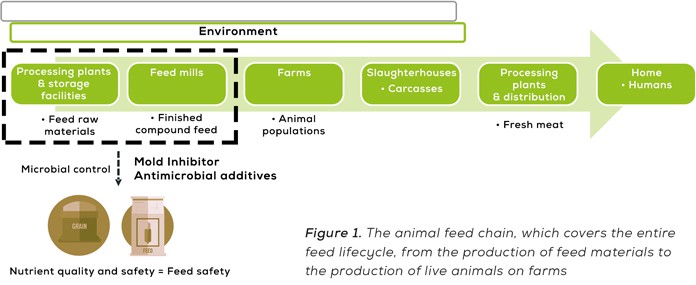
Microbial degradation is a continual process that begins when feed ingredients are used, continues during production and storage, and only ends once the feed is consumed (see Figure 1). These key milestones in the life of the feed are where nutrient quality and safety can decline. Acting during these milestones ensures high-quality, safe feed.
Organic acids are a crucial element of any livestock diet, as they not only help to preserve valuable nutrients and protect the diet from microbial degradation, but also ensure optimal animal health, performance and carcass quality. Organic acids are defined as organic compounds with acidic properties associated with their carboxyl group ‘-COOH’. It is crucial to understand the different chemical properties and actions of these compounds in order to choose the optimal solution for a specific challenge. Organic acids are capable of reducing pH in feed. It is well known that each group of microorganisms has an optimum pH range for growth. If the environmental pH is outside this range, their growth is disturbed. In addition, organic acids have the ability to cross the cell membranes of bacteria. Once inside the cell, they will dissociate and disturb metabolism. As a result, proliferation of the pathogenic microorganisms is reduced, resulting in lower pathogen counts in the intestinal tract. Thanks to these two modes of action of organic acids, growth of pathogenic bacteria in the feed can be reduced, therefore diminishing digestive disturbances in the intestinal tract.
 MOLD-NIL® – A COMBINED SOLUTION
FOR MICROBIAL CONTAMINATION AND MILL EFFICIENCY CHALLENGES
Organic acids are a key research field as they offer important antimicrobial properties. Combined with feed mill techniques, they already play an essential role in feed preservation. Weak organic acids are safe to handle (especially when they are buffered), compared to inorganic acids. In addition to their power to preserve feed, it has been shown that organic acid blends can support feed mill efficiency. As such, there are many sources and forms of organic acid blend solutions available on the market, and they are becoming more of a specialty business. Consequently, Adisseo has invested and innovated significantly in its organic acid blend product line, Mold-Nil®. It is Adisseo’s #1 priority to guarantee safe and effective feed additives, and to provide valuable solutions to the global feed industry.
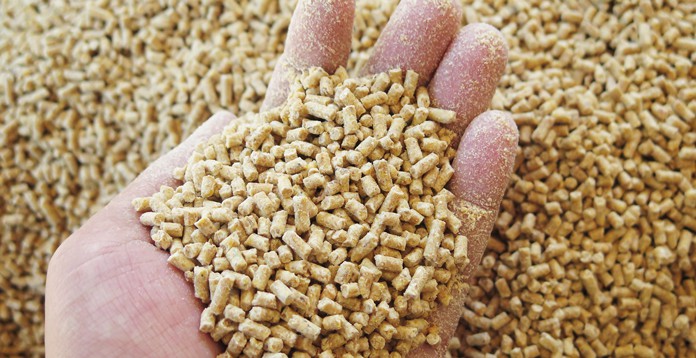
Mold-Nil® is a diverse portfolio of organic acid blend systems for grain and complete feed in both dry and liquid forms. Depending on the Mold-Nil® product, it contains synergistic mixes of propionic acid and other organic acids and their salts. The liquid portfolio even includes an emulsifier to ensure optimal homogeneity in the grain or feed matrix. These combinations produce a safe and stable solution that is more efficient than single-component organic acids.
 I. MOLD-NIL® – A SOLUTION FOR RAW MATERIAL AND FEED
Over the years, Adisseo has conducted numerous trials to show that Mold-Nil® Liquid not only inhibits growth of microorganisms in feedstuffs, but it also reduces them during storage. Furthermore, Mold-Nil® Liquid has been evaluated as a low-corrosive product, making it safe to use and compatible with feed mill equipment and facilities. Recently, a trial in an Indonesian feed mill was conducted with freshly harvested corn to test the adequate preservation effect of Mold-Nil® Liquid on grain storage and it’s corrosivity to silo material and equipment.
• Corrosion results
Mold-Nil® Liquid is essentially less corrosive, with a pH value of ~6.0. This is achieved through buffering and the inclusion of an emulsifier. Via a simple corrosion test, it can be easily shown that Mold-Nil® Liquid is less corrosive, especially compared to unbuffered liquid mold inhibitors (Product A). Comparing the corrosion of stainless steel at 65 ºC by measuring weight loss, Product A induced much higher weight loss (~5.4%) than Mold-Nil® Liquid (~2.9%).
 • Corn preservation results
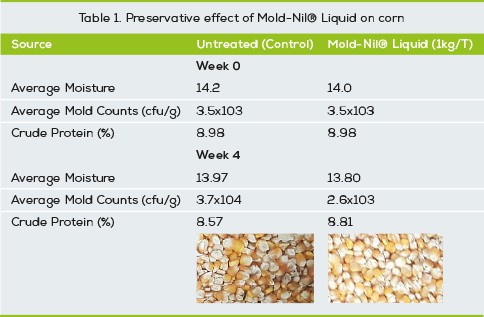
Mold growth concerns in corn have been mainly attributed to the potential formation of mycotoxins and their negative effects on animal performance. Often overlooked is the potential negative impact of storage on the nutritive value of corn, i.e., crude protein content. After one month, Mold-Nil® Liquid, versus a negative control, prevented the loss of ~1.9% crude protein and was able to further control the contamination of mold and mycotoxins during storage. In contrast, the untreated control with 14% initial moisture content was moldy after a short period of time. As shown in Table 1, corn without a Mold-Nil® Liquid treatment lost 4.2% crude protein due to fungal growth, which is of economic significance due to reduced processing and nutritional quality of the corn.
II. MOLD-NIL® – A SOLUTION FOR FEED MILL EFFICIENCY
Mold-NilÒ Liquid has been adopted in the feed industry due to its beneficial effect as a mold inhibitor. More recently, an improved Mold-NilÒ Liquid has shown to reduce the moisture variability in feed raw materials as well as during processing, which offers benefits to feed manufacturers looking to produce safe and economically viable feed. With the improved Mold-NilÒ Liquid at 1.0kg/T, the feed mill energy usage was decreased by 4.3% and the tons/hour was increased by an average of 7.3%. The pellet durability index and starch gelatinization were increased along with an improved feed moisture retention of 0.6%.
SOLUTION APPLICATION AND SERVICES
At Adisseo, we strongly stand by our liquid programs and are dedicated to ensuring optimal use of our liquid solutions along with proper product application and dosing, which we know is crucial. We offer a total solution, and are committed to providing customized equipment, product application advice and laboratory services from microbiology-related tests to physical and chemical tests, to lab scale simulation trials and many other services. This is part of our strategic approach that differentiates us among competitors. Our objective is “to offer our customers convenience”.
About Dr Edwin Chow, Ph.D.
Specializes in Feed Quality and Safety for product ranges antioxidants, antimicrobials, mold inhibitors, surfactants and emulsions and pellet binders.
Dr Edwin received his undergraduate and Ph.D. in Chemistry at the National University of Singapore (NUS). Dr Edwin currently holds the adjunct professor in the department of food science and technology, NUS. Dr Edwin has won numerous honors and awards and has authored over many articles, presented over invited lectures and international conferences as well as over 10 patents issued, pending or licensed.