

Traditional animal nutrition methods are shifting toward biotechnology-driven preventive strategies due to antimicrobial resistance and environmental constraints. In this context, silkworm pupae offer a bio-circular ingredient with high digestible protein and bioactive peptides. This resource, validated in aquaculture and livestock, plays a critical role in supporting immunity, enhancing stress tolerance, and building sustainable food systems.

CEO & Co-Founder
Loopworm Private Limited
Today, almost 86% of the world’s population consumes animal-derived foods, from milk and meat to eggs and fish, for their nutrition. Close to 12% of the world’s population directly depends on these foods for livelihood. As population rises and production of animal nutrition scales, the impact on land and water, the effects of climate change, and the threat of antimicrobial resistance and zoonotic disease outbreaks are already on the horizon.
Under these constraints, how can we look at ‘performance’ and ‘productivity’? While we optimise these systems for more productivity, we also need to consider how they shape food security, environmental systems and public health. The One Health approach, which focuses on preventing, predicting, detecting, and responding, helps chart the fundamental interconnectedness of these three aspects while using a multidisciplinary framework to provide holistic strategies.
NUTRITION FOR THE NEXT-GEN
For much of the past few decades, short-term gains have been the priority for animal nutrition. Despite the negative impacts of feed ingredients like soymeal and fishmeal on land and water, they were preferred for enhancing performance. Antibiotics and synthetic additives were preferred for increased short-term output. But what we did gain in performance in the short run, we paid for in the long term with antibiotic resistance, ecosystem degradation, and nutritional imbalances that have disrupted the food chain.
It clearly showed us that nutrition is not just a feed industry concern. It is health policy, environmental commitment, and moral responsibility rolled into one. Feed choices now shape outcomes far beyond growth rates and feed conversion ratios. They determine gut integrity, immune function, disease susceptibility, antimicrobial dependency, and the resilience of production systems over time. Within the industry, this has prompted a shift from a reactive strategy for diseases to one of preventing them from the get-go. Functional feeds that support gut integrity and microbiome balance are increasingly viewed as complementing biosecurity and management practices while reducing dependence on antimicrobials.
A CRISIS WITHOUT HEADLINES – ANTIMICROBIAL RESISTANCE
AMR has quietly become one of the most pressing global threats of our time. Once considered a breakthrough in animal agriculture, antibiotics were used to grow and treat animals and aid the rapid scaling of animal farms. Antibiotics have been routinely mixed with animal feed over the last few decades. This has created an incubator for superbugs that are resistant to treatment to thrive in. These superbugs are not just confined to farms. They move through soil and water runoff and thrive. They reach humans through food and spread through direct contact between animals and people. Consequently, infections are becoming harder and harder to treat. Approximately 1 million people die of AMR each year and the number is only growing. While antibiotics are a double-edged sword, it is unlikely and unethical to stop using antibiotics. That leaves us with the option to find a way to build systems beyond antibiotics.
BIOTECH TO THE RESCUE?
The bridge between nutrition and AMR resilience is being paved by biotech. It allows for nutrition to function as a preventive, biologically aligned intervention. Instead of a one-size-fits-all approach, biotechnology provides an arsenal of tools that enable better nutrition for animals. There have been numerous advances in fermentation, enzyme technology, and microbial products; furthermore, precision biomolecules can truly change the feed game. They ensure that nutritional feed can cause fewer health disruptions, improve survival, and provide more stable economics.
In an industry where predictability is as important as innovation, biotech has enabled exactly that. By turning traditional feed into a powerful preventive tool, biotech is reimagining nutrition as a first line of defence. In the years ahead, a bag of feed will represent a bioengineered ecosystem. It will be a customized formula designed to promote gut health and elevate productivity naturally. The future of preventive health is in the feed mill, the fermentation tank, and the genetics lab.
INSECTS AND CIRCULAR BIORESOURCES
Feed formulation is undergoing a strategic pivot, and diversification is the hot topic of conversation. Plant protein concentrates, microbial biomass, algae-derived lipids, and insect-based ingredients are being used, not as replacements for conventional inputs, but as ingredients in diversified portfolios. Within alternative protein sources, insect-derived ingredients offer a compelling case. They contain high protein content, balanced amino acid profiles, and functional lipids. The cherry on top is that insects require relatively little land and water.
Sure, alternatives exist, but the question for next-gen nutrition is if they can deliver commercially viable results every single time across contexts and geographies without birthing new vulnerabilities.
THE NEW SILK ROAD:
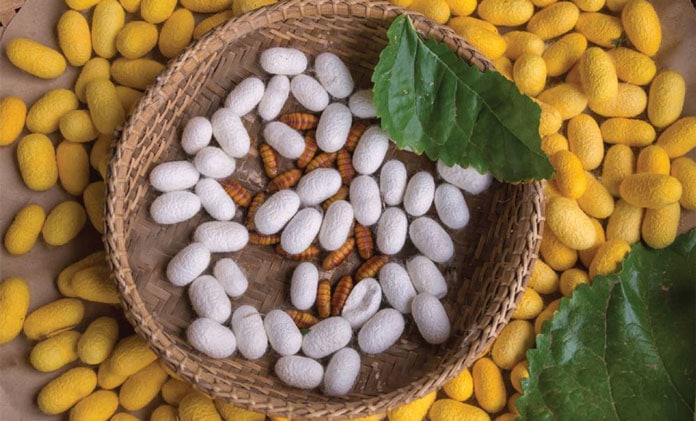
A great example of a commercially viable bio-circular ingredient is silkworm pupae. A byproduct of sericulture, silkworm pupae are at the heart of our work at Loopworm. Sustainability elevates them as a circular economy star. With established supply chains and proven nutritional value, they are transforming animal feeds for trout, salmon, shrimp, poultry, and swine.
Typically, they contain 50–60% crude protein and 20–30% lipids, and deliver better digestibility along with bioactive compounds that support immune function and stress tolerance. These pupae are high-performance ingredients that boost productivity and fortify immunity.
Silkworm pupae are nutritionally dense and highly bioactive. They contain high quantities of lysine, methionine, phospholipids, and omega-3, -6, and -9 fatty acids. According to a study published in 2021, silkworm pupae proteins exhibit high digestibility. Their PDCAAS score is 86. Lipids gain extra stability from tocopherol-phospholipid synergy, which preserves feed integrity and enhances omega-3 enrichment in meat and fillets.
In aquaculture, performance data is compelling. According to the Aquaculture journal (2019), in Pacific white shrimp, a full fishmeal replacement with defatted silkworm pupae improved growth and antioxidant capacity. Researchers recommended up to 75% substitution to safeguard hepatopancreas health. Rainbow trout thrived on 5 to 15% silkworm inclusion, matching fishmeal growth. As per the studies conducted between 2019 and 2025 on salmonids and crustaceans, bioactive peptides enhanced immunity and slashed disease losses by up to 40% through better pathogen resistance.
Livestock sectors report parallel wins. As per studies conducted between 2021 and 2024, broilers fed 4-10% of defatted silkworm pupae showed high growth and high stress resistance. For swine, as researched by animal nutritionists in heat stress models, the balanced amino acids in silkwormssupported liveweight gains and gut health. Furthermore, they comply with EU regulations, reduce emissions, and bolster gut microbiota for stress resilience.

FROM CLAIMS TO CREDIBILITY
Along with attention comes scrutiny, deservedly. This has made sure that transparency is the baseline. Assurances, claims and vague labels no longer satisfy consumers, regulators and buyers. However, unverified sustainability narratives are still a common theme. When promises exceed proof, trust fractures precisely when the food system can least afford it.
The questions confronting animal nutrition and biotechnology have become surgical. What does “antibiotic-free” mean across the entire production cycle? How traceable is each ingredient from origin to feed mill? Where is the evidence for claims about immune function, environmental impact, or contaminant levels? Only rigorous data, reproducible results, and independent validation can provide answers. Documenting performance through controlled trials is a must before making claims at all.
NUTRITION AS THE FOUNDATIONAL INFRASTRUCTURE FOR THE FUTURE
While breakthrough ingredients form a small part of the nutrition story, the other part of the story is about how effectively we embed nutritional strategy into the structural fabric of food systems.
Adopting a One Health lens means accepting this responsibility fully. It requires choices grounded in biology, validated through science, and proven at commercial scale. This is not simply an industry priority. It is fundamental to preserving the trust on which global food security depends.
About Ankit Alok Bagaria
Ankit Alok Bagaria is the CEO & Co-Founder of Loopworm, one of India’s largest insect-biomanufacturing platforms supplying proteins and lipids for aquaculture, poultry, pet, and specialty nutrition. An IIT Roorkee alumnus, he leads business development, R&D, and product strategy, focused on scalable manufacturing and bio-circularity. A Forbes 30 Under 30 Asia honouree, he is redefining global biomanufacturing and building a new silk road from India.