


Profitability is key to commercial fish farms of all sizes. It’s directly related to feed efficiency, including digestibility and feed conversion rates. A precise, well-balanced formulation features raw materials and ingredients tailored to provide the exact nutrients required by tilapia – no more and no less. With an accurate feeding regime and high-quality nutrition, producers could see improved aquaculture earnings and less waste.

Aquaculture Product Manager
ADM Animal Nutrition
Latin America is currently the fastest-growing production region for tilapia, largely driven by Brazil with a CAGR of 8.3%. One strategy to support this persistent growth is a precise nutrition approach, in which the nutritional requirements of tilapia are met with feed formulations customized to specific aquaculture conditions. The nursery phase is a critical period to maintain health and welfare, as that will affect overall growth performance and lifelong development. Quality feed and precise formulations are an investment that can greatly contribute to a farm’s economic success, as well as its environmental impact.
OPTIMIZE PERFORMANCE OUTCOMES
Each life stage in aquaculture has different nutritional requirements. The earliest feed stages are fundamental, providing both an immediate impact and long-term effects as fish advance to maturity. Proper and precise nutrition during the nursery phase is essential for growth, organ development, resistance to pathogens, and ultimately, fillet yield at harvest.
Young fish are exposed to a variety of stressors, including handling, vaccination, transferring between culture systems/farms, mixing of populations, density and water quality. Such stress can affect their physiological structures and growth at a time when both the immune and digestive systems are not fully developed. Nutrition plays an important role in supporting fish through these challenges of early life stages. Precise feed formulations are particularly effective, delivering the proteins, amino acids, lipids, vitamins, minerals, digestive enzymes and functional additives necessary for healthy development and growth.
For example, ADM’s Aqua Immune One is a functional feed solution that helps minimize the effect of external stressors and potential pathogens while also promoting efficient tilapia growth without the need for antibiotics. Functional diets are a promising strategy to help reduce the risk of antimicrobial resistance, a growing threat worldwide.
 ENHANCE AQUACULTURE EARNINGS
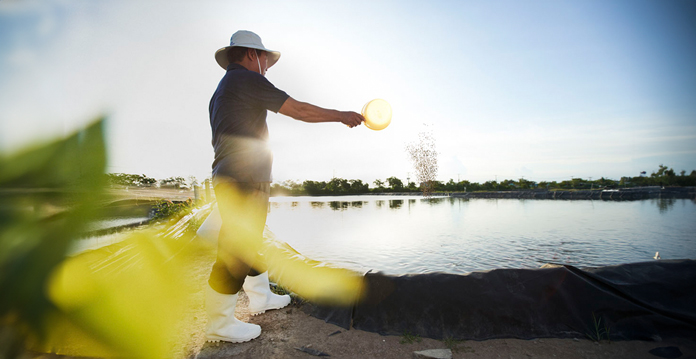
Profitability is key to commercial fish farms of all sizes. It’s directly related to feed efficiency, including digestibility and feed conversion rates. A precise, well-balanced formulation features raw materials and ingredients tailored to provide the exact nutrients required by tilapia – no more and no less. With an accurate feeding regime and high-quality nutrition, producers could see improved aquaculture earnings and less waste.
Laguna feeds by ADM are specifically formulated to enhance performance for omnivorous and carnivorous aqua species, encouraging efficiencies and consistent outcomes. For instance, ADM has calibrated the precise ratio of digestible protein to digestible energy within the formulation. As a well-balanced source of energy, Laguna feed supports growth with less fat accumulation for excellent fillet yield. Such an outcome helps aquaculture farmers secure a profitable harvest.
Further research is needed to study the synergy between various functional feed additives as a way to enhance growth, physiology and health in tilapia and other species. As scientific knowledge continues to advance and optimize aqua nutrition, fish farmers will be better prepared to align production and profits.
PROTECT THE PLANET
Environmental conditions are intrinsic to aquaculture. Factors like water temperature, quality and salinity can affect fish metabolism and nutritional needs. As an example, fish tend to consume less in colder water, so a regional and seasonal approach to nutrition that accommodates changing environmental conditions can significantly improve feed intake. Feed efficiency not only drives profits, but it can also support environmental sustainability. Focusing on the precise feed for each species, life stage, season and more will also help minimize waste and water contamination.
Moreover, feed manufacturing technology can help mitigate contamination in aquatic ecosystems. Pellet structures need to be stable enough to prevent the particles from disintegrating after water immersion. Pellet stability also helps maintain retention of hydrosoluble micronutrients and limits water pollution. Especially in the nursery phase, pellet shape and diameter must be appropriate to tilapia fingerlings’ mouth sizes. Cold microextrusion prevents denatured proteins to improve digestibility, water stability and pellet floatability.
Farm management techniques can also support healthy operations, such as water quality maintenance and strict biosecurity measures. These protocols are important to steward the environment and reduce risk factors throughout tilapia production, which supports food security for end consumers.
According to the World Food Programme, 345 million people in 82 countries are facing acute food insecurity. Aquaculture is positioned to be an efficient, responsible source of animal proteins to feed the demands of a growing population. In fact, the global aquafeed market is expected to be worth USD 88.0 billion by 2028, according to a MarketsandMarkets report. The nutritional quality and efficacy of feeds have been improved by scientific advances in technology and research, which have increased the growth rates, pathogen resistance and overall productivity of farmed fish. Aquaculture productions that support tilapia performance throughout its life cycle will be well-positioned for competitiveness and economic success.
About Eduardo Urbinati
Eduardo Urbinati is an Aquaculture Product Manager for ADM’s animal nutrition business, developing products for the fish and shrimp market in Brazil. He has a master’s degree in aquaculture from Universidade Estadual Paulista Júlio de Mesquita Filho (UNESP) and has worked for 10 years in the aquaculture nutrition market.