

Phytogenic feed additives in aquaculture offer natural alternatives to synthetic inputs, aligning with the industry’s shift toward sustainable, high-performance solutions. Recent trials on tilapia under heat stress showed promising outcomes in growth, digestion, and immunity. A proprietary encapsulation strategy ensured targeted delivery and stability. Results highlight potential cost savings and performance gains—but how far can these innovations really transform modern aquaculture?

R&D Director
Nuqo Feed Additives
MEETING THE CHALLENGES OF MODERN AQUACULTURE
As the global demand for seafood continues to rise, aquaculture plays an increasingly vital role in ensuring food security and supporting economic development. Among the many species cultivated worldwide, tilapia stands out as one of the most widely farmed fish, thanks to its fast growth, omnivorous diet, and adaptability to a range of farming environments. However, the intensification of tilapia farming also brings a host of challenges — from environmental stressors and disease pressure to the need for cost-efficient, high-performance feed strategies.
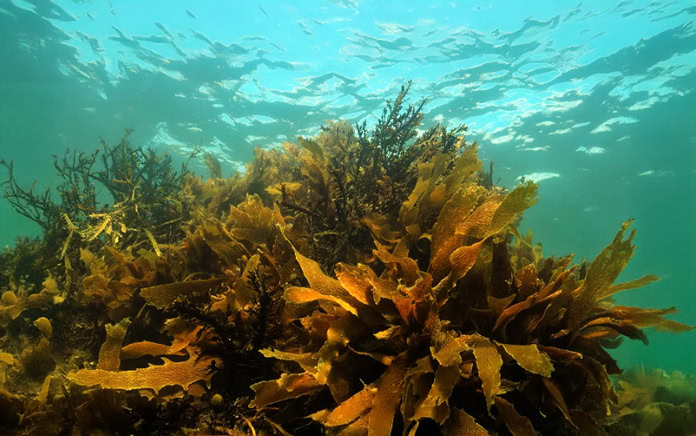
Today’s aquaculture systems demand solutions that not only improve performance and profitability but also align with growing expectations for sustainable and natural production. Fish producers are actively seeking alternatives to synthetic additives and antibiotics, focusing instead on plant-based and marine-derived bioactives, often grouped under the term “phytogenics” and “phycogenics” (from Greek Phytos = plant and Phykos = Algae). These compounds offer potential benefits including enhanced digestion, reduced oxidative stress, and improved immunity. However, their successful use in aquaculture depends heavily on the ability to protect and deliver these active molecules effectively within the fish’s digestive system.
This is where Nuqo’s latest innovation, referred to here as NQ technology, comes into play, offering a new level of performance through a unique blend of carefully selected plant and seaweed-derived compounds, supported by a proprietary microencapsulation process. Importantly, this solution was designed following Nuqo’s XPR approach – eXtra Protection & Release – which ensures optimal protection of active molecules, even under the stringent conditions of aquafeed production, while also guaranteeing precise release in the digestive tract of fish. This level of protection and targeted delivery represents a critical advancement in the functional use of phytogenics in aquaculture feeds.
A NEW GENERATION OF FUNCTIONAL ADDITIVES
The development of NQ technology represents a strategic leap in the formulation and delivery of phytogenic feed additives. Built on Nuqo’s strong foundation in research and manufacturing, this solution combines an exclusive mix of bioactive ingredients derived from both land-based plants and marine algae. These compounds were selected based on scientific evidence of their effects on gut health, immune modulation, and metabolic function in aquatic species.
Unlike conventional phytogenic products, which often rely on traditional herb combinations or diluted essential oils, NQ draws on next-generation molecules that offer greater potency and more clearly defined modes of action. This innovation responds to a growing market need for transparency, efficacy, and cost-efficiency in functional additives.
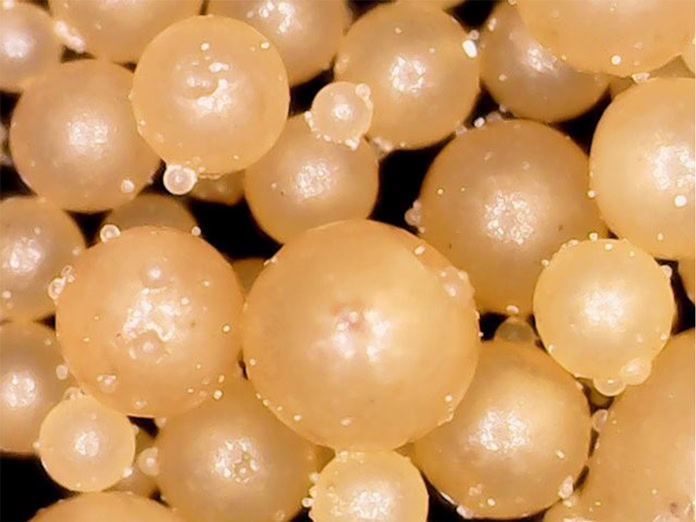
Crucially, NQ’s effectiveness lies in how its ingredients are delivered. Nuqo’s proprietary microencapsulation technology, aligned with the XPR philosophy, plays a central role in protecting sensitive molecules during feed manufacturing and ensuring their targeted release within the fish’s gastrointestinal tract. In aquaculture, where gut transit time and digestive conditions can vary widely, this controlled release technology significantly enhances the bioavailability and consistency of results.
The encapsulation process also ensures product stability, meaning that NQ maintains its activity even under harsh pelleting conditions. This high concentration and stability mean that the product can be used at very low inclusion rates, making it an economically attractive option for feed manufacturers and producers alike.
TRIAL RESULTS: A CLOSER LOOK AT NQ’S EFFECTS ON TILAPIA
To validate the efficacy of NQ in commercial aquaculture conditions, a comprehensive feeding study was carried out at the aquaculture research unit, R&D Department at Cairo feed company (CPC) in Egypt for 84 days. During the experiment fish exposed to a period characterized by high temperatures and significant environmental stress – ideal conditions for evaluating a heat-sensitive species like tilapia.
A total of 234 Nile tilapia (Oreochromis niloticus), with an initial average weight of 65.8 grams, were randomly distributed into three treatments each treatment had three fiberglass tanks (1000-liter, RAS system). The three diets were formulated and manufactured in CPC. The fish were fed a commercial pre-growth floating feed (30% crude protein), with corn and soybean meal as primary ingredients. The diet was extruded to ensure uniformity, optimal feed intake and simulation of fish farms.
Three feed trials were as follows;
I) The basal diet without any additive,
II) the same previous diet supplemented with NQ technology at 150 g/ton as a top-up,
III) NQ technology at 150 g/ton, using a matrix value (reducing 30 kcal/kg energy and 0.3% crude protein) to evaluate the additive’s cost-offset potential.
 Water quality parameters were carefully maintained throughout the trial. Temperatures ranged from 27 to 29°C, with dissolved oxygen levels above 5 ppm and concentrations of ammonia and nitrite maintained within safe thresholds.
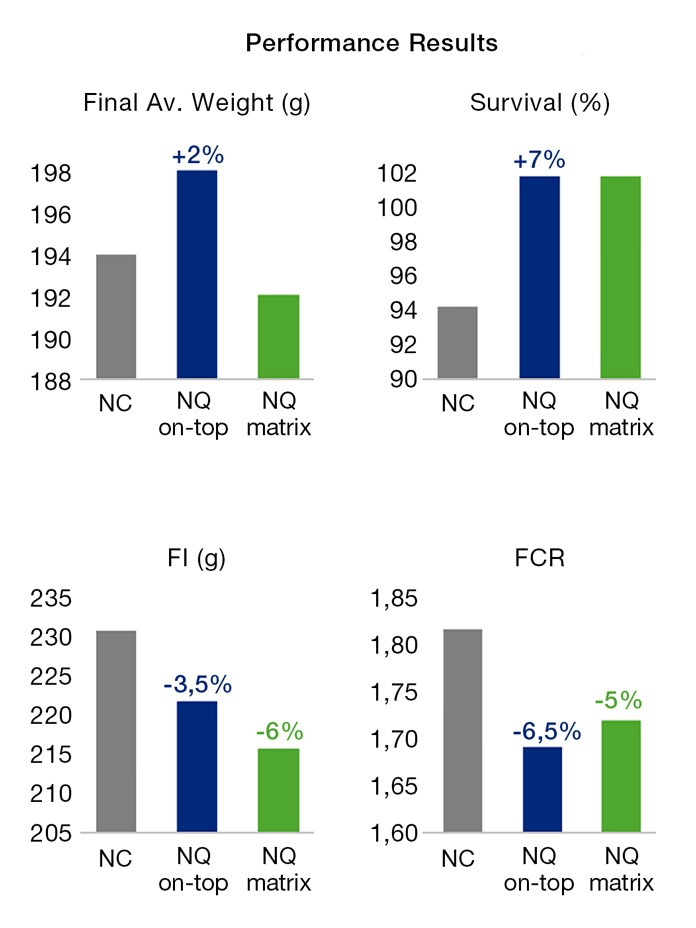
At the end of the 84-day trial, results were striking. Fish in both NQ-treated groups significantly outperformed the control group in terms of final body weight, specific growth rate, and protein efficiency rate. Feed conversion ratio improved noticeably with NQ supplementation, particularly in the top-up group. Survival rate was also higher in the NQ groups, indicating enhanced resilience and reduced mortality during a period of environmental stress.
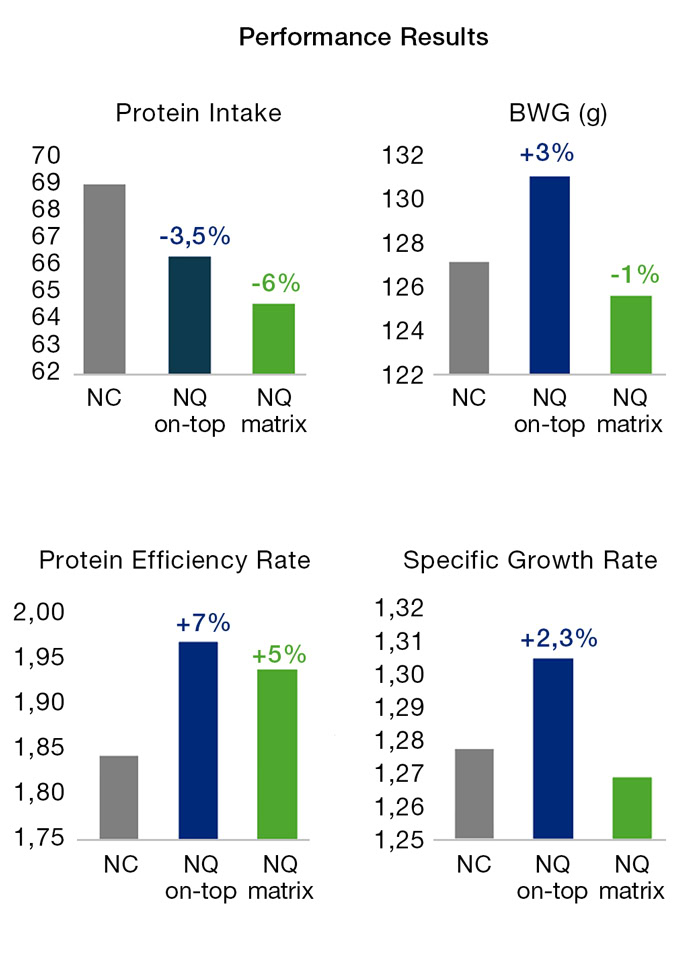 Return on investment was calculated at approximately 7:1 in the NQ top-up group, underlining the economic value of the additive. The matrix group, despite the lower protein and energy content, demonstrated equal or better survival and protein efficiency than the control, clearly showing that NQ not only improves performance but also supports cost-saving strategies through nutrient optimization.
IMPROVING GUT HEALTH AND DIGESTIVE EFFICIENCY
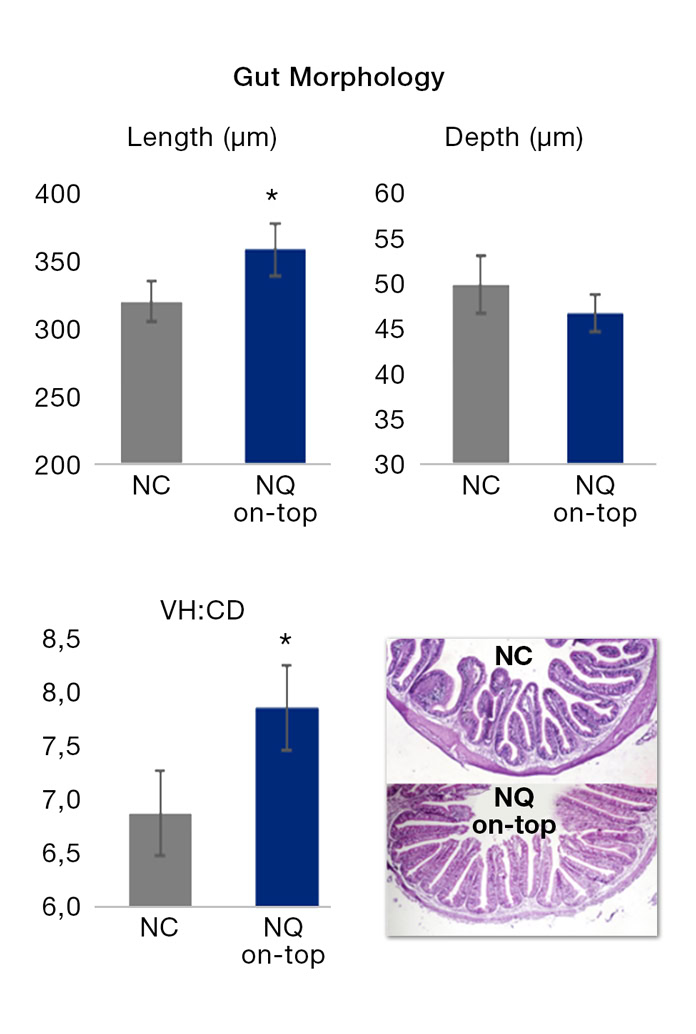
The trial also examined the impact of NQ technology on intestinal morphology and digestive health, two key pillars of feed efficiency and overall fish productivity. The histological analyses were performed in the Faculty of Veterinary Medicine of Cairo University. Histological analysis of the intestine revealed significant improvements in gut architecture in fish receiving NQ. Villus height and surface area were markedly increased, suggesting a greater absorptive capacity. The ratio of villus height to crypt depth, a widely accepted marker of gut health and regeneration, was also improved, indicating a more balanced and functional intestinal lining with less evidence of cellular stress.
In parallel, blood enzyme analyses supported these findings. Fish receiving NQ showed increased activity of digestive enzymes, notably amylase and lipase, reflecting improved capacity to break down and utilize carbohydrates and fats. Moreover, reduced levels of uric acid, triglycerides, and very-low-density lipoproteins (VLDL) pointed to more efficient metabolism of proteins and lipids. These combined improvements in gut morphology and enzymatic function contribute directly to better nutrient absorption, improved growth, and reduced feed waste — key indicators of sustainable and profitable production.
 STRENGTHENING IMMUNITY AND RESILIENCE
Beyond performance and digestion, fish health is a central concern in modern aquaculture, especially for warm-water species like tilapia, which are prone to opportunistic infections under stress. In this context, NQ technology showed meaningful benefits on oxidative balance and immune competence.
Oxidative stress was significantly reduced in the NQ groups, as shown by lower concentrations of malondialdehyde (MDA), a key biomarker of lipid peroxidation. In addition, fish receiving NQ had numerically higher total antioxidant capacity, indicating a stronger internal defense system against reactive oxygen species and related cellular damage.
Immune function also showed improvement. The albumin-to-globulin (A/G) ratio, which reflects the balance between structural proteins and immune-related globulins, was higher in the NQ groups, suggesting improved immunocompetence. Furthermore, lysozyme activity – a frontline defense mechanism of the innate immune system – was elevated, indicating enhanced ability to combat bacterial pathogens. These parameters together demonstrate that NQ contributes not only to performance and digestion but also to health resilience, reducing the need for therapeutic interventions.
A VERSATILE SOLUTION FOR MODERN AQUACULTURE
NQ technology demonstrates a dual function: It can act as a performance enhancer when used on top of the standard diet and as a cost-reduction tool when used with a matrix value. This flexibility is valuable for aquafeed producers and farmers operating in diverse production systems. Whether targeting high-performance outcomes or seeking to reduce feed formulation costs, NQ provides a science-backed option that delivers measurable benefits.
In a context where the aquaculture industry faces rising pressure to reduce antibiotic use and minimize environmental impact, functional feed additives based on natural, well-characterized ingredients are becoming essential. The combination of precisely selected bioactives and proprietary microencapsulation – following the XPR approach – positions NQ as a cutting-edge solution that supports productivity and sustainability in equal measure.
CONCLUSION: SETTING A NEW BENCHMARK IN TILAPIA NUTRITION
The recent trial, and several others, clearly illustrate that advanced encapsulation technologies – such as NQ, developed under Nuqo’s XPR strategy (eXtra Protection & Release) – represent a major leap forward in functional feed solutions for aquaculture. Designed specifically to meet the stringent requirements of aqua feed manufacturing, NQ technology ensures exceptional workability, thermal stability, and homogeneous application, guaranteeing both safety and efficacy during feed processing and on-farm use.
Beyond its compatibility with feed production, NQ technology delivers proven biological results and opens new opportunities for tilapia farmers to either boost performance or optimize feed costs – two critical drivers of profitability. This dual advantage underscores the strategic value of NQ, not just as an additive but as a true tool for economic and productive gain. When compared to older-generation phytogenic solutions, NQ sets a new benchmark, offering precise release of high-value plant and seaweed actives where they matter most: in the fish’s digestive tract.
As aquaculture evolves toward more sustainable, efficient, and resilient models, next-generation technologies like NQ mark a decisive step forward. With its scientifically validated impact on growth, gut health, oxidative balance, and immune function, this innovation brings a clear, natural, and profitable solution to the challenges facing modern tilapia farming.
About Dr. Stephanie Ladirat
Currently working as Nuqo’s Technology Director, Dr. Stephanie Ladirat obtained her MSc degree in Food Technology with a specialization in Food Ingredient and Functionality and her PhD degree in Food Chemistry from Wageningen University (The Netherlands). During her PhD thesis, she studied in depth the human gut microbiota composition and its modulation upon prebiotic supplementation and/or antibiotic treatments. From 2014 till 2020, she worked at Cargill Animal Nutrition, first as technology lead for gut health additives and, then, as swine portfolio manager. She provided global technical product support for a broad range of products (phytogenics, organic acids, short and medium chain fatty acids, probiotics) and trained technical and sales teams. She most recently managed R&D projects and developed innovative feed additive solutions to answer specific customer needs related to animal gut health and performance.