
Ever since I joined Hamlet Protein in 2019, my focus has been on the customers we serve and the people we work with. Our global market presence has grown; we have added experienced commercial and technical staff and published data from research projects with leading universities. That is how Hamlet Protein has earned the trust from producers as an expert in providing health through nutrition.

CEO
Hamlet Protein
As one of the industry leaders in young animal nutrition, Hamlet Protein has been delivering innovative solutions to its customers for decades. The company develops high-quality, highly digestible protein products and complementary feed solutions designed to support growth, gut health, and overall performance of animals. Combining scientific research, technical expertise, and hands-on experience, Hamlet Protein works closely with producers to address the challenges of early-life nutrition while supporting efficient and sustainable animal production.
In this interview, Erik Visser, CEO of Hamlet Protein, highlights the company’s approach to young animal nutrition and the innovations that set its products apart. He also reflects on the challenges and opportunities of supporting producers around the world, as well as the company’s strategies for sustainability, growth, and maintaining high standards in an evolving industry. Through his insights, readers will gain a deeper understanding of how the company is aiming to shape the future of animal nutrition.
Hamlet Protein has been recognized for its innovative solutions for young animal nutrition since 1989. How would you describe your work to date, the progress you have made, and your company’s current global vision?
For more than 35 years, Hamlet Protein has been effectively and efficiently delivering high-quality specialty protein products to give young animals the best start in life and support the animal protein production industry with science backed solutions.
Our passion and purpose are to bring unique products and service solutions to the industry that can optimize animal performance and address key challenges faced by producers.
Ever since I joined Hamlet Protein in 2019, my focus has been on the customers we serve and the people we work with. Our global market presence has grown; we have added experienced commercial and technical staff and published data from research projects with leading universities. That is how Hamlet Protein has earned the trust from producers as an expert in providing health through nutrition. Backed by science, hands-on experience, and a strong network, we have become a reliable partner for swine, poultry, and ruminant producers around the world.
You stand out with your highly digestible soy-based protein solutions for young animals during the weaning period. Could you give us a little more detail about your products? What advantages do they offer in terms of digestibility, gut health, or performance?
Let’s start with the why: Weaning is an early, abrupt, and stressful event. Young animals still have immature digestive and immune systems, and face multiple stressors such as new environments, feed changes, vaccinations, and management practices. Stress is associated with changes in the gut microbiota, which in an immature gastrointestinal tract leads to a high incidence of diarrhea.
Our goal is to reduce this stress by contributing to feeds that are low in anti-nutritional factors (ANFs), highly digestible, and quickly absorbed. Fast-digesting protein provides the building blocks for efficient tissue development while minimizing undigested protein in the hindgut, which could otherwise fuel the growth of harmful pathogens.
Early-stage nutrition strategies directly affect growth performance, immune development, and feed utilization efficiency of animals. How does Hamlet Protein assess the critical role of this period and shape its product range according to this scientific approach?
We like to say that a good start makes all the difference. Nutrition is a cornerstone of animal health and performance. Ensuring optimal nutrition during early life stages and other critical periods pays dividends for producers in the long run. It means fewer resources; less feed, reduced medication, and faster achievement of genetic growth potential.
To succeed in providing protein for these critical periods, we deliver consistent products batch after batch, which deliver consistent on farm performance. Our quality assurance teams at both production sites conduct more than 10,000 analyses annually to monitor incoming raw materials, adjust processing conditions, and ensure final product quality. Meanwhile, our technical team is continuously present in the field, offering guidance and gathering feedback to refine our programs and product applications, making sure animals receive the optimal Hamlet Protein solution for their needs.
Soy protein can naturally contain certain anti-nutritional factors, which can cause digestive problems in young animals. However, you have developed a bioconversion technology to eliminate this issue. Could you explain this technology, its scientific basis, and how it addresses the anti-nutritional factor challenge?
Our process is optimized to remove three ANFs from soybean meal, compounds that are particularly harmful to young animals, without compromising protein bioavailability. We hold patents on both the process and the production hardware, making it truly unique and, of course, backed by scientific research.
The process uses a continuous flow system. After a quality evaluation, soybean meal (SBM) is precisely mixed with water and enzymes. This mixture is processed under tightly controlled conditions, including temperature and retention time. Following enzymatic treatment, a gentle sterilization step deactivates the enzymes, reduces heat-sensitive ANFs, and ensures product stability. Finally, the product is carefully dried to preserve protein quality.
What makes this process unique is its ability to produce a consistent product quality, regardless of natural variations in the raw material.
Some of your products highlight fiber and prebiotic effects in addition to protein balance. What physiological or microbial parameters are considered in the development of these products, and how are these innovations received in the market?
Fiber plays a crucial role in animal nutrition. Our goal is to hydrolyze specific linkages in complex fibers to create substrates that support beneficial gut microbiota. HP FiberBoost combines the physiological benefits of insoluble fiber with the stimulating effects of prebiotic carbohydrates on gut health.
Specific enzymes hydrolyze sections of the carbohydrate structure to reduce viscosity while preserving the physical characteristics of fiber. This targeted cleavage enhances the concentration of prebiotic carbohydrate fractions, which stimulate beneficial bacteria in the hindgut to produce significant amounts of butyric acid.
Our feeding concept starts with high-quality protein as the base, with specialty fiber added to improve overall gut health. This approach helps animals become more resilient and uniform. Feedback from producers confirms that HP FiberBoost results in increased uniformity and reduces the incidence of diarrhea.
Soy production on a global scale is the subject of significant environmental debates in terms of deforestation and carbon emissions. How does Hamlet Protein address these concerns? How does your ‘responsible soy sourcing’ strategy tangibly support environmental sustainability?
Sustainability has always been a priority for Hamlet Protein. We have recently completed our Life Cycle Assessment (LCA) and have defined Science Based Targets (SBTi) which highlights our company’s commitment to a sustainable feed-for-food supply chain.
We are ready to comply with the European Union Deforestation Regulation (EUDR). This new EU regulation aims at reducing global deforestation and requires full traceability of all imported soybean meal into the EU.
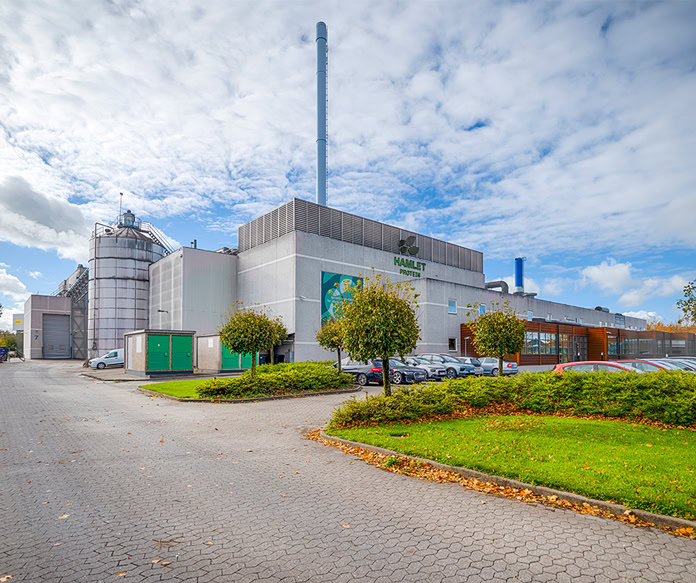
Something that we are particularly proud of is our cooperation with the regional heating company at our production site in Horsens (Denmark), where we redirect heat from our production to warm more than 3,000 homes.

With restrictions on the use of additives such as antibiotic growth promoters and zinc oxide, the importance of early-stage nutrition solutions has increased. How is Hamlet Protein responding to this shift, and how does your product portfolio meet the needs of this new era?
Early life nutrition has never been more important. Investing in young animals’ diets is extremely important as it has a strong impact on their performance later in life.
In the face of restrictions, such as those on antibiotic growth promoters and zinc oxide, producers look for alternatives. Often, the solution is a combination of strategies: improved biosecurity, better management and equipment, targeted feed additives, and highly digestible proteins like HP300, along with fiber specialties such as HP FiberBoost.
Your growing presence in North America and Asia in recent years is noteworthy. What are your growth strategies targeting in these regions? How do regional differences shape your product formulation or nutrition approach?
We place strong emphasis on local partnerships and regional support teams, supported by global category managers. As important as science is in our industry, trust and relationships may be even more important. I am a strong believer that it is our people that make an impact every day, by going the extra mile for their customers and working alongside them to build success together.
Each market has unique demands. In North America, growth is fueled by efficiency, adopting strategies that increase productivity and are highly profitable. At the same time, a big segment is aiming to maintain their feeds antibiotic-free production.
In Asia, we are seeing rapid growth in animal protein production, driven by rising demand from the expanding middle class. Of course, health challenges can reshape global markets in unexpected ways, so agility and local insight are key. That is why we have feet on the ground in all important export markets.
Hamlet Protein positions itself not only as a product supplier but also as a business partner offering integrated nutrition solutions. What new opportunities do these partnerships open up for the industry? What results are you observing, particularly in projects carried out with producers?
Hamlet Protein has been a trusted partner in nutrition and health for young animals for more than 35 years – starting in Denmark and expanding globally. Our customers become part of our community. We learn from each other, share insights, and exchange data that help improve our products and their applications.
For example, we have developed pre-starters that focus on faster and more efficient protein digestion, which can even help reduce nitrogen emissions. We partner with universities and producers to evaluate products and find the best applications in production animals, expanding our benefits to other life stages or species.
We work directly with customers and through a network of distributors to make sure we truly understand the local market dynamics, which allow us to tailor our approach to delivering products and services that make a difference.
Which areas will Hamlet Protein be innovating in over the coming years? What are your future priorities in terms of R&D, sustainability, or new protein sources?
All innovation starts with understanding our customers’ needs and challenges. From there, we enhance our production methodologies, improve factory efficiency, and design new concepts.
For proteins, this is largely influenced by the speed of protein digestion and absorption, which is a priority research area currently. We are evaluating protein sources through in vitro studies of “fast protein,” which is the portion digested and absorbed within the first 30 minutes, and in vivo studies of digestibility and protein disappearance per intestinal segment.
These insights will help us build the feeds of the future: more efficient, better for gut health, and contributing to reduced nitrogen excretion into the environment.
Is there anything else you’d like to add?
We are proud to be part of an innovative industry that contributes to feeding the world in a sustainable manner.
When looking at early life nutrition, choosing the right protein source is critically important. That’s where Hamlet Protein delivers unparalleled value. With a track record across species and geographies, our science-backed solutions have become the industry benchmark.
About Erik Visser
Since 2019, Erik Visser (NL) has been the CEO of Hamlet Protein. His international career started in Latin America and expanded across Europe. An experienced leader in the animal nutrition industry, he worked with multinationals like Provimi, Nutriad and Adisseo.