


Authored by an international team of academics, a new study finds that public claims about the sustainability of insect farming have been exaggerated. According to the study, insect protein produced at scale is, in most cases, less environmentally-friendly than conventional ingredients across multiple metrics.
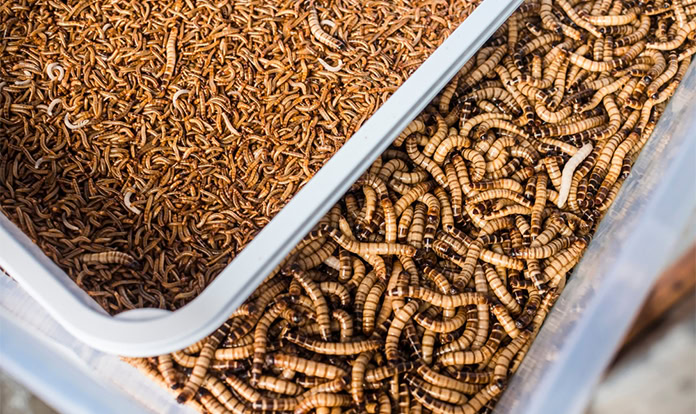
New peer-reviewed research, published in the respected scientific journal Biological Reviews, concludes that insect farming’s impact on the sustainability of the food system is far less positive than initially promised.
Authored by an international team of academics from the UK, USA, and Europe, “Have the Environmental Benefits of Insect Farming Been Overstated? A Critical Review”, finds that public claims about the sustainability of insect farming have been exaggerated. In stark contrast to claims made by insect companies, the study found that insect protein produced at scale is, in most cases, less environmentally-friendly than conventional ingredients across multiple metrics. For example, most studies find that the greenhouse gas emissions associated with farming insects are greater than those associated with the conventional feed and pet food ingredients it’s meant to replace, such as soybean meal and fish feed. One recent study found emissions from farming black soldier fly larvae in the UK are up to 13.5 times more than from soybean meal, and up to 4.2 times more than from fish meal.
Concerningly, the study also found that the frequent and high numbers of escaped insects and a lack of regulation on biosecurity measures means that insect farming could pose a serious risk to natural environments. Escaped farmed insects could pose risks by adversely affecting local insect populations, potentially disrupting local natural ecosystems through competition with native species or by introducing harmful genes into wild populations. They could also transmit deadly diseases and pathogens, including novel strains, to wild populations, including threatened pollinators like bumblebees.
Dr. Dustin Crummett, co-author of the report, and Executive Director of the Insect Institute and affiliate instructor at the School of Interdisciplinary Arts and Sciences at the University of Washington Tacoma, said, “Insect protein has been widely hyped over the past decade, but our comprehensive review of the scientific literature tells a different story. There is essentially no public demand for farmed edible insects, and farming insects for pet food or farmed animal feed is usually worse–often many times worse–for the environment than even conventional options. The same factors that make insect feed environmentally inefficient also make it economically uncompetitive, leading to the repeated failures of major industry players.”
He continued, “Further, there are almost no meaningful safeguards to protect local ecosystems from the risks posed by insect farms spreading diseases or parasites, invasive or pest species, and selectively-bred or genetically-modified strains of insects. Governments should act to address risks related to the industry, including by developing scientifically-informed biosecurity regulations, and investors and others looking to support a sustainable food system should consider turning to more promising options.”
The report highlights:
• Biodiversity risks: Escaped insects could pose risks to local biodiversity including by competing with native species and spreading pathogens, parasites, and modified genes. A study of small-scale insect farms for pet food found parasites in over 80% of them. In 30% and 35% of these farms, these parasites had the potential to affect humans and animals, respectively. (Gałęcki et al., 2023).
• Genetic contamination. Recent gene sequencing found evidence of genes selected for in captivity in wild insect populations in Europe (Generalovic et al. 2023) That earlier study found that these genes are present “likely as a product of escaped flies from commercial, or amateur farms,” and that “Whilst a lack of biosecurity measures allowing the release of domesticated flies into the wild poses conservation concerns, it also threatens potential undocumented and economically relevant trait loss from naturally diverse wild populations through genomic homogenisation.”
• Circular economy flaws: Early interest in insect farming was driven by the claim that farmed insects would be fed on organic waste, contributing to the circular economy. However, challenges involving microbiological safety, nutritional content, inconsistent availability, and the logistics of collection severely limit the use of genuine waste in insect farming, with large-scale farms relying heavily on ingredients like wheat bran or corn starch that would otherwise be used as feed for farmed animals anyway. When insects fed on feed ingredients are themselves used as feed for other animals, they inefficiently add a level to the food chain.
• Insect pet food likely has a high carbon footprint: The data on insect-based pet food, which accounts for half of the insect farming market, indicate a significantly higher carbon footprint compared to conventional products. One study showed that insect protein emits 3–30.2 kg CO₂e per kg of dry protein, versus about 1–2 kg CO₂e for conventional pet-food protein — meaning roughly 2–10 times worse on average (Bosch & Swanson, 2021). This is because conventional pet food tends to rely heavily on offcuts and byproducts, which have a lower impact than meat that would be eaten by humans. Plant-based pet foods likely have a lower impact than either conventional or insect-based products.
• Insect-based feed is likely less sustainable than conventional feed: Most Life Cycle Assessments – or LCAs – indicate that insect farming has a higher climate impact than soybean meal or fishmeal when food waste is not used as a substrate, and in some studies even when waste is used. A recent study commissioned by the UK government found that the farming of black soldier fly larvae in the UK emits up to 13.5 times more greenhouse gases than soybean production, and up to 4.2 times more than fish meal production. This is partly because insects are generally fed feed-grade materials, meaning they add a level to the food chain when the insects are themselves used as feed. Insects also require other resource-intensive inputs (e.g., potentially significant energy needs when attempting to farm tropical insects like black soldier flies in climates like Europe). Alternative solutions, such as sustainably sourced soy or innovative fish feed formulations, appear to be more promising for reducing the environmental footprint of the food system.
• Economic uncompetitiveness: The resource-intensive nature of insect farming also renders farmed insect products significantly more expensive than alternatives, with insect meal being several times the cost of fishmeal and up to ten times the cost of soymeal. This has led to weak sales and serious financial troubles for leading companies.
The publication comes at a critical time, as governments, food companies, academics, and not-for-profit entities around the globe meet to discuss solutions to feed the world and reduce the environmental impacts of the global food system. The review’s results could cast doubt on continued green investment in the sector, which has recently experienced a slate of setbacks, including several pioneers of the industry facing bankruptcy proceedings.
This groundbreaking study offers one of the most comprehensive reviews to date of the environmental impacts of large-scale insect farming in Western countries. The research team conducted an extensive literature search across multiple academic databases, including Google Scholar, Scopus, OpenAlex, and ScienceDirect. They analyzed both English and French language studies published through September 2024, focusing on key insect species such as black soldier flies, mealworms, and crickets. Using targeted keywords related to insect farming and environmental impacts, the team initially identified hundreds of studies. After a rigorous screening process, they narrowed their analysis to 352 relevant papers that specifically addressed the environmental consequences of insect farming operations.
The full study is available online.