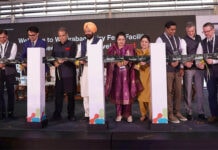

The first Methane Connect Summit, held on November 19, 2025, highlighted how Europe is moving from targets to practical action by deploying measurement tools, financial incentives, and farm-level strategies that enable dairy farms to reduce enteric methane emissions. Speakers included representatives from Arla, Danone, Nestlé, Bel/APBO, and Schreiber Foods.
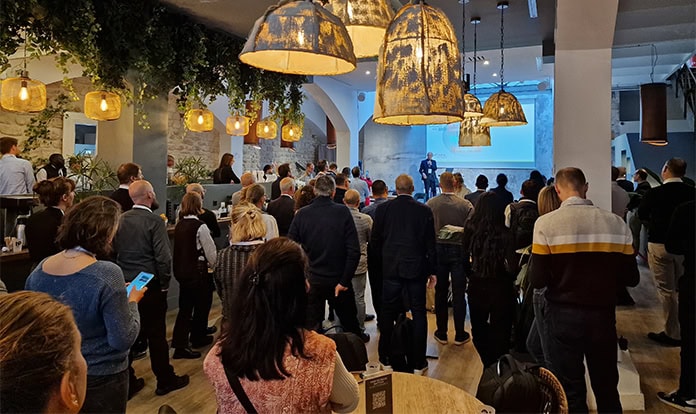
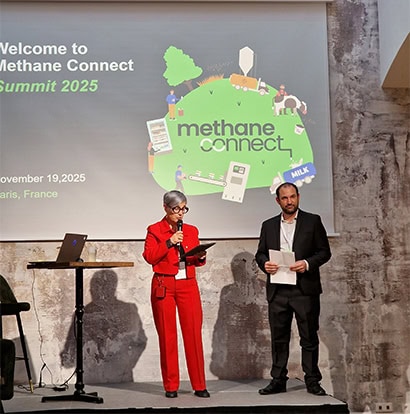
The mitigation of enteric methane, one of the most significant greenhouse gases from dairy cows, is moving from spreadsheets to the field. The first Methane Connect Summit, held on November 19, 2025 in Paris, showed how the European dairy sector is not only debating methane reduction but already putting in place concrete changes in herd management, advisory services and farm contracts.
More than 120 participants from around 20 countries took part, including farmers, cooperatives, dairies, researchers, technology providers, and financial institutions.
Speakers included representatives from Arla, Danone, Nestlé, Bel/APBO, Schreiber Foods, Carbon Maps, BNP Paribas and Glasgow University, among others, alongside farmers and institutes such as IDELE and AFBI.
FROM TARGETS TO PRACTICE ON FARMS
Morning sessions explored how enteric methane emissions are now linked to day-to-day herd management as well as to corporate climate strategies.
Farmers and advisers from Belgium, France, and the UK emphasized that the first levers for methane reduction are technical: feed efficiency, forage and grassland quality, herd health, and longevity. Speakers highlighted that methane reduction is not an additional burden but a lever for independence and performance when farmers have the right tools, data, and recognition. As one farmer on the “From Farm to Milk” panel put it, “Transition begins with a mindset, grows with evidence, and lasts when it becomes profitable.”
Companies including Danone, Nestlé and Bel showed how methane is integrated into their decarbonisation strategies, and research presented at the summit highlighted how consumers respond when progress is linked to farming practices and product quality.
MEASURING AND FINANCING METHANE EMISSIONS
A dedicated session compared the tools currently used to estimate or monitor methane emissions: Farm-level carbon tools, platforms used by cooperatives and dairies, and emerging approaches based on milk analysis. Speakers distinguished between diagnostic tools, used periodically for full carbon and GHG emissions accounting and reporting, and operational monitoring tools, used more frequently to steer farm decisions and support climate bonuses or other incentive mechanisms.
On finance, examples from food companies, investors and a major bank showed that multiple mechanisms already exist — from climate bonuses and co-financing schemes to environmental funds and green loans. The main challenge identified was not the lack of money but fragmented signals for farmers. As one speaker on the “Funding Change” panel summed it up, “the real challenge is not finding new funding but synchronising what already exists” – so that producers receive clearer and more predictable frameworks over several years for low-carbon dairy farming.
FROM PILOT TO SCALE: CONCRETE DAIRY CASE STUDIES
If the morning explored the “how”, the afternoon showed the “how it’s already happening”.
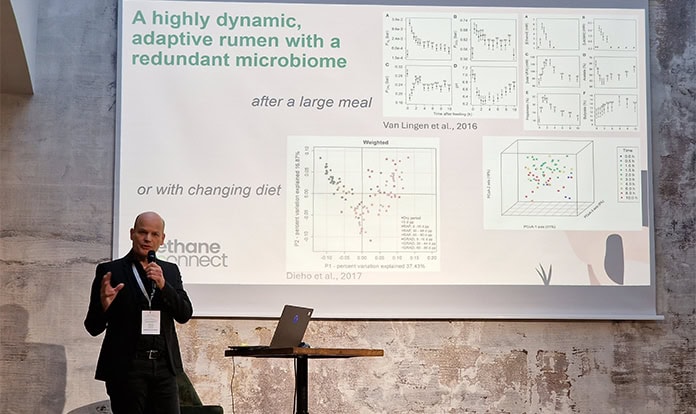
The afternoon session showcased how major European dairies — including Arla, Mooh, Bel/APBO, Schreiber Foods and Danone — are already deploying methane-reduction actions at scale. Their case studies covered monthly methane monitoring through milk analysis, feed-based strategies such as extruded linseed, climate bonuses, advisory programmes, carbon-credit pathways and retail partnerships highlighting low-methane milk. Together, these examples showed methane reduction is now a reality in Europe.
FARMERS AT THE CORE OF CREDIBILITY
Organisers point out that, across all sessions, one message emerged: Methane strategies will not be credible or durable without the active involvement of farmers in their design and implementation.
Farmers speaking at Methane Connect called for simple and transparent indicators, tools that fit into existing workflows on dairy farms, and fair, stable remuneration for practice changes and investments. Case studies showed how these principles translate into schemes, specifications and consumer-facing products.