

Even if trace minerals represented only 0.78% of total feed ingredients consumed in Europe, they showed the highest contribution to freshwater and marine ecotoxicity, due to their high toxicity potential when emitted into soils and waters, and to metal depletion, due to the fact that they are non-renewable resources. This high contribution demonstrates the importance of the sustainable use of trace minerals in terms of source and dose used in animal nutrition.

R&D
Animine

Product Manager
Animine
Improving sustainability of the livestock sector is essential. Life cycle assessment (LCA) studies have shown that feed production accounts for 70% of the carbon footprint of animal products which makes it an important element to account when considering mitigation options. Improved knowledge of the environmental impact of feed ingredients is fundamental to inspire a positive change.
The idea of a comprehensive environmental LCA was conceived in the USA in the late 1960s/early 1970s. In 1969, the Coca Cola Company commissioned the first LCA study to examine the complete environmental impact of a package, focusing on sustaining the use of high value recyclable materials and reusable packages. Around 1973, the interest turned to energy mainly due to the oil crisis. In 1988, interest returned to solid waste, but this was quickly replaced by a more balanced concern about the areas of resource use and environmental emissions. In 1991, concerns over the inappropriate use of LCAs to make marketing claims by product manufacturers, led to the development of the LCA standards in the International Standards Organization (ISO) 14000 series. In 2002, the United Nations Environment Programme (UNEP) joined forces with the Society of Environmental Toxicology and Chemistry (SETAC) to launch the Life Cycle Initiative, an international partnership to improve the supporting tools through better data and indicators.
FOUR PHASES OF AN LCA STUDY
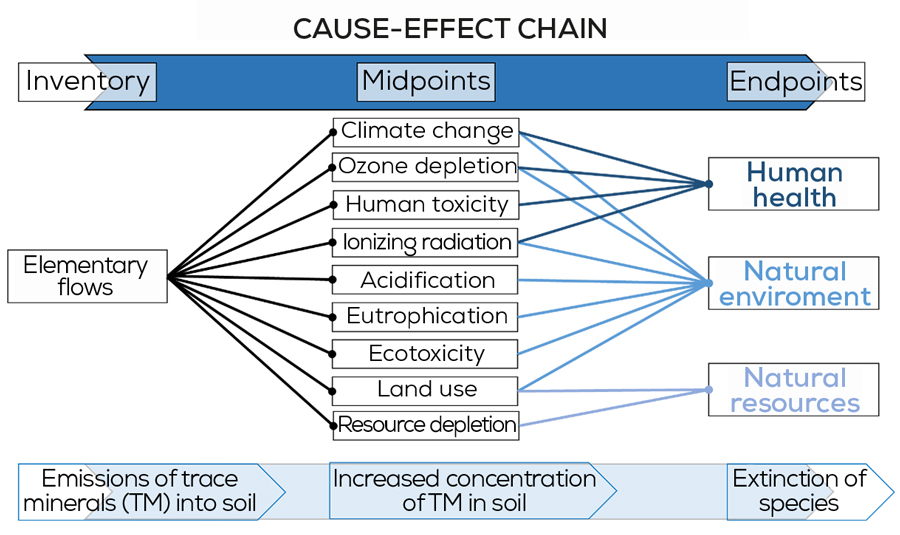
As required by ISO 14040, four phases are involved in an LCA study and they include: (i) goal and scope definition, (ii) inventory analysis, (iii) impact assessment, and (iv) interpretation. The results of an LCA study can be calculated using different impact assessment methods, which give different detail levels of the cause-effect chain. Considering the cause-effect chain for a trace mineral, a midpoint method looks at a point in the cause-effect chain, i.e., the increased concentration of trace minerals in soil, while an endpoint method looks at environmental impact at the end of this cause-effect chain, i.e., the extinction of species due to the emission of such a mineral (Figure 1).
Among midpoint and endpoint approaches, the environmental effect of system inputs can be expressed into different LCA impact categories. Some of them have been widely addressed since the first LCA studies, such as climate change or carbon footprint. Over the years, other categories raised environmental concerns, such as acidification, eutrophication, and energy use. Others were neglected for several years but are currently being highlighted, such as toxicity-related issues and biodiversity. Whatever the impact category considered, the knowledge of the environmental impact of the process and/or products is important to achieve a global sustainable development. That is why environmental footprint (EF) initiatives have been developed worldwide to move towards a sustainable economy.
STRATEGIES TO IMPROVE SUSTAINABILITY
In the past, traditional environmental themes, such as protecting species and improving the air/water quality were the major environmental concerns facing the world. Nowadays, more systematic approaches that consider the links between various themes and their global dimension are required. A multi-stakeholder initiative named LEAP (Livestock Environmental Assessment and Performance Partnership) has been created by FAO. It develops guidance and methodology for understanding the environmental performance of livestock supply chains, in order to shape evidence-based policy measures and business strategies. In 2016, LEAP published a guideline for the assessment of environmental performance of animal feeds supply chains, based on LCA. Feed additives, such as minerals, are considered as feed ingredients in these guidelines; however, detailed guidance regarding their production is outside its scope. In 2018 in Europe, the product environmental footprint category rules (PEFCR) were approved by the EU commission. The EU feed industry was the first sector to have its PEFCR, based on LEAP guidelines. It provides a more detailed and comprehensive technical guidance on how to conduct a PEF study, with the objective of delivering more sustainable consumption and production, by ensuring more environmental friendly products on the EU market. Besides that, PEFCR presented the LCA results for one ton of animal feed, representing the average composition of feed ingredients consumed by the EU feed industry from 2009 to 2013. Among the impact categories covered by PEF results, the toxicity-related ones (terrestrial, freshwater and marine) were excluded from the LCA, due to the lower robustness of ecotoxicity models. However, applicants who want to calculate the PEF profile of their product in compliance with PEFCR requirements are encouraged to include the characterized results for all impact categories (including toxicity).
This methodology was considered the basis for the Global Feed Lifecycle Assessment Institute (GFLI), which covers a wider geographical context and impact categories. Nowadays, GFLI database has become the leading global reference for public access datasets for all major feed ingredients used in compound feed production.
Most of LCA initiatives provided solid information on plant- and animal-based feed ingredients. However, for feed additives such as minerals, enzymes, vitamins or amino acids, the model of their production process is still being improved. It is expected that LEAP will develop in the near future recommendations on how to model the production of these particular feed ingredients, which may have a significant contribution to some environmental impacts although they are incorporated at a very low level in the diet.
FEED INDUSTRY’S ENVIRONMENTAL FOOTPRINT
The feed industry is committed to contributing to the generation of high-quality data on feed additives. In line with this, an LCA was developed for the potentiated zinc source named HiZox® and a monovalent copper source named CoRouge® (Animine, France). To represent the contribution of trace mineral sources on EF of complete feed, a diet based on the composition of the virtual feed proposed by PEFCR was created. The results show that cereals and oilseeds (48% and 28% of total feed composition, respectively) contribute the most to EF on climate change, acidification and eutrophication, energy demand, and terrestrial ecotoxicity, due to the use of fertilizers, pesticides, and transportation network for their production (Figure 2).
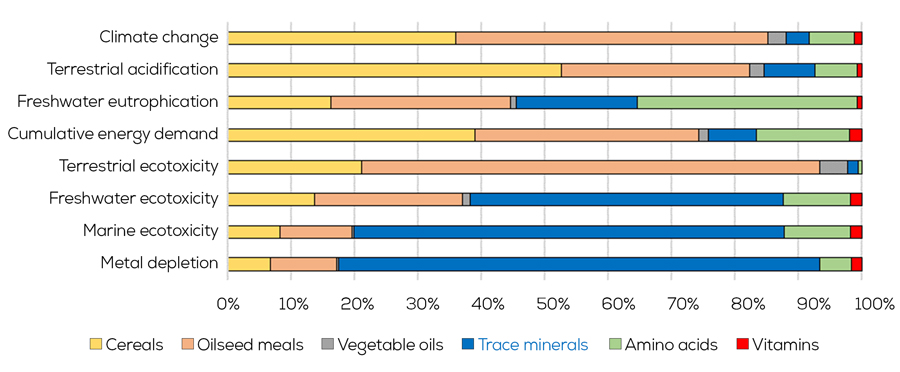
Even if trace minerals represented only 0.78% of total feed ingredients consumed in Europe, they showed the highest contribution to freshwater and marine ecotoxicity, due to their high toxicity potential when emitted into soils and waters, and to metal depletion, due to the fact that they are non-renewable resources. This high contribution demonstrates the importance of the sustainable use of trace minerals in terms of source and dose used in animal nutrition.
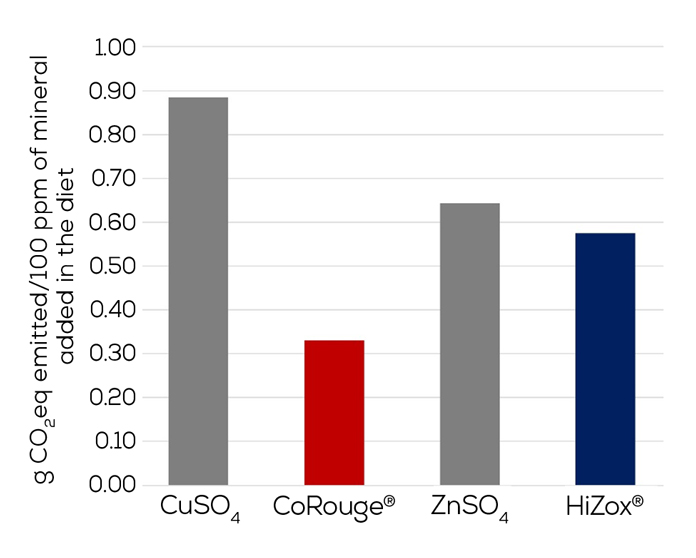
The recent LCA performed by Animine for its trace mineral sources showed that the carbon footprint (g CO2-eq/100 ppm of mineral provided in the diet) of HiZox® and CoRouge® are much lower than the standard sulfate sources (Figure 3). The same was showed for water quality impact categories (freshwater ecotoxicity, freshwater eutrophication, marine eutrophication). The reasons for this lower impact are the high metal concentration of HiZox® and CoRouge® combined with their low levels of contaminants (e.g., heavy metals).
These results showed that to provide the same metal amounts, Animine products have less environmental impacts than sulfates. These results can be included by feed manufacturers in their calculation of their own PEF assessments, knowing the impacts of their complete feed.
SO, WHERE WE ARE FOR TRACE MINERALS?
LCA models for feed ingredients are well established, and a lot of data are available in literature to characterize their impact in different scenarios of production (geographical zones, land use conditions, …). However, for trace minerals and other feed additives, there is still a need for more information on their production process and their impacts. Trace mineral suppliers must contribute with initiatives as the PEFCR or GFLI, providing LCA data of mineral production to be used for feed formulators to achieve a low impact of feed production.
About Alessandra Monteiro
Dr. Alessandra Monteiro is an animal scientist graduated in Brazil. In 2014 she started her PhD degree in Animal Production in partnership between the State University of Maringá (Brazil) and INRAe (France). In 2017, she worked as a Postdoctoral Research Associate at INRAe. Alessandra joined Animine in 2018 and have been working with the research and development group since then.About Axel Minetto
He is an agronomic engineer and worked for the past 8 years in Valorex (France) where he gained solid monogastric and international skills to push nutritional solutions. His particulars skills are trace minerals, essential fatty acids, omega 3 enrichment, feed formulations, protein sources evaluations, nutritional matrix development and applications.