
The latest report published by the Feed Education and Research Institute (IFEEDER) highlights the U.S. feed and food sector’s heavy reliance on China for critical vitamins and amino acids, warning that potential supply chain disruptions could undermine animal production, food security, and market stability.
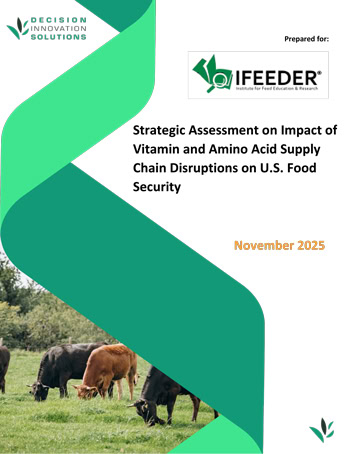 The Institute for Feed Education and Research (IFEEDER) has published a new report, “Strategic Assessment on the Impact of Vitamin and Amino Acid Supply Chain Disruptions on U.S. Food Security,” which explores America’s dependence on China for critical inputs that impact food security for both animals and humans, as well as the on-farm production and animal welfare impacts that could arise should these ingredients be in short supply.
The research, conducted for IFEEDER in collaboration with Decision Innovation Solutions and Lobo Consulting, assessed publicly available data on global vitamin and amino acid production, U.S. import and export quantities, and utilization rates in domestic livestock diets. The researchers applied diet modification strategies to evaluate whether alternative feed ingredients could partially compensate for limited vitamin and amino acid supplementation. While the report showed that, in some instances, farmers and ranchers could modify animal diets to mitigate the impacts of reduced vitamins or amino acids, it would not fully resolve the negative consequences for animal health, welfare and production efficiency.
“IFEEDER plays a critical role in identifying key questions and delivering independent, science-based research to inform U.S. feed and pet food industry leaders,” says IFEEDER Executive Director Lara Moody. “Proactively addressing potential supply chain threats is one of the industry’s most pressing concerns. The extent of the U.S. reliance on China for vitamins and amino acids was more significant than many anticipated—underscoring the need for objective, reliable data to guide effective policy decisions before these risks escalate.”
The report investigates several of the most critical vitamins and amino acids, including vitamin A, thiamine (B1), riboflavin (B2), niacin (B3), biotin (B7), vitamin B12, vitamin D3, vitamin E, lysine, threonine, tryptophan and methionine. Data ranging from 2020 to 2024 showed that the U.S. relies on China for 78% of total vitamin imports and 62% of global amino acid production that are used in everything from pet foods and animal feed to pharmaceutical products. For some vitamins such as biotin, China produces 100% of the global supply. In the case of a supply chain disruption, the U.S. currently has little to no recourse, as few alternative suppliers exist.
The report also underscores the domino effects of insufficient feedstuff nutrients. For example, the amino acid, lysine, ensures proper egg size, strong eggshells and healthy albumen content in laying hens. In short, lysine ensures that there are enough eggs being produced and that they are likely to arrive unbroken in grocery stores. In another example, food-producing animals that maintain adequate levels of vitamin A tend to reach market weight faster and more efficiently, basically stabilizing the availability and affordability of protein options.
These nutritious diets developed by years of research, development and field testing are essential for U.S. livestock and poultry production. In addition to supporting animal health and development, all the vitamins and amino acids that animals need are identical to those that humans use in enriched foods and supplements.