



Executive Director
The North American Coalition for Insect Agriculture (NACIA)
HOW INSECT AGRICULTURE IS ADVANCING IN NORTH AMERICA
Over the past decade, insect-based ingredients have moved from the margins of animal nutrition into serious commercial and regulatory consideration. While early global enthusiasm for insect agriculture often focused on future food narratives, the North American market has taken a more pragmatic path—one centered on animal nutrition, regulatory clarity, and fit-for-purpose applications.
Today, insect-derived ingredients are no longer experimental in North America. They are approved, commercialized, and increasingly integrated into feed and pet food formulations. This progress reflects not only technological advances, but also a regulatory framework that has enabled responsible innovation while maintaining safety, transparency, and confidence across the value chain.
A NORTH AMERICAN MODEL BUILT ON PRACTICAL APPLICATION
One of the defining features of insect agriculture in North America is its application-driven development. Rather than attempting to introduce insects broadly across all food systems at once, producers and regulators have focused on where insects make the most immediate sense: animal feed, pet food, and complementary agricultural inputs.
This approach has allowed the industry to mature steadily, guided by market demand and regulatory alignment rather than speculative scale. As a result, North America has seen meaningful commercial adoption across black soldier fly (BSF), mealworms, and crickets.
 REGULATORY PROGRESS AS A FOUNDATION FOR GROWTH
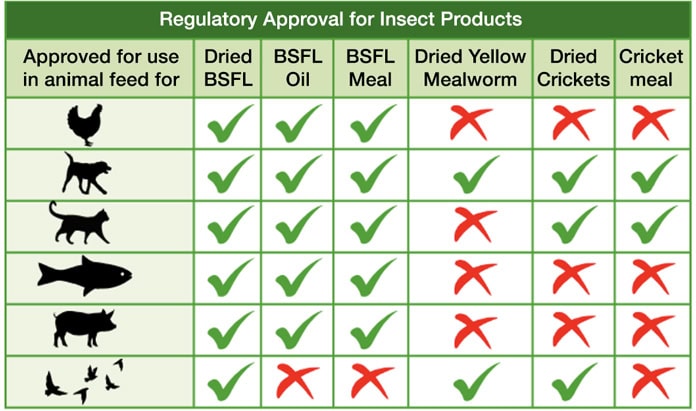
Regulatory clarity has been central to this progress. In North America, insect ingredients have advanced through established feed approval pathways which included review by US Food and Drug Administration (FDA) and the Association of American Feed Control Officials (AAFCO).
By working within existing regulatory structures the insect agriculture sector has built approvals that are durable, science-based, and broadly accepted by regulators, customers, and downstream users.
Black soldier fly has seen the most extensive regulatory success to date. BSF ingredients are approved for use across a wide range of animal species, including poultry, aquaculture species, swine, and multiple pet food applications. These approvals reflect a growing body of safety data, nutritional research, and real-world feeding experience.
Mealworms and crickets have also made important regulatory advances, particularly in the pet food sector. Recent approvals for these species mark a significant milestone, opening the door for broader use in companion animal nutrition and reinforcing confidence in insect-derived ingredients beyond production animals.
This regulatory progress stands in contrast to other regions where market development has sometimes outpaced regulatory or commercial readiness. In North America, approvals have followed demonstrated need, performance data, and transparent review—resulting in a more stable foundation for growth.
NUTRITIONAL VALUE BEYOND NOVELTY
From a nutritional perspective, insect ingredients offer compelling functional benefits. They provide high-quality protein, favorable amino acid profiles, and, in many cases, functional components such as lipids and bioactive compounds that support animal health.
Importantly, insect ingredients are not positioned as universal replacements for conventional feedstuffs. Instead, they are increasingly used as targeted inputs—addressing specific nutritional, functional, or formulation needs where they add measurable value.
This positioning has helped insect-based ingredients integrate into existing feed systems rather than compete directly with established commodities. It also aligns with how nutritionists and formulators evaluate ingredients: based on performance, consistency, and suitability for a given application.
A MEASURED ROLE FOR CIRCULARITY AND CO-PRODUCTS
While insect agriculture is often associated with circular economy concepts, North American producers have taken a practical, application-driven view of circularity. Insects can convert certain underutilized nutrient streams into higher-value outputs when feedstock availability, logistics, and location are aligned.
Co-products such as frass—the residual material from insect production—are increasingly recognized as valuable inputs for soil and agricultural applications. In North America, frass is not treated as a by-product afterthought, but as an integrated output that can strengthen overall system economics and nutrient efficiency. While animal nutrition remains the primary market driver for most producers, the responsible utilization of co-products reflects a broader, more resilient approach to agricultural resource use.
LEARNING FROM EXPERIENCE, NOT HYPE
Like many emerging sectors, insect agriculture has experienced periods of heightened expectations. Some highly visible international projects pursued rapid scale and capital-intensive models that proved difficult to sustain. In North America, the industry’s evolution has been more incremental, informed by early lessons and grounded in operational realities.
Today’s progress reflects that learning curve. Companies are focused on operational efficiency, customer relationships, and regulatory alignment—rather than broad claims or one-size-fits-all solutions.
As Chris Warburton, President of the North American Coalition for Insect Agriculture (NACIA) and Chief Scientific Officer of Entosystem, notes: “What we’re seeing in North America is not hype—it’s steady progress. Regulatory approvals, commercial adoption, and real customer demand are moving together, which is exactly how a new ingredient category should mature.”
LOOKING AHEAD: A DURABLE ROLE IN ANIMAL NUTRITION
Insect-based ingredients are now firmly part of the animal nutrition conversation in North America. Their role is defined not by novelty, but by performance, safety, and suitability within established feed systems.
As regulatory frameworks continue to evolve and additional data becomes available, insect ingredients are well positioned to expand responsibly into new applications—particularly in pet food and specialized animal nutrition markets.
The North American experience demonstrates that innovation in animal nutrition does not require disruption for its own sake. Instead, progress is achieved through alignment: between science and regulation, between producers and customers, and between innovation and practicality.
In that context, insect agriculture represents not a revolution, but a meaningful addition to the animal nutrition toolbox—one that continues to earn its place through results.