

In its recently published climate plan, FrieslandCampina has announced that it aims to produce net climate-neutral dairy by no later than 2050.
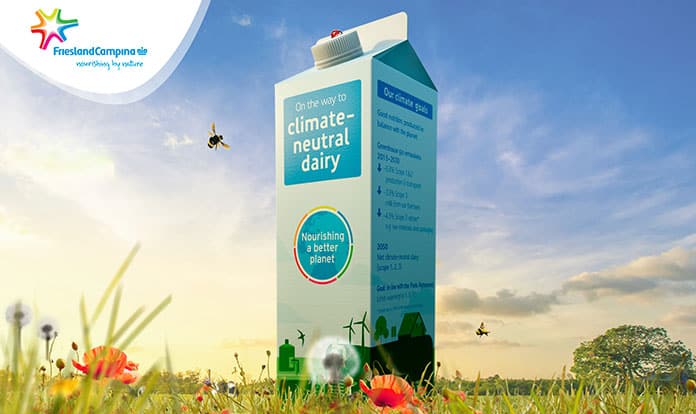 As part of its integrated Nourishing a better planet sustainability programme, FrieslandCampina published its climate plan ‘On the way to climate-neutral dairy’. FrieslandCampina is aiming to produce net climate-neutral dairy by no later than 2050. The climate plan contains clear targets and concrete actions, with a checkpoint being a significant reduction in greenhouse gas emissions by 2030.
“FrieslandCampina is keen to give people throughout the world daily access to good and affordable food, produced in balance with the planet. Unsurprisingly, then, reducing our greenhouse gas emissions is one of the priorities enshrined in our Nourishing a better planet sustainability programme,” says Hein Schumacher, CEO of Royal FrieslandCampina N.V.
“The Paris Agreement encompasses agreements on measures throughout the world to help keep global warming below 2 degrees Celsius and preferably to 1.5 degrees Celsius. Our detailed climate plan demonstrates that we are keen to do our bit. Our targets and concrete actions provide a clear road map towards a significant reduction in greenhouse gas emissions by 2030, putting us on course to achieve net climate-neutral dairy by 2050. In line with FrieslandCampina’s cooperative nature, we are working closely together with member dairy farmers, customers, suppliers, scientists, NGOs and government on meeting the climate targets,” he adds.
GREENHOUSE GAS REDUCTION THROUGHOUT THE CHAIN
In its climate plan, FrieslandCampina focuses on the entire value chain (‘scopes 1, 2 and 3’). Within its own operations (‘scopes 1 and 2’), e.g. worldwide production and transport, the company has set itself a target of a 63 percent reduction in greenhouse gas emissions by 2030 compared to 2015. Over the next few years, the reduction in greenhouse gas emissions will be achieved through measures as the use of non-fossil (green) energy in production and transport, and optimisation of the production footprint.
For the production of milk at the member dairy farms (‘scope 3’), the target is a 33 percent reduction in greenhouse gas emissions compared to 2015. The reduction in greenhouse gas emissions on the farm will be achieved by means of a package of options that match with the diversity within the cooperative and the professionalism and entrepreneurship of the member dairy farmers. Consider in this regard further optimising of agricultural practices, feed (e.g. by using guaranteed deforestation-free soy in cattle feed), use of feed additives that reduce methane emissions from cows, green solar and wind energy from the farmyard and cowshed measures (e.g. through innovative technology, such as mono-manure fermenters and low-emission cowshed floors).
The target in the raw materials supply chain and in the supply of products (‘scope 3, other’), such as packaging, procurement of basic dairy and sugar, is a 43 percent reduction in greenhouse gas emissions by 2030 compared to 2015. To achieve this target, FrieslandCampina is working closely with its suppliers.
2030 TARGETS REDUCTION IN GREENHOUSE GAS EMISSIONS (BASE YEAR 2015)
| Scopes 1 and 2 / Production and transport | -63% |
| Scope 3* / Milk from member dairy farms | -33% |
| Scope 3-other* / E.g. raw materials and packaging | -43% |
*Reduction targets currently set for >70% of scope 3 emissions
FrieslandCampina’s climate targets are currently being validated by leading international institute Science Based Targets initiative (SBTi).
ADDITIONAL INVESTMENT OF 1.5 BILLION EUROS
Realisation of FrieslandCampina’s climate plan will over the current decade and beyond require substantial additional investment in terms of time, money, and resources. FrieslandCampina is committed to achieving the goals of this climate plan and is expecting an additional investment of approximately 1.5 billion euros until 2030. The company will seek to finance a proportion of this through pricing for sustainably produced dairy and through general means such as current government subsidies.
REDUCTION WELL UNDER WAY
FrieslandCampina already reduced greenhouse gas emissions within the business (‘scopes 1 and 2’) by 28 percent between 2015 and 2021 through energy saving measures and the use of green energy. Greenhouse gas emissions from the >10,000 farms affiliated with the cooperative fell by 12.5 percent over the 2015-2021 period, partly due to measures pertaining to green energy, manure processing and cattle feed.
NOURISHING A BETTER PLANET
FrieslandCampina’s climate plan is part of its Nourishing a better planet sustainability programme, within the compass of which attention is also being devoted to good and affordable food, a good living for farmers, biodiversity, sustainable packaging, and sustainable sourcing of raw materials.