
A recent study conducted in the United States has shown that nursery piglets fed 250 mg of Cu/kg from CuSO4 present an improved feed efficiency compared to those fed 5 mg of Copper (Cu), but without differences on inhibitory action of bile against Salmonella, E. coli or Enterobacter populations. Another trial performed at University of Illinois with high levels of Cu showed that the hepatic Cu accumulation is not related to its effect on pigs performance.

R&D
Animine
Copper (Cu) at high dietary levels has been used for a long time as a growth promoter in different production animals. Two possible modes of action have been proposed: a pre (antimicrobial and local) and a post (systemic) absorption effect.
In the feed, Cu is usually provided as a sulphate source (CuSO4), although other sources are also available. Increasing CuSO4 supplementation to supra nutritional levels is well recognized to significantly enhance the growth performance of piglets, as shown in the Figure 1 where the improvement in body weight (BW) is of 3.4 kg when 160 mg/kg of Cu are compared to 15 mg/kg.

HYPOTHESIS OF PRE-ABSORPTION EFFECT OF Cu
The antimicrobial effect has been recognized since Ancient Egypt, where Cu was used to sterilize chest wounds and drinking water. In the pig, this antimicrobial effect would occur once dietary Cu passes through the stomach, dissociated into Cu ion, and reaches the intestine in its ionic form.
Some authors reported that the supplementation of high Cu (250 ppm from CuSO4) reduced the cecal Enterobacteriaceae population by 23% and improved the average daily gain in piglets by 37% when compared to a basal diet.
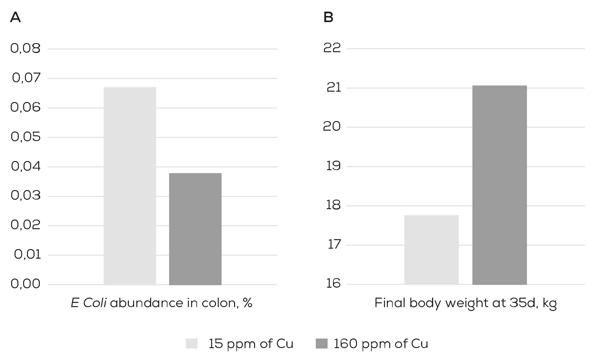
The improvement in pig performance following supra nutritional addition of Cu in the diets was also observed in a recent feeding trial performed at Wageningen University & Research (WUR) with 200 weaned piglets. Copper was supplemented from CuSO4 at two levels (15 or 160 ppm) in the diets. The significant increase in the final BW by Cu supplementation was accompanied by a decrease in E. coli population in the colon (Figure 2).
These results suggest that prior to absorption, high levels of Cu reduce bacterial populations, resulting in a positive modulation of the intestinal microbiota. Other studies have also shown that high Cu dosages by CuSO4 supplementation significantly inhibited potential pathogenic coliforms in the cecum and the colon of piglets.
This regulation positively affects the intestinal health and reduces the incidence of diarrhea in piglets. Besides this, the modulation of microbiota also has an effect on the dietary utilization and metabolism of energy and protein, which may render available more energy and nutrients for the host animal.
In the small intestine, for example, bacteria can produce the bile salt hydrolase (BSH) enzyme, which is involved in lipid metabolism and energy release. A reduction of this enzymatic activity has been reported as effective to enhance feed efficiency and body weight gain in monogastric animals. As Cu is one of the main BSH inhibitors, a modulation of the intestinal microbiota composition may be one mechanism by which Cu improves growth performance in piglets. This may explain why some recent studies demonstrated that Cu supplementation seems to enhance pigs’ ability to utilize fat after absorption, resulting in increased energy utilization of the entire diet.
HYPOTHESIS OF POST ABSORPTION EFFECT OF Cu
Once Cu is in the intestine, the Cu (II) form must be reduced at membrane level to the Cu(I) form, so it can be absorbed by the enterocytes. Then, it is bound to chaperone proteins and/or metallothionein (MT) to avoid cellular toxicity and to further transport copper outside the enterocyte. Cu is exported via the portal venous system to the liver, which is the central regulatory organ of copper homeostasis; but it can be then taken up by other tissues (brain, kidney, heart…).
On its entry to the hepatocyte, Cu is again rapidly taken up by cytosolic ligands such as MT and glutathione. The main role of MT is the storage of Cu in a “safe compartment” and the sequestration of an intracellular excess of Cu in response to supra-physiological Cu exposure, which can generate hydroxyl radicals and be potentially toxic.
Because the liver is the main storage site for Cu, the bioavailability of Cu sources has been traditionally evaluated by using liver Cu accumulation as the key criterion. This kind of studies have been performed at nutritional dosages, to allow homeostatic regulation. More recently, however, feeding trials with high Cu levels for pigs have also used hepatic Cu as an indicator of bioavailability. These levels, which by far exceed the requirements of pigs, demonstrate with the Cu accumulation in the liver, a way that the organ finds to avoid Cu toxicity.
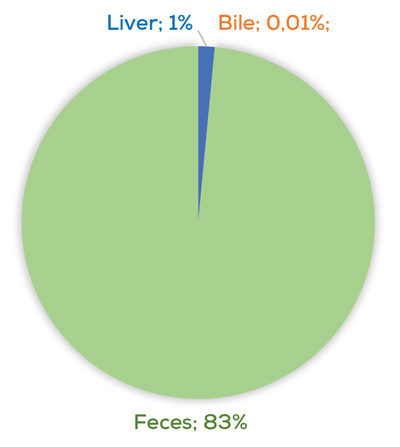
Into hepatocytes, Cu is associated to different enzymes and the excess is removed from the liver through biliary excretion. The main roles of bile are to enhance the fat digestion and absorption as well as the excretion of metabolic waste products from the organism. As around 80% of the absorbed Cu is excreted in the bile, a post absorption antimicrobial activity of Cu has been raised by some authors. It has been reported that the Cu in the bile is in the form of nonabsorbable-stable copper chelates. Biliary Cu recycling can be thus, considered negligible and being mostly excreted in feces. Besides, the Cu excreted by the bile (considering the Cu concentration and the bile flow during 28 days) represents less than 0.1% of total Cu intake, so it can be suggested that biliary excreted Cu would not have the same antimicrobial impact on microbiota as the dissociated Cu ion after ingestion.
A recent study conducted in the United States, has shown that nursery piglets fed 250 mg of Cu/kg from CuSO4 present an improved feed efficiency compared to those fed 5 mg of Cu, but without differences on inhibitory action of bile against Salmonella, E. coli or Enterobacter populations. Another trial performed at University of Illinois with high levels of Cu showed that the hepatic Cu accumulation is not related to its effect on pigs performance. The increase of Cu supplementation from 125 to 250 mg/kg of Cu from CuSO4 for fattening pigs resulted in higher hepatic Cu accumulation, so it can be expected to have a high Cu exportation in the bile. However, after 133 days of trial, final BW did not increase accordingly (Figure 3). Although a plateau in the growth rate of finishing pigs was observed when Cu levels in the feed exceed 100 mg/kg, Cu accumulation in the liver showed a dose response behaviour.
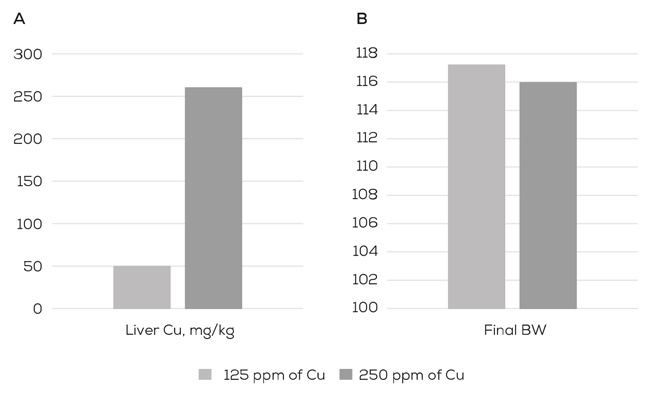
The storage of Cu in the liver is a consequence of Cu intake and not the cause of its growth promoter effect. Besides, the long-term feeding with high Cu levels leads to an excess of Cu in the organism, which can cause cellular damage through the formation of free radicals and this may induce oxidative stress.
PRE VS POST ABSORPTION HYPOTHESES
According to recent studies, copper metabolism seems to be not related to growth promotion. The strongest hypothesis is that its effect seems to be related to microbiota modulation resulting in the improvement of gut health, but not to Cu accumulation in the liver. Thus, a more antibacterial copper source might be more efficient to promote growth.
The effects of Cu in killing bacteria differ according to its redox state: the Cu(I), the reduced cuprous form, has a stronger antibacterial effect in anaerobic conditions than Cu (II), the oxidized cupric form.
A red source of monovalent copper (CoRouge®, Animine) has shown improved pig performance and a strong antibacterial effect, with lower risk of animal toxicity.
About Dr. Alessandra Monteiro
Dr. Alessandra Monteiro is an animal scientist working within the R&D team of Animine. Her main expertise is the sustainable usage of trace minerals in monogastric nutrition.