

Circular feed ingredients represent one of the most practical tools for improving the sustainability of animal feed. By valorising industrial by-products into nutritious inputs for livestock and aquaculture, they can help diversify supply chains and reduce over-reliance on conventional ingredients such as soy and fishmeal. Substantive progress will depend on supportive regulation, investment in infrastructure, and stronger collaboration between feed producers, innovators, and policymakers.

Director of Research
Centre for Feed Innovation
Feed supply chains in both livestock and aquaculture rely heavily on a small number of conventional ingredients, including soy and fishmeal. Whilst ingredients such as soy and fishmeal have delivered efficient and highly nutritious sources of protein for decades, reliance on a narrow set of inputs exposes feed supply chains to environmental and market risks. For example, climate change is altering weather patterns, with droughts and shifts in ocean conditions reducing crop yields and fish stocks. Meanwhile, cyclical events, such as El Niño, are intensifying these challenges by simultaneously disrupting both agriculture and fisheries. Overfishing is leading to resource depletion, and large-scale soy production has been linked to biodiversity loss. Furthermore, trade disputes, tariffs, and transportation bottlenecks are contributing to volatility in global markets.
In response, the feed sector is increasingly exploring the adoption of novel ingredients to diversify inputs and enhance the circularity of feed production. These novel ingredients, many of which can be produced using industrial by-products, including agricultural waste, processing effluents or landfill biogas, offer a promising solution to reduce dependency on environmentally intensive or volatile inputs, while helping producers improve their climate and biodiversity performance.
WHAT ARE CIRCULAR FEED INGREDIENTS?
The utilisation of waste is already a well-established practice within feed production. Brewers’ spent grains, a major by-product of beer production, are commonly repurposed as a nutrient-rich ingredient in livestock feed. In addition, swill feeding is a practised approach in East Asia, where regulated frameworks support the large-scale conversion of post-consumer food waste into pig feed.
Novel feed technologies are emerging ingredients that offer the potential to further expand the range of sidestreams valorised for animal feed, using more heavily underutilised waste streams, including industrial by-products, emissions, and processing residues. Through fermentation, enzymatic hydrolysis, pyrolysis and other bioprocessing methods, industrial side-streams can be converted into high-value nutrition for livestock production and aquaculture. Rather than drawing on new land or ocean resources, they close the loop by transforming existing outputs into proteins, oils, and functional additives that can be incorporated into animal feed.
WHAT ARE THE POTENTIAL CIRCULAR FEED SOLUTIONS?
Single-cell proteins (SCPs)
Single-cell proteins are ingredients produced by cultivating microbes, including bacteria, yeasts, or microalgae, on carbon-rich feedstocks. They can be processed to generate concentrated protein meals with balanced amino acids, or oils rich in omega-3 fatty acids, and are positioned as partial replacements for fishmeal and fish oil in diets for salmon and shrimp. Use cases are also emerging in piglet feeds and in pet food. In principle, SCPs can be cultivated on a wide range of side-streams, including waste gases such as biogenic methane, nutrient-rich wastewaters such as aquaculture effluents, lignocellulosic biomass such as woody agricultural residues, and food industry by-products like whey permeate.
Circularity is already being demonstrated through several established pathways. Yeast SCPs produced on whey from cheese manufacturing and on molasses from sugar refining are already widely incorporated into animal feeds, demonstrating well-established circular pathways. Distillery residues are also being commercialised as substrates for cultivating microalgae rich in omega-3s, showing how nutrient-dense side streams can be upgraded into high-value ingredients, though adoption remains at an earlier stage. In parallel, bacterial SCPs produced on natural gas are entering commercial markets, where natural gas could eventually be replaced by biogenic methane as the feedstock. Research is also exploring additional lower-value substrates with greater circularity potential, including lignocellulosic residues, aquaculture effluents, and other nutrient-rich wastewaters. These approaches remain experimental but illustrate the scope for SCPs to redirect heavily underutilised outputs back into the food system.
Regulatory frameworks are adapting, with approvals in the EU, US, and Japan showing that microbial proteins can be authorised when substrates are clearly defined and demonstrably safe. However, commercial production is concentrated on relatively clean co-products such as whey and molasses, or on defined inputs such as natural gas. Expanding the use of underutilised waste streams such as industrial effluents and wastewaters will require regulatory adaptation, new infrastructure to link residues with fermentation plants, and further cost reductions in large-scale bioprocessing.
As a circular solution, SCPs are among the most advanced options available today. They already demonstrate how industrial by-products can be redirected into high-value ingredients, while offering clear scope for expansion as new substrates are approved and technologies mature. With supportive regulation, improved logistics, and ongoing cost reductions, SCPs are well placed to make a significant contribution to a more circular feed system.
Protein hydrolysates
Protein hydrolysates are produced by using enzymes to break down animal and plant by-products into functional feed ingredients. Protein hydrolysates help valorise trimmings from fish processing, poultry offcuts, and cereal processing residues. This process extends the utility of existing nutrient resources within the food system by improving the digestibility of by-products while increasing the bioavailability of peptides and amino acids.
The circular production of hydrolysates is well established. Hydrolysates derived from fish trimmings are widely incorporated into salmon aquafeeds and early-life diets, where they improve palatability and growth. Poultry and fish by-products are also widely processed into protein hydrolysates for use in piglet and pet diets, while cereal residues can be converted into soluble proteins or functional protein extracts for livestock feed. The market for hydrolysates is concentrated in early-life and high-value feeds, where the nutritional and functional benefits justify their price premium. Although production is relatively small on a global scale, it is commercially stable and widely incorporated into aquafeeds. Constraints are mainly linked to feedstock availability and logistics, as suitable inputs for hydrolysis are finite and have other commercial uses.
As a circular solution, protein hydrolysates illustrate how existing side streams can be upgraded into higher-value ingredients in a technically mature and commercially proven way. Their overall contribution remains limited by the finite availability of suitable feedstocks, but within these constraints, they remain a dependable pathway for making animal feed more sustainable.
Insect proteins
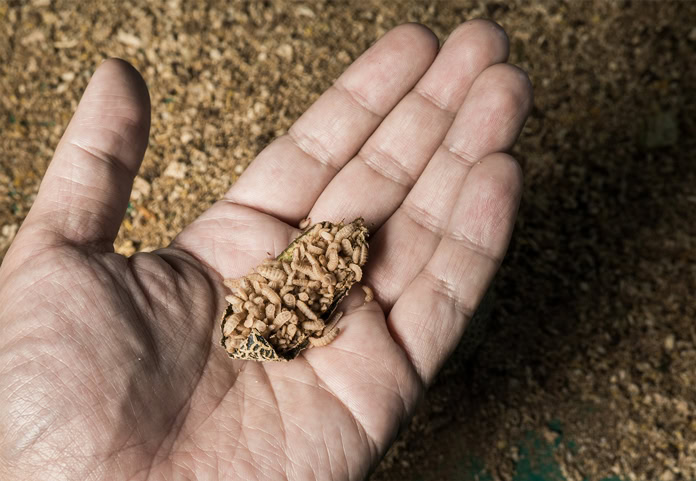
Insect proteins are mainly produced from the black soldier fly larvae or mealworms. They are reared on organic substrates and then processed into protein meals and oils for use in animal diets. By converting organic residues into protein and lipids, this process has the potential to revalue waste products into feed ingredients.
The circularity potential of insect ingredients remains constrained by regulatory limits on approved feedstocks. In key markets such as the EU and US, the use of post-consumer waste and animal by-products is prohibited in insect farming due to food safety concerns. As a result, producers rely on cleaner inputs such as bakery waste, fruit and vegetable trimmings, and cereal by-products, as well as crops and feed materials that compete with other uses in livestock feed, pet food, and bioenergy. Despite these restrictions, several early commercial production facilities have been established, demonstrating some progress beyond the pilot stage. However, high capital costs and reliance on relatively expensive substrates continue to limit profitability and restrict the volume of commercially available product.
The promise of insect proteins as a circular solution is based on strong principles, but continues to face challenges in implementing circularity and reaching commercial scale. The insect farming industry is still in its early stages, with companies actively testing various production scales and refining indoor farming technologies to identify viable and efficient business models. The industry will have to overcome its challenges in sourcing circular feedstocks and achieving regulatory acceptance of underutilised waste streams in key markets before production volumes can increase.
Biochar feed additive
Biochar is a carbon-rich material produced by pyrolysing (i.e., heating without oxygen) biomass such as crop residues, forestry by-products, or food waste. When included in small amounts in animal diets, early studies suggest it may influence gut function, reduce methane emissions in ruminants, and alter nutrient cycling. These effects can also improve manure quality, lowering ammonia emissions and enhancing soil fertility when the manure is applied as fertiliser. Biochar’s circularity potential lies in converting waste biomass into a feed additive while creating co-benefits for both livestock systems and soils.
The commercial adoption of biochar remains in its early stages and is currently limited to trials and niche markets. In experimental settings, the use of biochar has yielded inconsistent results for both animal performance and environmental outcomes. Regulatory approval is also still evolving. For biochar to be deployed more widely in feed, updated safety and efficacy standards are needed.
As a circular solution, biochar illustrates an intriguing pathway to link waste management, livestock production, and soil health. Its role in feed remains experimental, with inconsistent evidence and evolving regulation limiting broader uptake. Realising its potential will require a stronger evidence base and a clear demonstration of benefits at a commercial scale.
NOVEL INGREDIENTS CAN HELP CLOSE THE LOOP IN FEED
Circular feed ingredients represent one of the most practical tools for improving the sustainability of animal feed. By valorising industrial by-products into nutritious inputs for livestock and aquaculture, they can help diversify supply chains and reduce over-reliance on conventional ingredients such as soy and fishmeal. Substantive progress will depend on supportive regulation, investment in infrastructure, and stronger collaboration between feed producers, innovators, and policymakers.
At the Centre for Feed Innovation, we believe the sector’s priority should be to advance feed solutions that combine circularity with commercial viability. By directing support toward approaches that can scale safely and sustainably, the feed industry can strengthen resilience, reduce environmental impact, and deliver on the promise of closing the loop in livestock and aquaculture nutrition.
The Centre for Feed Innovation is a think tank dedicated to advancing novel feed ingredients. We work with companies, policymakers, and investors to identify commercially viable pathways, de-risk innovation, and accelerate adoption. We will continue to provide analysis and insights on how circular feed ingredients can contribute to more resilient and sustainable food supply chains.
About Aashish Khimasia
Aashish Khimasia is Director of Research at the Centre for Feed Innovation (CFI), a think tank dedicated to accelerating the transition toward sustainable, scalable and safe animal feed. Khimasia leads CFI’s research agenda on novel feed ingredients, in collaboration with academics & industry, bridging technical, regulatory, and investment perspectives to help support the scaling of new solutions from pilot to market.