


Circularity may be the latest buzzword to find purpose in an insect farming industry that has given up on having a transformative effect on food systems, yet, under scrutiny, the use of food waste appears more counterproductive than anything. Any sustainability or economic gain made by feeding insects on food waste fails to make insect protein a competitive and environmentally beneficial alternative to animal feed or pet food. Besides, the food safety and animal welfare risks surrounding insect farming are exacerbated when relying on true waste streams.

Insects Political Adviser
Eurogroup for Animals
As the European Union is striving to develop its circular economy, insect farming is often presented as an innovative solution that can reconcile food waste management and protein production. Beyond the buzz, can insect farming really deliver on circularity without compromising on quality, safety, competitiveness, and welfare?
CIRCULARITY AS A LAST RESORT
Industrial insect farming is starting to soar in Europe. Initially touted as a ‘sustainable’ form of agriculture by comparison with other livestock systems, it is now clear that insect farming is essentially about insects being used as feed for animals. This growing industry is predominantly driven by a need to feed other farm animals reared in intensive systems or, as long as this remains unprofitable, to enter premium pet food formulas.
The claim that farming insects pollutes less than producing cow meat fails to consider the bigger picture. What is the true cost of using insects to replace soymeal, fishmeal, or pet food ingredients?
Insect farming is an additional step in the food chain, feeding on crops, vegetables or feed-grade by-products and taking their place in the diet of farmed and companion animals. Essentially, it upholds an already unsustainable status quo.
In its current form, insect farming makes food systems lengthier, and is not circular at all. It comes as no surprise that its environmental impact is higher than most pet food ingredients (including animal by-products), and up to 13.5 times higher than soybean (4.2 times higher than fishmeal) (Ricardo Ltd., 2024, see Figure 2).
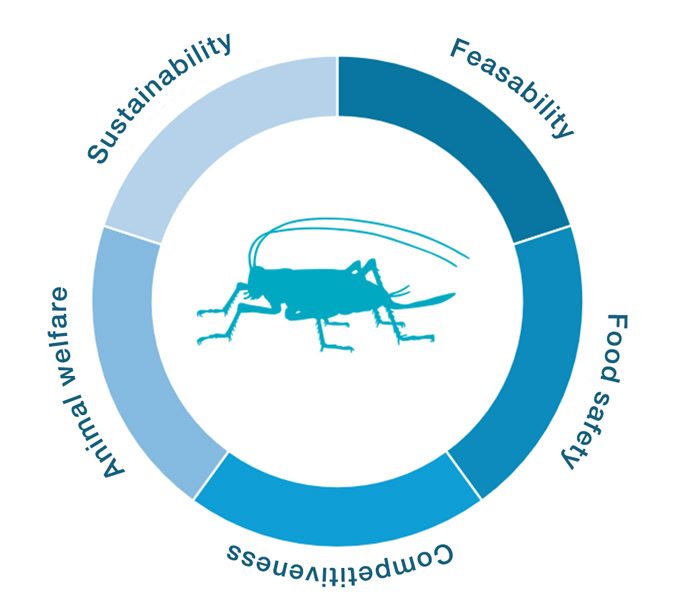
This reality, combined with the industry’s economic difficulties, has led many to question the purpose of the sector. Some insect businesses and representatives have come up with propositions that claim to make insect farming really circular: Allowing “true” waste streams to be fed to insects, and better valorising a by-product of insect protein production, “frass”, as a fertiliser (Figure 1).
CAN INSECTS AS ANIMAL FEED BRING SUSTAINABILITY BENEFITS?
It is unquestionable that food waste is a key concern of our food systems, with one quarter of the food produced for human consumption being wasted. It would however be foolish to think that all of it can be upcycled through insect farming, without compromising on food safety, costs, and animal welfare.
It would make little sense for insects to be fed the meat and fish co-products that are already used directly as pet food, given to farm animals, or utilised for composting or in other economic sectors. Incidentally, the properties that make a substrate useful or desirable for insect production are often the same that make them useful or desirable for other industries (Roffeis et al., 2020). A 2025 study of waste-to-nutrition pathways in France highlighted the limits of feeding waste to insects and concluded that feeding livestock with suitable organic waste was actually much more efficient to reduce the environmental impact of food systems (Javourez et al., 2025).
The most comprehensive life cycle analysis of insect protein production, commissioned by the UK government, compared insect meal from grain-fed, manure-fed, and waste-fed insects against soybean and fishmeal (see Figure 2). It found the climate impact of waste-fed insects to still be 1.8 times higher than fishmeal, and 5.7 times higher than soybean (and performing worse than soybean on 15 environmental metrics out of 16). Even fed with waste, insect feed would still be worse for the environment than what the industry seeks to replace at the moment.
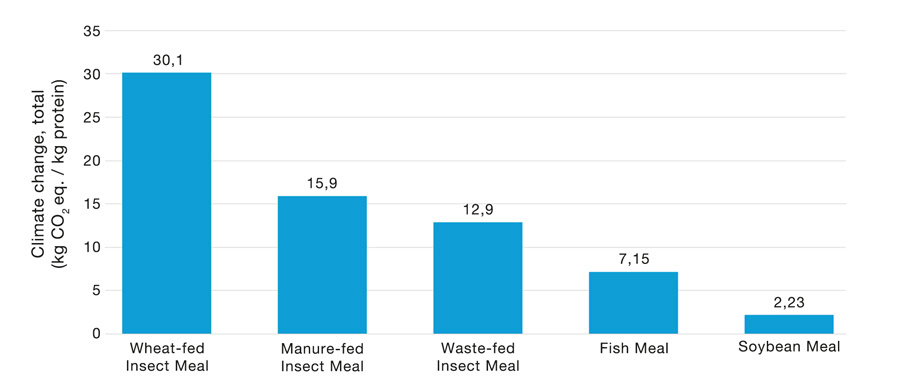
Data from Ricardo Ltd., “Life Cycle Assessment of UK Insect Protein Production Processes for Pig and Poultry Feed” (2024)
Looking towards insect frass, a co-product of insect farming, also praised for its circularity potential, its environmental profile is unclear. The same UK government-commissioned study concluded that “further research needs to be conducted to assess both efficacy and environmental risk” due to a general paucity of data on this recently developed product. Some studies also suggest that frass from Black Soldier Fly larvae grown on food waste can hinder the growth of maize, contribute to excessive nitrite accumulation, and thus present little environmental benefits (Alattar et al., 2016; Watson et al., 2021).
FOOD SAFETY IN CIRCULAR ANIMAL FARMING
Intensive forms of animal farming are notoriously a leading cause of food safety problems, and there is no reason to believe that insect farming is an exception. With thousands, if not tens of thousands, of highly selected and homogenous individuals crammed in a limited space, insect farms are health liabilities. A 2019 study of insect farms in Germany and Central European countries detected parasites in 81% of examined facilities, with 35% of them infectious for animals and 30% for humans (Gałęcki and Sokoł, 2019).
Channeling waste streams (particularly meat waste streams) in animal farming has led to some of the worst animal diseases in history, like the BSE (Bovine spongiform encephalopathy). While early research suggests insects may be at lower risk of transmitting BSE-causing prions, they can still accumulate and transmit pathogenic elements from the feed they are given. Even the Black Soldier Fly, reputed for its ability to process some waste, can accumulate heavy metals present in the substrate at high level (Diener et al. 2015).
Currently, nine species of insects are allowed to be farmed at EU level, and insects reared in the same farm may be destined for human, farm animal, or pet consumption. While one insect species might be able to safely process one type of food waste, another may not, and the utmost care needs to be applied to safely trace the origin and content of waste streams, and the end use of the insects that will be fed upon them. There is no one size fits all.
Insects being natural vectors of pathogens, the highest level of caution needs to be taken before considering feeding them food waste, and only a careful evaluation of the safety of each waste stream for each species could prevent insect farming to replicate the animal diseases that regularly plague animal farming.
DO INSECT PRODUCERS CARE ABOUT WASTE AT ALL?
Using food waste would lead to several trade-offs when it comes to the consistency of insect farming end products. While a regular stream of feed-grade by-products is quite easy to channel to an insect farm, waste streams will differ in form, quality, and availability throughout the year, threatening the reliability of the insect supply chain. In addition, the ability of an insect to survive on food waste is not equivalent to its ability to deliver high-quality and cost-effective products. The nutritional quality of the substrate given will not only impact the nutritional profile of the end product, but also the life cycle of the animal.
If it takes a Black Soldier Fly 10 days to reach the appropriate larva stage when fed high-quality feed, it can take 35 days if it is fed potato peel, and even longer on inconsistent waste streams. This extra time induces energy and labor costs that can offset any production gains made elsewhere. It comes as no surprise that most major producers have been careful not to embrace inconsistent waste streams, even those that are authorised at the moment. It has also been admitted by industry players that it is extremely difficult to harness waste streams due to their high variability, referring to the example of AgriProtein, the former market leader having gone bankrupt after its failed attempt to scale up using waste (Biteau et al. 2024).
ECONOMICS OF USING FOOD WASTE
The idea of utilising food waste comes in a context of great uncertainty regarding the viability of the insect farming industry. Plagued with high energy and labor costs, the sector has seen several market leaders filing for bankruptcy despite investments that numbered in the hundreds of millions of euros, while other companies across France, Denmark and the Netherlands have faced economic difficulties. This suggests that the problem may not be limited to just one company, one choice of insect, or one business model, but extends to the whole sector.
Insect meal currently retails at around 3800-6000 USD, and might go as low as 1600–2700 USD by 2030 according to some projections (de Jong & Nikolik, 2021). That would still put insect meal at a much higher price than the projected price of fishmeal, and that of soymeal.
While the use of low-cost food waste, combined with high retail prices for insect co-products, may be profitable, it has been deemed unrealistic for mass production in the largest study on the economics of industrial insect production in the Netherlands (Leipertz et al., 2024). As evoked earlier, relying on food waste would induce other costs that can offset any gains.
IS CIRCULAR INSECT PRODUCTION GOOD FOR THE ANIMALS?
From an animal welfare perspective, incorporating food waste in insects’ diets, and waste-fed insects in other animals’ diets might not be the best solution. While some studies suggest insect protein may be beneficial for some farm animals, the effect of waste-fed insects in farm animals’ diets has been understudied and a precautionary approach is needed.
On insect welfare, a growing body of evidence suggests that insects, like many other invertebrates, may be sentient and feel pain (Gibbons et al., 2022). The question of insect welfare, recognised by industry representatives (IPIFF, 2019), extends to insect diets and their effect on their well-being. Just like improper feed may be detrimental to a farmed cow, improper feed may be detrimental to farmed insects.
While some insects may be able to digest several forms of waste streams, others, such as the yellow mealworm and the house cricket, two of the most farmed insects in Europe, need high quality ingredients to grow and remain healthy (Billen et al., 2020). Crickets were shown to experience a 99% mortality rate when fed on municipal-grade waste (Lundy and Parrella, 2015). Waste streams may also lack essential properties for insect farming, such as having a sufficient solidity for yellow mealworms. Even Black Soldier Flies are not immune to these challenges, as rearing them on manure was shown to hinder their survival (Miranda et al., 2020).
In general, the inconsistency and variability of food waste make using it as insect substrate hazardous in terms of welfare. Eurogroup for Animals recently published a report on insect diets and welfare, showing “a need for further research on insects’ dietary preferences” to enhance their welfare (Eurogroup for Animals, 2023).
CONCLUSION
Circularity may be the latest buzzword to find purpose in an insect farming industry that has given up on having a transformative effect on food systems, yet, under scrutiny, the use of food waste appears more counterproductive than anything. Any sustainability or economic gain made by feeding insects on food waste fails to make insect protein a competitive and environmentally beneficial alternative to animal feed or pet food. Besides, the food safety and animal welfare risks surrounding insect farming are exacerbated when relying on true waste streams, shedding doubts on the overall viability of the model. We can doubt whether, even with new waste streams being authorised, insect producers will choose this path forward.
The insect farming sector needs to be clear on its goals if it seeks to achieve policy change and develop at scale. The constant backpedaling of the sector in the last few years – from diet revolution to feed additive and from waste upcycling to lengthier food chain – make its latest claims of circularity hard to believe.
About Francis Maugère
Currently leading Eurogroup for Animals’ work on insect farming, Francis Maugère has worked on several groundbreaking publications, pulling together the latest research, scientific evidence and expert opinions on insect farming, and has intervened at several insect farming conferences to explore the sector’s significant implications for animal welfare and the environment.