


“Production challenges at higher stocking densities and fluctuating prices for small sizes of white leg shrimp have prompted the farming of black tiger shrimp in India. Farmers’ growing demand for SPF black tiger PL spurred hatchery operators to import more broodstock.”

Assistant Professor
Mandapam Centre for Sustainable Aquaculture (MCeSA), TNJFU, India
The immense resources (1.2 million hectares of brackish water) available are one of the primary forces driving the rise of the shrimp farming industry in India. The commercialization of white leg shrimp (Litopenaeus vannamei) had a significant impact on the market, which reached an all-time high of approximately 815,745 metric tonnes (MT) during 2020-21, with Andhra Pradesh leading the way, followed by Gujarat and Tamil Nadu far behind. The boom in vannamei shrimp production and export has eclipsed the native shrimp species, Penaeus monodon (black tiger shrimp), which was dominating until 2003. In 2020-21, the total output of black tiger shrimp was 27,616 MT, with West Bengal forging ahead, followed by Andhra Pradesh and Kerala. For the past few years, the major extensive producers of black tiger shrimp (West Bengal and Kerala) have shown a falling trend in production, while Andhra Pradesh and Gujarat have been attempting to set the pace with their keen interest in farming P. monodon due to the availability of Specific Pathogen Free (SPF) Post Larvae (PL) in India since 2021.
ENTRANCE OF THE WHITE LEG
White spot syndrome virus (WSSV) issues affecting black tiger shrimp production deterred investment in the sector, forcing many farmers and investors to quit. While farmers were looking for a remedy to the decline in output caused by WSSV, the introduction of white leg shrimp in 2009, which was characterised by higher productivity and superior disease resistance, provided them with a happy side to quench their thirst and revitalise the sector. Vertically integrated companies were also the first to experiment with L. vannamei farming in corporate farms. It only took a few years after Coastal Aquaculture Authority (CAA) permission for Indian farmers and investors to switch virtually entirely to L. vannamei. Aside from being more productive and disease resistant, the availability of SPF broodstock and PL and the competency for intensive farming with increased profits remained the primary drivers of species transition among hatcheries, farmers, and processors. Farmers that wished to adhere to black tiger shrimp found it challenging when the industry around them shifted toward L. vannamei. This boosted L. vannamei output in India.
RETURN OF THE BLACK TIGER
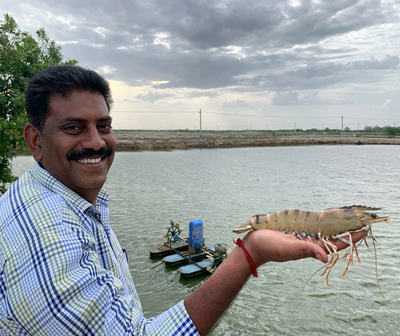
Despite the fact that most farmers made the switch, some in Guntur, Andhra Pradesh, purchased PL from commercial hatcheries that used wild-caught ready-to-spawn females and consistently produced roughly 3,000 MT of black tiger shrimp each year (Pijl, 2021). Although the early years of cultivating L. vannamei shrimp turned many Indian farmers wealthy, they ran into hardship within a few years, and many are still struggling today. Rising L. vannamei specific infections and diminishing prices make it difficult for growers to generate income even with a good yield. Instead, they lowered stocking densities and farming cycles, harvesting smaller sizes of L. vannamei. Unfortunately, with dwindling small-size prices, many people are realising that this approach would most likely fail in the coming years. This has caused individuals to return to P. monodon for the past couple of years, which was previously not a possibility for many because of the lack of SPF PL. Although the Marine Products Export Development Authority (MPEDA) constructed a government-run nucleus breeding centre (NBC) and broodstock multiplication centre (BMC) on the Andaman Islands in 2014, this operation have been unsuccessful in producing substantial numbers of SPF black tiger broodstock. Recognizing the situation, CAA issued a request for expressions of interest in 2019 for providers of SPF black tiger broodstock to apply for a permit to supply the Indian market, resulting in the introduction of two suppliers with their SPF black tiger broodstock.
SPF BROODSTOCK SUPPLIERS
The companies listed below supply specific pathogen free (SPF) black tiger broodstock globally.
1. CPF (Thailand)
2. Moana Technologies (Hawaii, USA)
3. Aquaculture de la Mahajamba (known as Aqualma, and part of the Unima Group) (Madagascar)
4. Topgen (Thailand)
Moana has an NBC in Hawaii and a BMC in Vietnam’s Ninh Thuan province. The company supplies to Bangladesh, Indonesia, and the Philippines. CP Foods primarily provides its own hatcheries in Thailand, Vietnam, Malaysia, and China, as well as to other hatcheries in Sri Lanka and Bangladesh. Topgen, founded in 2012 by a group of shrimp pioneers, established the black gen line through multi-collaborations and now has global clientele supplying broodstock to China, Singapore, Malaysia, Vietnam, South Korea, Myanmar, Taiwan, Sri Lanka, Bangladesh, Greece, and Ukraine. Aqualma has been selling broodstock to Malaysian hatcheries for several years, and India is the company’s second Asian export market. Moana and CP Foods currently hold the majority of market share. In 2020, the two firms produced approximately 80,000 broodstock, the majority of which originated from Moana (Pijl, 2021). Among the four, the Indian government permitted Moana Technologies and Aqualma to supply SPF black tiger broodstock to India in October 2019. Thai suppliers were officially excluded, as in the case of L. vannamei, due to the concerns about disease frequency in Thailand.
SPF MONODON HATCHERIES IN INDIA
There are three hatcheries producing SPF black tiger PL in India.
1. Vaishnavi Aquatech (Moana)
2. Unibio (Aqualma)
3. Gayathri Bio Marine (Aqualma) (New entry in 2022)
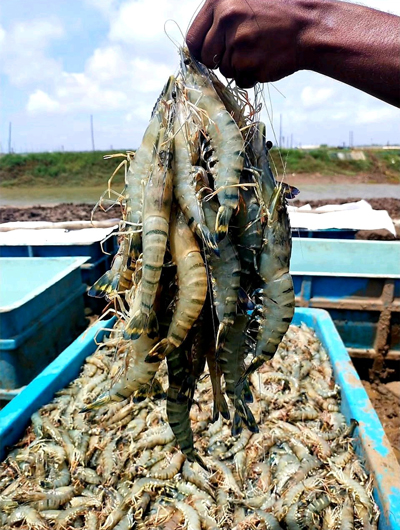
On September 30, 2021, CAA issued an official advisory to coastal aquafarmers to purchase SPF monodon seeds from Vaishnavi and Unibio. The Authority updated the list in 2022, when the third company received permission to produce and sell seeds in the country. Currently, these hatcheries are the only option for farmers to acquire SPF black tiger PL. According to CAA, these hatcheries imported 6316, 912 and 1190 SPF P. monodon broodstock, respectively from January to May 2022 which clearly indicates the farmers desire for raising black tiger shrimp. Recently on 09th August 2022, the first BMC for SPF P. monodon by Vaishnavi Aquatech was inaugurated by Hon’ble Minister of Fisheries, Animal Husbandry and Dairying Shri Parshottam Rupala in Gujarat.
Production challenges at higher stocking densities and fluctuating prices for small sizes of white leg shrimp have prompted the farming of black tiger shrimp in India. Farmers’ growing demand for SPF black tiger PL spurred hatchery operators to import more broodstock. Furthermore, the success updates of monodon farming in Andhra Pradesh and Gujarat is enticing L. vannamei hatchery operators and farmers to return back to black.
References
1. Coastal Aquaculture Authority. (2022). http://caa.gov.in/ (Accessed on June 30, 2022)
2. Marine Products Export Development Authority. (2022). https://mpeda.gov.in/ (Accessed on June 30, 2022)
3. Moana Marine Biotech. (2022). http://www.moananinhthuan.com/en/ (Accessed on July 25, 2022)
4. Pijl, W.V.D. (2021). https://shrimpinsights.com/blog/india-black-really-going-be-back.
5. Topgen Aquaculture. (2022). http://www.topgenaquaculture.com/index.php
About R. Dinesh
Dinesh has been an Assistant Professor in the Department of Aquaculture at the Mandapam Centre for Sustainable Aquaculture (MCeSA) of Tamil Nadu Dr. J. Jayalalithaa Fisheries University (TNJFU), India since 2021. He undertakes strategic and applied research in the field of Mariculture, offering extension services to farmers as well. Dinesh completed his Master’s degree in Fisheries Science with a special focus on Aquaculture at the Central Institute of Fisheries Education (CIFE) and his undergraduate studies at TNJFU. His research interests lie in Aquaculture and Aquaculture Nutrition. Before joining academics, he was directly involved with the shrimp production industry for five years as a technical officer and aqua feed formulator, working with different corporates. He has won prestigious awards and has authored several books and peer-reviewed articles. Dinesh serves as a reviewer for high-impact journals, and he’s a member of various professional and academic societies.