
Feed for the larvae emerged as the most significant contributor to emissions, but also the area with the greatest potential for improvement. Farms using organic waste streams like potato pulp dramatically reduced their carbon and water footprints. According to the GHG protocol, true waste materials carry zero upstream carbon burden, making them ideal for sustainable feed.
Head Of Business Development
Better Insect Solutions
In the heart of Central Europe, a quiet revolution is taking place in the world of sustainable agriculture. Black Soldier Fly (BSF) farming, once a niche concept, is now emerging as a powerful solution to the environmental challenges of traditional livestock feed production. A recent study conducted by Better Insect Solutions in collaboration with FarmInsect sheds light on the carbon and water footprints of BSF farming – and the results are promising.
FARMING INSECTS, NOT EMISSIONS
The study analyzed three operational BSF farms each producing between 400 and 1,000 tons of live larvae annually. These larvae are used in livestock and pet food, offering a protein-rich alternative to conventional feed sources. The study focused on the “fattening stage” of BSF larvae, where young individuals are grown into harvest-ready larvae – similar to broiler chicken production.
What makes BSF farming stand out is its low carbon footprint. All three farms reported emissions below 1 ton of CO₂ equivalent per ton of fresh BSF larvae produced. In fact, when benchmarked against broiler farming, BSF production showed up to 40% lower emissions. This is a game-changer for the feed industry, which is under increasing pressure to reduce its environmental impact as well as remaining cost-effective.
FEED AND FRASS: THE TWIN PILLARS OF SUSTAINABILITY
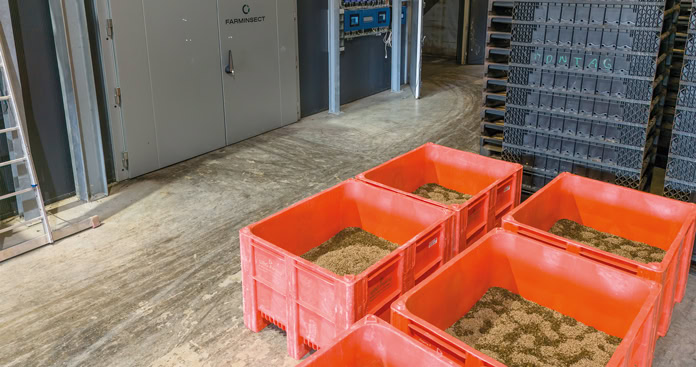
Feed for the larvae emerged as the most significant contributor to emissions, but also the area with the greatest potential for improvement. Farms using organic waste streams like potato pulp dramatically reduced their carbon and water footprints. According to the GHG protocol, true waste materials carry zero upstream carbon burden, making them ideal for sustainable feed.
Then there’s frass, the nutrient-rich by-product of BSF farming that can be valorized as a fertilizer and used in biogas facilities. One farm uses 25% of its frass to generate energy, while another farm is experimenting with natural drying methods to hygienize frass for agricultural use. These innovations not only add economic value but also shift emissions away from the primary product, further improving the sustainability profile of BSF farming.
WATER USE: LESS IS MORE
Water consumption is another area where BSF farming shines. The study tracked blue (surface/groundwater), green (rainwater), and grey (polluted) water usage. Two farms consumed around 10,000 liters of blue water per batch, while the farm using potato pulp, relied heavily on green water which is considered more sustainable. Compared to traditional livestock, BSF larvae require approximately 2,700 m³ per ton which is significantly less water than required for other livestock. This is roughly 1.5-5 times higher than the water consumption required for producing a ton of fresh soybeans or industrial fish for fishmeal; however, the water used for BSF farming can predominantly (70-90%) be provided as green water.
HEATING SMARTER
Heating is the second-largest source of emissions in BSF farming. Farms using fossil fuels like LNG recorded higher emissions, while those using biomass or wood chips fared better. For instance, one of the farms could reduce its heating emissions by 43% through the installation of a heat recovery system saving 187 MWh of energy annually.
A BLUEPRINT FOR THE FUTURE
As the insect farming sector continues to grow, data-driven insights like these will be crucial for guiding policy, investment, and innovation. A recent life cycle assessment study commissioned by Department for Environmental Food & Rural Affairs (DEFRA) in the UK, raised concerns that insect protein meal could be up to 13.5 times worse for the climate than soy and up to 4.2 times worse than fishmeal (reference: Life Cycle Assessment of UK Insect Protein Production Processes for Pig and Poultry Feed – SCF0235). Our farm-level assessment presents a more grounded and optimistic view. The UK report relied heavily on cradle-to-gate modeling and included scenarios using high-impact feedstocks like traditional feed, which may not reflect best practices in commercial insect farming. In contrast, this study draws on real-world production data from three operational BSF farms in Germany, each employing practical sustainability strategies such as biomass heating, frass valorization, and organic waste feed integration. These farms demonstrated carbon footprints below 1 ton CO₂e per ton of fresh BSF larvae, which is at the low end of the scale for an animal-based product used for feed and petfood. By focusing on actual production conditions and scalable waste management solutions, the findings offer a more nuanced and actionable blueprint for sustainable insect farming, bridging the gap between theoretical modeling and industrial reality.
WASTE MANAGEMENT AS PART OF THE SOLUTION
This study offers more than just numbers—it provides a roadmap for making insect farming a cornerstone of sustainable agriculture. But beyond feed optimization and energy efficiency, one of the most transformative opportunities lies in waste management. By upcycling food waste and agricultural residues into high-value protein and fertilizer, these insects act as natural decomposers reducing landfill volumes and preventing methane emissions. This isn’t just sustainability; it’s circular economy in action. Furthermore, when applying waste streams as main feedstock for insect farming this will also enable compliance with the EU Deforestation Regulation (EUDR).
To support the continued growth of the insect farming sector, it is pivotal to integrate waste valorization into its core operations. At present EU legislation is holding back on fully leveraging this potential. Whether it’s through frass-to-fertilizer innovations or full-scale organic waste conversion, BSF farming is poised to become a dual-purpose solution: providing nutrition for animal and plant production through upcycling waste streams in our food system.
About Lars-Henrik Lau Heckmann
As a business development leader, Lars-Henrik Lau Heckmann has a strong focus on innovation, strategic partnerships, and portfolio growth. At Better Insect Solutions, he drives initiatives across product development, R&D, marketing, and stakeholder engagement. With a background in biology and insect farming, he combines scientific expertise with commercial insight, shaped by leadership roles in biotech and applied research. His business acumen is supported by executive education from institutions like Harvard Business School. He has helped shape the insect-based feed and food industry over the last 10 years and contributed to regulatory progress through active involvement in international platforms such as IPIFF.