


Due to climate change heat stress becomes an increasingly common phenomenon. The consequences for broilers are all too obvious with a significantly lower feed intake and a lower productive efficiency. Many people however, are unaware that the intestines suffer considerably from high ambient temperatures. Recently, FRAmelco researchers found a successful and innovative way to support the broilers’ gut under heat stress.

R&D Manager
FRAmelco
Although birds perform well within a relatively wide range of temperatures, optimal performance for growing broilers is found to be between 18 and 22 °C. However, when the temperature in a broiler house rises above their comfort zone, broilers experience physiological stress known as heat stress. In this regard, the effect of relative humidity should not be underestimated. A high environmental temperature in combination with a high humidity is much more detrimental to broilers than a high temperature alone. Although heat stress is mainly a concern in warm and humid regions, due to climate change it may become a more widespread problem.
NEGATIVE IMPACT OF HEAT STRESS
As birds are covered with feathers and lack sweat glands, they are relatively vulnerable to heat stress. To prevent death from heat exhaustion when facing temperatures above their comfort zone, birds must make major thermo-regulatory adaptions. Their most important strategy to cool down is increasing their respiratory rate, they start to ‘pant’. To lose more heat they also spread their wings and open their plumage. In addition, heat-stressed birds redistribute blood to their skin to facilitate heat loss. These physiological adaptations will cost the birds a lot of energy which will be reflected in performance results.
Heat stress will not only considerably reduce feed intake and consequently nutrient intake, it also has a negative effect on broilers comfort end suppresses productive efficiency. Moreover, during heat stress, cells in the body and intestines can be damaged due to oxidative stress, i.e. an imbalance between free radicals and antioxidants. Heat stress also appears to affect the immune response in broilers making them more vulnerable to infections. Since heat stress leads to substantial economic losses and threats to bird performance, health and welfare it is necessary to take measures.
NUTRITIONAL STRATEGIES TO REDUCE HEAT STRESS
What tools do broilers farmers have to minimize the impact of heat stress? Controlling the house temperature and humidity is obviously the most effective way to protect animals from the adverse effects of heat. But management strategies like providing adequate and cool drinking water and feeding smaller and more frequent meals during the cooler parts of the day will stimulate broilers’ appetite and enhance feed intake. One other method to alleviate the effect of high ambient temperature on the performance of broilers is dietary interventions.
 A common strategy to reduce heat stress in poultry is trying to maintain normal nutrient intake by increasing nutrient density proportional to the expected decrease in feed intake, e.g. by increasing the fat content of the diet. Dietary fat produces less heat during digestion and metabolism compared to other ingredients. Another measure to combat heat stress is the reduction of dietary protein while balancing the limiting amino acids, especially methionine and lysine.
Adding minerals like potassium bicarbonate, ammonium or potassium chloride will support the electrolyte balance, which is more critical during summer heat. And in warmer regions of the world, it is common practice to provide extra antioxidant vitamins like vitamin E and C help to support birds to cope with the consequences of oxidative stress.
BUT HERE IS MORE…
While most broiler nutritionists and farmers look with suspicion to depressed feed intakes, much more is happening inside the animal. American researchers recently confirmed not only the negative effect of heat stress on daily gain, feed conversion ratio and meat yield. They also discovered that these effects are not only due to the low feed intake, but also are a direct effect of a damaged gut.
This is how it works. Heat stress increases the production of pro-inflammatory immune cells (cytokines), which lead to damage of tight junctions in the small intestine. In addition, heat stress induces oxidative stress at the gut epithelium, leading to impaired permeability. As a result, the intestinal barrier function is negatively affected and pathogens and endotoxins can enter the animal body leading to an increased susceptibility to infection and inflammation.
Moreover, according to research, heat stress alters the composition and abundance of the microbiome. This disturbance of the microbiota can be the result of an impaired immune function, but a low feed intake and high water intake during heat stress can be a reason as well. Disturbance of the microbial balance induces proliferation of harmful bacteria and a reduction in beneficial bacteria. It makes the birds prone to intestinal diseases. That got FRA’s researchers thinking.
THE BENEFITS OF BUTYRIC ACID
From both research and practice, it is well known that butyric acid is highly beneficial to improve intestinal integrity and development. However, because pure butyric acid is very hard to handle due to its incredible bad smell, FRAmelco developed the innovative FRA® Butyrin Hybrid Dry, an effective and easy to handle blend of tributyrin and alpha-monobutyrin. FRA® Butyrin Hybrid Dry is designed to improve intestinal integrity and development, such as villi height and villi height to crypt depth ratio, but also balance the microbiome. Butyrate increases the expression of tight junction proteins, improving the epithelial barrier which is essential for normal intestinal function. Hence, it was expected that dietary supplementation of FRA® Butyrin Hybrid Dry would have a positive effect on performance and intestinal health of broilers during chronic heat stress.
PROOF OF CONCEPT
To test this hypothesis, FRAmelco carried out a broiler study during the hot-dry season in Nigeria last year. From rectal temperatures of 42.8 °C and respiratory rates of 96 breaths per minute, it became clear that the Arbor Acres broilers really suffered from heat stress. The control group received a basic commercial start, grower, and finisher diet based on maize and soybean meal. The test group received the basal diet supplemented with FRA® Butyrin Hybrid Dry (500 g/ton) during the entire trial period of 42 days.
BETTER PERFORMANCE UNDER HEAT STRESS WITH FRA® BUTYRIN HYBRID
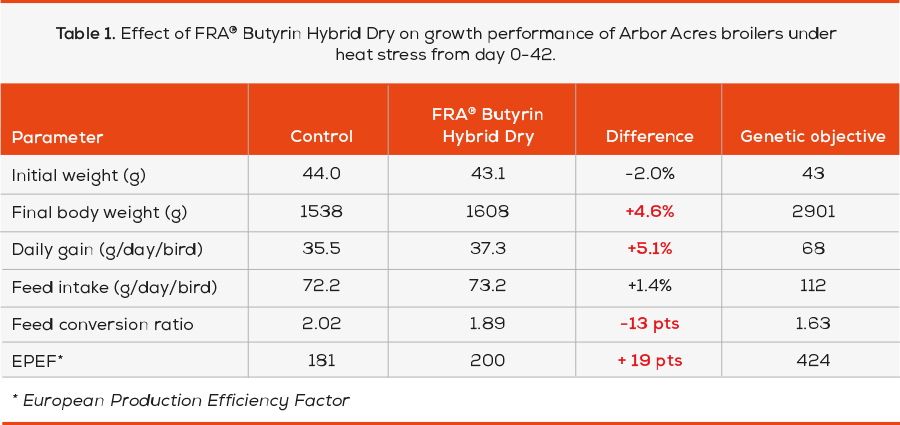
As expected, the effect of heat stress was seen on all parameters as growth rate, feed intake, feed efficiency and final body weight were negatively affected in both treatment groups compared to the performance objectives of the genetic (see Table 1). However, FRA® Butyrin Hybrid Dry was able to alleviate the effects of heat stress as average daily weight gain was improved with 5.1% compared to the control group. As a result, at slaughter these broilers were 70 grams (4.6%) heavier. Remarkably, instead of a higher feed intake, in particular feed was better utilized when FRA® Butyrin Hybrid Dry was fed as feed conversion ratio was improved by 13 points.
 Looking at the carcass quality, dressed poultry was significantly increased with 6.7% and the percentages of breast meat, thigh and drumsticks were also elevated in the treatment group compared to control animals, with 5.1%, 6.1% and 1.9% respectively.
Overall, the results of the current study are in line with scientific publications where blends of tributyrin and alpha-monobutyrin increase growth performance and breast meat yield. The total improvement in performance resulted in an increase of 19 points on the European Production Efficiency Factor.
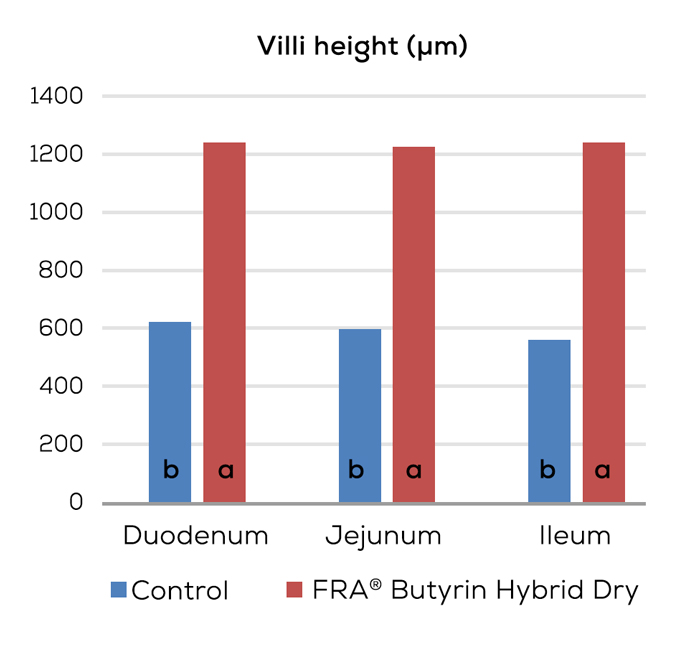
abBars per intestinal segment with a different superscript are significant different (p≤0.05).
To find out what is behind this considerably improved feed efficiency, the researchers at FRAmelco went on to investigate the intestinal health of the heat-stressed broilers.
MORE HEALTHY GUT UNDER HEAT STRESS WITH FRA® BUTYRIN HYBRID
They found out that the favourable effects of FRA® Butyrin Hybrid Dry on heat stressed broilers, may have been the result of the gut supporting abilities of the feed additive, which agrees with knowledge from literature. In the current trial, FRA® Butyrin Hybrid Dry significantly improved villi height compared to the control group as well in the duodenum as in the jejunum and ileum as shown in Figure 1, thereby significantly improving villi height to crypt depth ratio (VH:CD ratio) from approximately 3.7 till 6.5 in each intestinal segment compared to the control group (see Figure 2).
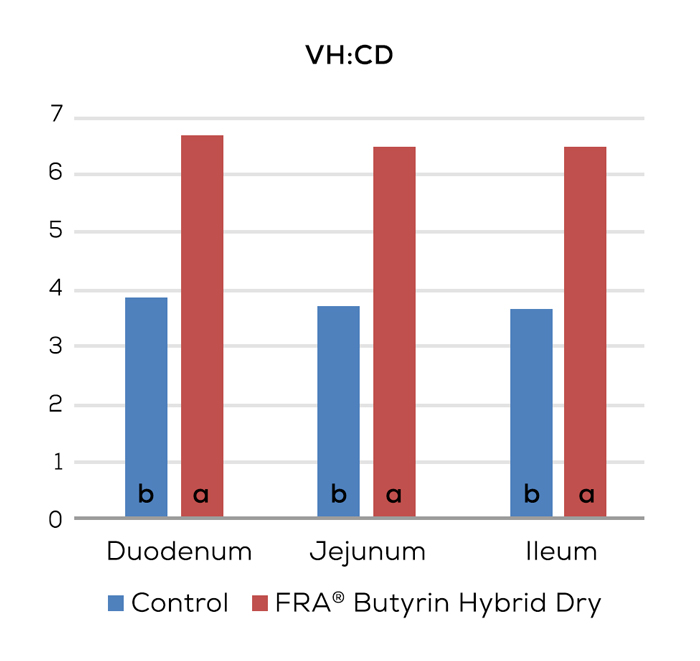
abBars per intestinal segment with a different superscript are significant different (p≤0.05).
A higher VH:CD ratio results in a decreased turnover of the intestinal mucosa, which decreases the maintenance requirement and finally can result in a higher growth efficiency of broilers. Furthermore, higher villi increase the nutrient absorption area in which more feed is available for the animal resulting in higher growth rates. The improved intestinal integrity could be one of the explanations why higher growth rates and a more efficient feed conversion rate was observed when FRA® Butyrin Hybrid Dry was fed (Table 1).
MORE BALANCED MICROBIOME UNDER HEAT STRESS WITH FRA® BUTYRIN HYBRID
Heat stress not only causes damage to the gut, it also alters the composition of the microbiota in an unfavourable way. From the current trial it becomes clear that under high ambient temperatures FRA® Butyrin Hybrid Dry could help maintaining a healthy microbiome in broilers. As can be concluded form Figure 3, viable counts of the beneficial Bifidobacterium and Lactobacillus were increased with 56.9% and 7.1% respectively when compared to the control group. On the other side, the potential pathogenic bacteria Clostridium perfringens and Escherichia coli were greatly reduced with 26.1% en 18.6% compared to the control. This improvement in microbiota balance is in line with results from other scientific experiments.
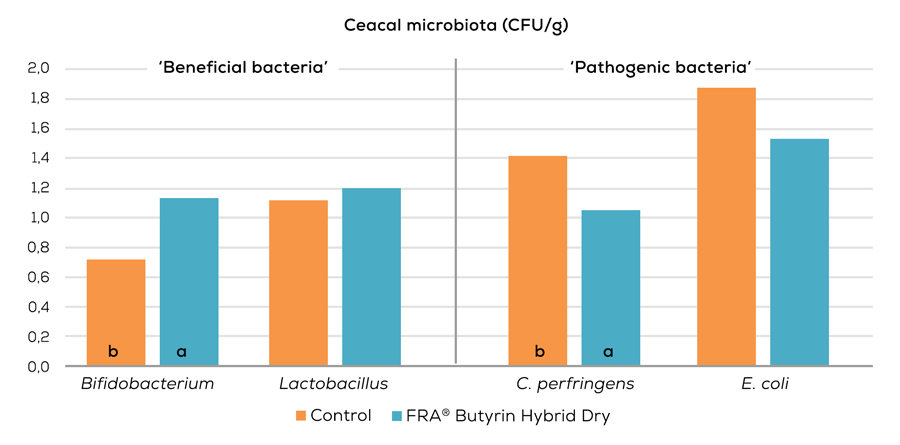
abBars with a different superscript are significantly different (p≤0.05).

abBars with a different superscript are significantly different (p≤0.05); or xy near significantly different (p≤0.10).
REDUCING THE RISK OF E. COLI
When looking in more detail to the microbiota of the broilers, it becomes evident that also lower counts of pathogenic E. coli were found when FRA® Butyrin Hybrid Dry was administrated to the diet. A significant reduction of even 51.4% was observed in the ileum and a near significant reduction of 36.5% in the jejunum (see Figure 4).
Together with the data from the cecum, it proves that FRA® Butyrin Hybrid Dry balances the microbiota to a state with more beneficial bacteria and less potential harmful bacteria in broilers under heat stress, which could be one mechanism leading to better broiler performance.
CONCLUDING REMARKS
More and more evidence becomes available about heat stress damaging gut integrity and microbiome balance in broilers. The good news, however, is that dietary inclusion of butyric acid in the form of FRA® Butyrin Hybrid Dry for heat-stressed broilers could be an effective nutritional tool to alleviate the detrimental effects of heat stress to the broilers’ gut. Not only was the innovative feed additive in this recent FRAmelco-trial able to improve growth performance, it also showed a favourable effect on gut health and microbiota balance, which might be the reason for the higher growth efficiency and improved profitability.