

Director at European Forum
of Farm Animal Breeders — EFFAB
EFFAB is the voice of animal breeding and reproduction organisations and companies. From small, medium and global organisations, we cover a wide variety of actors breeding for conventional, outdoor and organic animal farmers aimed at improving the next generations of farm animals. With our sister platform (FABRE TP), also hosted by the EFFAB secretariat, we are a unique place where the private sector and scientific institutions are committed to advancing responsible and innovative animal breeding practices through scientific collaboration. EFFAB’s primary mission is to dialogue with European policymakers and stakeholders, to whom we provide science-based and practical information about the role of animal breeding and genetics in sustainable animal farming.
Animal breeders are at the start of European food systems and respond to farming and societal challenges. Yet, breeding in general and animal breeding in particular take time, and the decisions on the direction of travel made today will impact animal farming in 10 years’ time. This direction of travel is often narrowed to improving feed efficiency and animal productivity. These characteristics or traits are the basic ones linked to farmers’ profitability, and the communication focus historically was on those. Worth noting that feed efficiency is also an indirect way to reduce GHG, in both monogastrics and ruminants.
However, in the past 20 years, thanks to better knowledge and technology developed in research institutions, animal breeders have been able to expand the breeding goals and traits in breeding programs to better animal health and welfare, a further reduction of environmental impact (CH4 and N2O) and a better use of resources. This wide approach is called balanced animal breeding, as it aims to make an equilibrated compromise between all the essential aspects of animal farming. The weight of the different elements will depend on the species, the breeds and the farming systems.
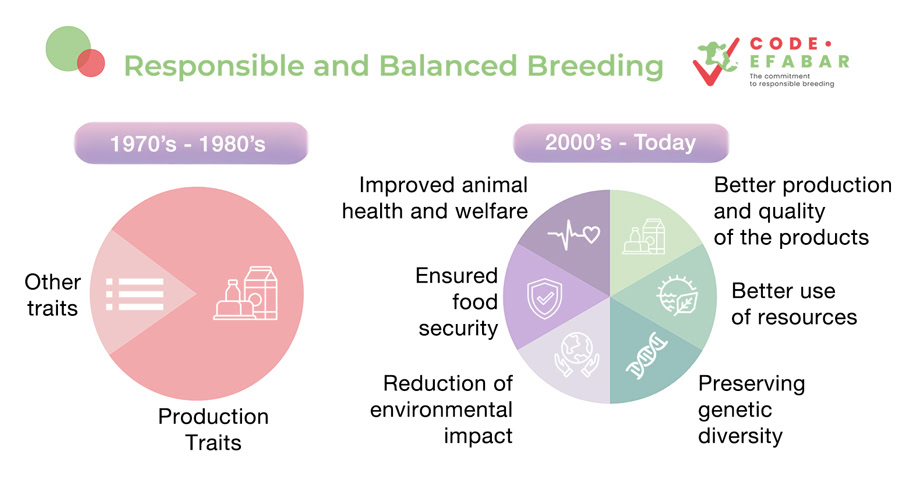 To illustrate this evolution, EFFAB has developed Code EFABAR, which aims to showcase how breeders nowadays implement all these elements in their breeding programmes. The sole objective is to contribute responsibly to improving the sustainability of all animal farming systems.
EFFAB PARTICIPATING IN LIVESTOCK AND AQUACULTURE POLICY DISCUSSIONS
Food production and farmers’ situation have been receiving well-deserved attention from EU policymakers since 2023. The Green Deal cannot work without considering competitiveness and the sector’s resilience. Animal breeding is key to delivering solutions, and the upcoming strategies in the EU for livestock and aquaculture must look at those. EFFAB is proud to be part of the conversation in Brussels, mainly but not only. The contributions of our members —scientists, researchers, and the private sector— are essential to enhancing the sustainability, resilience, and efficiency of animal farming. Their expertise fuels innovation and ensures that animal agriculture evolves in harmony with societal expectations, environmental imperatives, and animal welfare standards.
Having these conversations is not just important—it is essential. The vitality and the social and environmental preservation of rural and coastal areas rely on pre-farm activities, such as animal breeding. The benefits of balanced animal breeding programs are numerous: Healthier animals, reduced environmental footprint, improved productivity, and greater societal acceptance of animal agriculture. EFFAB links the activities of our members to policymakers and stands ready to support the development of a forward-looking animal farming strategy that reflects these values. This is summarised in the EFFAB vision for 2030.
More policy-related topics in which we are involved range from animal health and welfare to technology use and data sharing. This concretely means that we actively raise practical and science-based points from the semen collection sector related to the EU Animal Health Law, to mention one example. For some years now, we have been involved in the legislative process around the animal welfare initiatives for legislation of the European Commission; since the EC requested to EFSA to publish scientific opinions on the welfare of several farm animal species until the final legislative text, in the case of the Animal Welfare during Transport proposal. It’s not about keeping the sector operating under potentially outdated rules; it’s about making sure that policymakers make decisions based on in-depth knowledge of the animal breeding and reproduction sector and what it offers.
This is when our Code EFABAR is more relevant than ever. We recommend that this Code of Good Practices for Responsible and Balanced Breeding should be recognised as the EU standard when drafting new policy initiatives and legislation. This ensures that policymakers and stakeholders are up-to-date on breeding practices, as the code is renewed every 3 years.
Building on what already exists is key to creating a smart policy landscape for breeding organisations and to allow them to make further progress. And further progress can only be achieved by investing in ambitious research and innovation frameworks for pre-farm gate activities, including animal breeding and genetics. We need animal breeding in the EU to maintain its position as a world leader while continuing to create more opportunities for international cooperation in research and regulatory developments. It’s not only about the private sector being competitive, it is also about research institutions continuing to educate and prepare a high-level next generation of breeders and other related scientists.
This year, at the EAAP conference in Innsbruck, we will host a challenge session on Wednesday, August 27, on the future of the European animal breeding sector from the academia and private sector perspectives. You are welcome to join us.
EFFAB is also part of the European Livestock Voice and other platforms, as EPRUMA, which we have highly promoted to enhance communication around the animal farming sector. Meaningful collaborations are also with the Animal Task Force, EATiP, the European focal point on Animal Genetic Resources, and other international organisations, such as the FAO and ICAR. More can be done. And together, through dialogue and innovation, we can shape a more sustainable and responsible future for European animal agriculture and aquaculture.