


Tools such as near-infrared spectroscopy (NIR), real-time nutrient profiling, and digital monitoring systems enable faster and more accurate evaluation of feed quality. By ensuring precise nutrient delivery and early detection of antinutritional factors, rapid feed analysis helps improve growth rates, strengthen immune function, and reduce health risks across livestock species.

Director of Service Commercialization
Evonik Animal Nutrition
Feed quality is never constant, and this variability can negatively affect livestock health and performance. Inconsistent raw materials can disrupt growth, compromise gut integrity and immune function, and increase vulnerability to pathogens, worsening feed conversion ratios (FCR). Poor feed efficiency also raises costs and nitrogen emissions, reducing farm resilience. To overcome the challenges of feed variability, rapid feed analysis has become an essential tool for the livestock industry. It is the foundation of precision nutrition, enabling producers to improve animal health and performance while meeting sustainability goals.
THE IMPORTANCE OF PRECISION NUTRITION
The goal of feed formulation is to meet animal needs without overfeeding. Achieving this balance supports performance, profitability, and environmental responsibility. However, nutritional requirements are not fixed — they vary by species, breed, age, sex, housing conditions, and production objectives. For example, broiler diets may prioritize live weight or breast meat yield depending on market demands. Precision nutrition allows producers to customize diets for these changing conditions, ensuring animals receive exactly what they need for optimal health and growth.
BETTER HEALTH THROUGH BALANCED DIETS
Animals require amino acids in just the right quantities and ratios to each other. Excess protein can feed harmful bacteria in the gut, causing microbiome imbalances and compromising overall gut health. At the same time, it increases the metabolic burden of detoxifying surplus nitrogen, leading to higher water consumption and increased nitrogen emissions.
Low crude protein (LCP) diets, supported by targeted amino acid supplementation, are a proven way to maintain growth performance, reduce nitrogen emissions, and support animal welfare. Lower nitrogen levels in excreta lead to lower ammonia levels, resulting in healthier litter and improved air quality. This translates into practical welfare benefits, from fewer respiratory issues to reduced instances of footpad dermatitis in broilers.
Balanced diets also support the removal of antibiotic growth promoters (AGPs) and help minimize overall antibiotic use, reinforcing animal health through prevention rather than cure. Accurate information about the nutrients in raw materials, combined with precision feeding, is crucial to optimizing this approach.
ANALYTICS: THE FOUNDATION OF PRECISION FEEDING
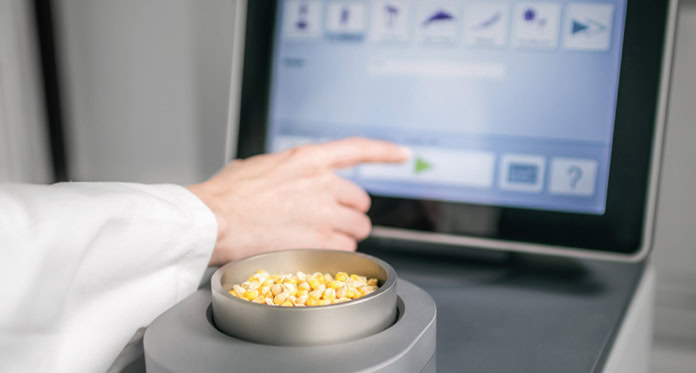
Accurate feed analysis is the first step toward precision nutrition. Modern livestock operations that rely on rapid, reliable nutrient data are better equipped to manage variability in raw materials and ensure that each animal’s diet matches their requirements as closely as possible. Near-infrared spectroscopy (NIR) has emerged as a valuable tool for this, offering rapid analysis of key nutrients across a range of feed ingredients and finished feeds.
Producers can integrate NIR into their operations in several ways. Samples can be scanned onsite using FOSS or Bruker devices, or sent to external labs. The process is simple: scan the feed ingredient with the NIR device, which shines near‑infrared light onto the sample. The sample absorbs and reflects that light in a unique pattern, a spectrum. These spectra are uploaded for analysis, and in return you receive a detailed report within minutes. This speed enables large-scale screening at low cost, supporting more consistent feed ingredient evaluation and tighter quality control.
Services such as Evonik’s AMINONIR translate NIR spectra into nutrient profiles for more than 60 raw materials and finished feeds. This real-time data helps producers to verify ingredients and adjust feed formulations quickly, reducing reliance on costly protein and energy sources without compromising performance.
Modern feed formulation also relies on high‑precision laboratory analysis to characterize raw materials and monitor variability. Wet‑chemistry services – including long‑established providers such as Evonik’s AMINOLab – can measure amino acids, reactive lysine, fibre fractions, starch digestibility, mycotoxins and other key parameters. These data help nutritionists identify and manage imbalances, support low‑crude‑protein strategies and maintain consistency across ingredients and finished feeds. Used alongside rapid NIR screening, they provide a more complete analytical foundation for precision feeding.
QUALITY CONTROL IN ACTION
Soybean products illustrate why analytics matter. Under-processing leaves trypsin inhibitors that reduce digestibility and performance, while over-processing destroys heat-sensitive amino acids and lowers digestibility of amino acids in general. With these effects not always visible, analytical tools are essential for detecting variation and maintaining consistent feed quality.
Tools that assess processing intensity provide a reliable way to evaluate heat treatment and optimize digestibility. For example, indicators such as the Processing Conditions Indicator (PCI) within AMINONIR can help quantify the impact of thermal processing on nutrient availability. Continuous monitoring identifies sources of variation, providing the basis for informed decision-making and action to improve consistency. In many cases, variation can be reduced by more than 50%, supporting better feed efficiency. These improvements contribute to stronger animal health outcomes and underline the role of analytical tools as a foundation for performance and welfare.
A HOLISTIC APPROACH: COMPREHENSIVE DATA, FEEDING PROGRAMS AND ACCURATE DOSING
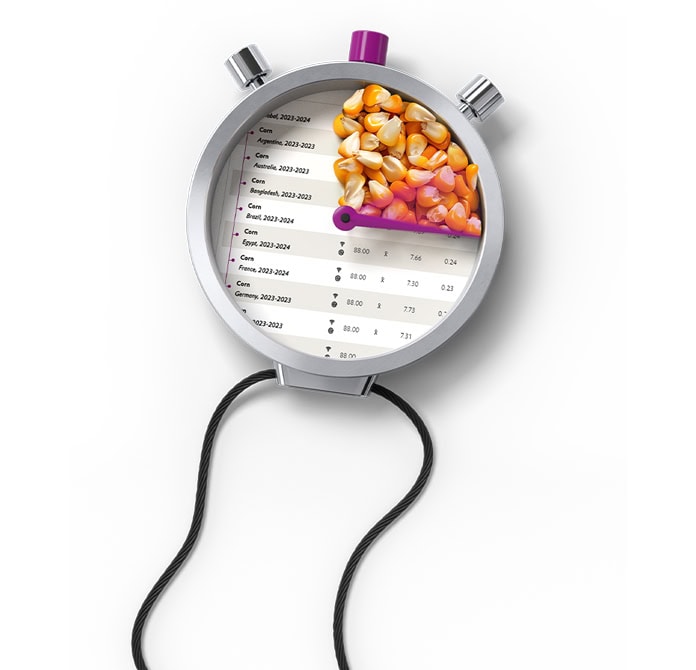
Analytics are most effective when combined with smart planning and integrated services. Modern feeding programs increasingly rely on platforms that translate nutrient data into dynamic feeding programs for poultry, pigs, and aquaculture. These systems allow users to enter key details such as production goals, feed form, and phase lengths, before generating tailored nutritional targets. Many also connect to large ingredient databases, such as AMINODat – containing more than 1.2 million feed ingredient samples from across the world and over 68 million analytical results – providing up-to-date matrix values for formulation.
Precise feed formulation is only part of the story. Accurate dosing during feed production is also needed to achieve precision nutrition. Automated micro-ingredient systems such as AMINOSys help ensure accurate dosing of micro-ingredients, reducing errors and improving consistency across batches. Taken together, these complementary services give producers a more reliable foundation for providing the best feed for their animals.
CONCLUSION: RAPID ANALYSIS AS A FIRST LINE OF DEFENSE
Rapid and reliable analysis is essential for managing the natural variability of feed ingredients. Producers leveraging this technology are able to implement more informed feeding strategies with enhanced precision, supporting more consistent and reliable animal performance. When combined with planning and execution systems, as well as amino acids and additives, these tools create an end-to-end precision feeding ecosystem, contributing to better business outcomes.
About Dr. Markus Wiltafsky-Martin
As Director of Service Commercialization in Evonik’s Animal Nutrition business, Dr. Markus Wiltafsky-Martin received his degree in Agricultural Science from the Technical University of Munich, Germany. He has been with Evonik since 2009 and has more than 16 years of experience in conducting projects with stakeholders of the animal protein business, focusing on the importance of feed ingredient quality for the overall business. In the last 13 years, Wiltafsky-Martin has worked intensively on the quality evaluation of feed ingredients and on the translation of analytical data into valuable information for the feed industry via advanced data evaluation.