


Phytogenics may offer a solution to optimize feed efficiency, support margin in dairy farming, and reduce costs in dairy farming. By focusing on optimal feed intake and thereby enhancing nutrient utilization, dairy farmers can navigate the challenges of feed costs and milk prices while maintaining profitability and sustainability in their operations.

Phytogenic Ruminant Tech Lead
Cargill Animal Nutrition
Dairy farmers face ongoing challenges in maintaining profitability, especially with the constant fluctuations in feed and milk prices. The efficiency of nutrient utilization is crucial for profitability, given that feed costs typically account for 70-80% of the variable costs of milk production. Enhancing feed efficiency in dairy cows has become a key strategy for increasing profitability.
This article delves into the evolving landscape of feed costs, the importance of feed efficiency in dairy cow margins, and the transformative impact of phytogenic feed solutions on dairy farm performance.
EVOLUTION OF RAW MATERIAL PRICE AND MILK PRICE IN DAIRY FARMS
The milk price experienced a significant increase in 2022 and 2023 but started to decrease toward the end of 2023, following the trend of dairy product prices. This decrease, coupled with high feed costs, has created a challenging situation for the dairy industry, often referred to as the “scissors effect.”
For years, dairy farmers have dealt with fluctuations in feed prices and milk prices, impacting their profit margins significantly. These fluctuations highlight the need for strategies that can help stabilize costs and improve efficiency in dairy farming operations.
Phytogenics, offer potential solutions to help farmers and feed mill companies save on feed costs while providing flexibility in feed formulation and diet optimization. By utilizing phytogenic feed solutions, dairy farmers can potentially manage their costs and improve profitability even in challenging market conditions.
EFFECT OF FEED EFFICIENCY FOR THE MARGIN IN DAIRY COWS
Feed efficiency (FE) is a critical factor for profitability in high-yielding dairy cows, alongside reproduction and longevity. FE is typically measured as the kilograms of milk produced per kilogram of dry matter consumed. It reflects the cow’s ability to convert feed nutrients into milk or milk components. FE is not only an indicator of nutrient absorption and metabolism but also impacts the income after feed costs and has implications for environmental impact. Target FE values vary based on the stage of lactation, with different targets for cows at different stages.
Defining FE in lactating animals is more difficult than for growing animals in their linear phase, as dairy cows show stages of rapid catabolism post-calving, followed by anabolism of reserves until their next calving. Feed efficiency of 1.5 to 1.6 is a reasonable target for cows or herds between 150 to 200 days in milk (DIM). For cows being in milk for more than 250 days, a FE below 1.4 should be expected. For animal in the beginning of lactation the target is above 1.6; Yet a very low FE (below 1.2) in early lactation, could indicate health problems such as acidosis or, if the cow is in good health, a very poorly performing animal.
Improving FE can also have positive environmental effects, such as helping support the reduction of methane production and protein losses. Maintaining a high FE is crucial for overall herd productivity.
EFFECT OF PHYTOGENICS IN FEED EFFICIENCY
Research with phytogenics has been shown to support the increase in milk production and improvements in milk quality in field trials, demonstrating its effectiveness in improving feed efficiency. The results in this field trial highlight the potential of phytogenic feed solutions to revolutionize dairy farming by providing solutions that may support farm profitability and environmental sustainability (Graphic 1).

A phytogenic feed solution was tested in a field trial in China, including a local diet. This product has shown to improve milk production and energy corrected milk significantly, together with an improvement of the milk quality (Table 1).
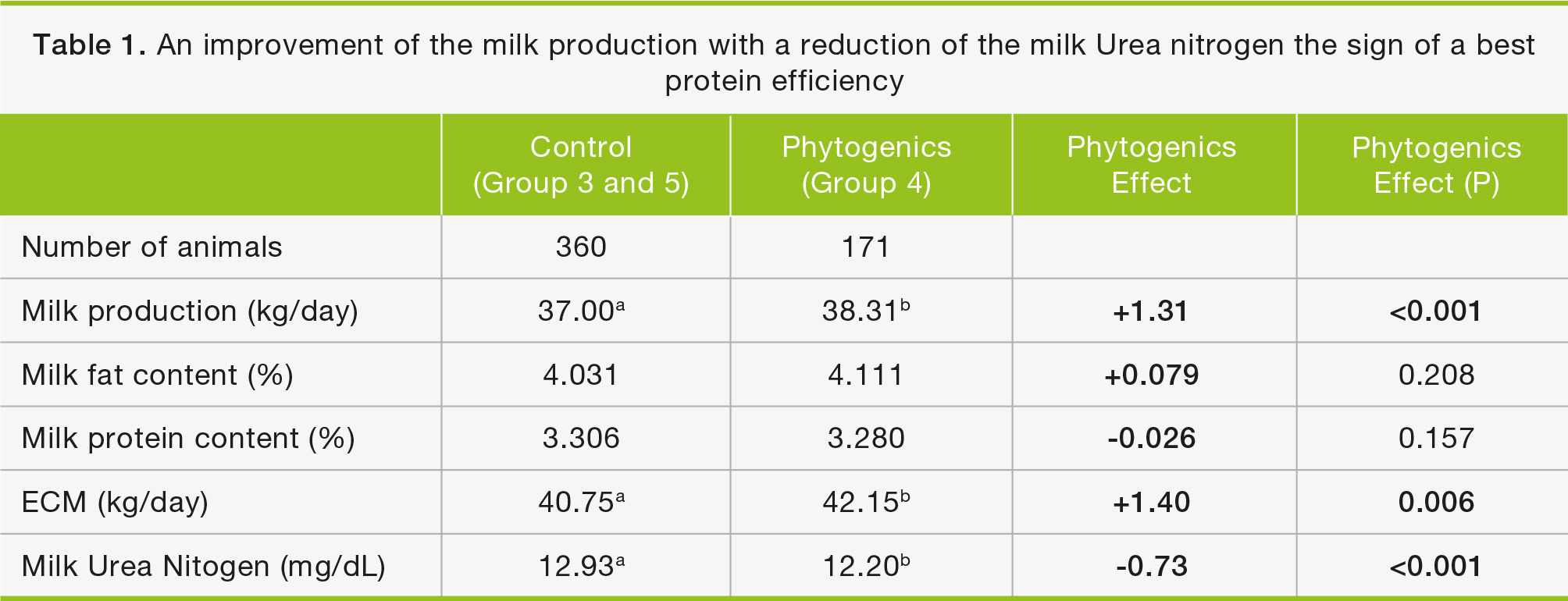 The phytogenic feed solution tested in this trial combine essential oils, spices, and triterpenoid saponins. The increase in milk production observed in this trial was likely due to an improvement in energy efficiency and protein efficiency in dairy cows. It works by stimulating fiber digestibility in the rumen and enhancing starch and fat digestibility in the small intestine.
Plant-based products like phytogenics, have shown promise in supporting optimal feed efficiency and reducing costs in dairy farming. The following effects of phytogenics in ruminants are observed and proven:
• Support of optimal level of rumen undegradable protein hence improving the metabolizable protein level
• Improving the microbial protein synthesis
• Help minimizing NH3 losses
• Improving protein digestibility in the small intestine
CONCLUSION
Phytogenics may offer a solution to optimize feed efficiency, support margin in dairy farming, and reduce costs in dairy farming. By focusing on optimal feed intake and thereby enhancing nutrient utilization, dairy farmers can navigate the challenges of feed costs and milk prices while maintaining profitability and sustainability in their operations. Integrating these solutions into dairy farming practices can lead to a more efficient and profitable industry, benefiting farmers, consumers, and the environment alike.
*This article only provides scientific information and should not be construed as marketing claims or guidance. All technical statements are based on scientific literature; references are available upon request. The products discussed in this article are not available in all countries. Please contact a Cargill representative to learn more about the local availability of products.
About Thierry Aubert
Thierry Aubert is the technical lead in ruminants micronutrition & health solutions at Cargill Animal Nutrition. His areas of expertise include management of research projects or collaboration with the Cargill team, training for the sales team and technical local team, technical sales support for the company’s customers and distributors, and many more. Aubert also manages the support for different channels: Cargill, Provimi, external distributors.