
Smart storage technologies are transforming feed safety from a reactive practice into a proactive quality management approach. With the expansion of global supply chains and increasing climate variability, traditional storage methods are falling short of maintaining feed integrity. Advanced sensors, automation, and data-driven monitoring systems enable the early detection of mycotoxin risks, preservation of nutritional value, and reduction of losses, becoming a strategic tool for both safety and operational efficiency for feed producers.
By Derya Gulsoy Yildiz
Storing feed ingredients and compound feeds is no longer merely a logistical activity; it is a critical control point for ensuring feed safety, preserving nutritional value, and achieving economic sustainability. The expansion of global supply chains, the sourcing of raw materials from diverse climatic regions, and prolonged storage periods are increasingly exposing the inadequacies of traditional storage approaches.
Fluctuations in moisture and temperature, oxidative degradation, nutrient loss, and the formation of mycotoxins are among the primary challenges encountered during storage processes. Particularly in raw materials with high fat content, lipid oxidation can lead to a decrease in the energy value of the feed and a reduction in palatability. Furthermore, vitamins and certain functional components are extremely sensitive to storage conditions.
Traditional storage systems are generally built upon routine manual inspections, fixed aeration schedules, and limited data tracking. This method, which fails to meet modern-day requirements, makes it difficult to detect sudden risk changes in the storage environment in a timely manner. In contrast, storage in the modern feed industry has moved beyond being a static process; it has evolved into a field of continuous surveillance and technology-driven quality management.

Symaga
Storage Must Actively Contribute to Quality Preservation
Evaluating the reasons behind this evolution, Alfonso Garrido, CEO of Symaga, explains why modern storage has become a critical control point in the production chain: “The feed industry is operating in a far more demanding environment than ever before. Raw materials travel longer distances, climate variability is more pronounced, and quality standards are increasingly strict. Under these conditions, storage is no longer a passive phase between production and processing — it is a critical control point that directly impacts feed safety, nutritional value, and profitability.”
“The fundamental challenge is maintaining stability in a living biological product. Variations in temperature and moisture inside a silo can trigger condensation, microbial growth, oxidation of fats, nutrient degradation, and ultimately mycotoxin development. Even minor fluctuations can create localized “hot spots” that compromise an entire batch,” says Garrido, continuing: “Traditional storage approaches were largely reactive: periodic manual checks, limited monitoring points, and corrective actions taken after a problem appeared. Today, this is not sufficient. The industry requires continuous monitoring, predictive capability, and structural solutions that minimize risk from the outset. Storage infrastructure must actively contribute to quality preservation, not simply contain the product.”
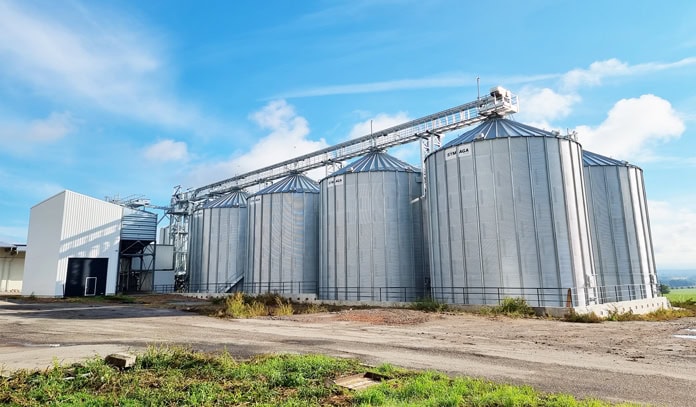
EMERGING TECHNOLOGIES IN STORAGE
At the heart of current feed storage technologies lie sensor-based monitoring systems. These systems measure temperature, relative humidity, oxygen, and carbon dioxide levels within silos and warehouses in real-time, enabling monitoring via digital platforms. These sensors typically operate integrated with IoT (Internet of Things) infrastructure. This allows operators to track storage conditions remotely and receive instant alerts when pre-defined threshold values are exceeded. This approach provides the opportunity for preventive control rather than intervening after problems have already emerged.
Another key component of next-generation storage systems is automated aeration and temperature control solutions. These systems analyze environmental conditions and activate only at optimal times. In doing so, they both reduce the risk of moisture condensation and molding while preventing unnecessary energy consumption. Furthermore, smart silo solutions enable the detection of “hot spots” by digitally mapping different zones within the silo. Working in tandem with digital traceability applications, these systems make it possible to record the storage conditions for every single batch.
Toward Smart, Connected, and Automated Systems
Providing information on the emerging technologies in feed and raw material storage, Garrido shares the following: “The sector is clearly moving toward smart, connected, and automated systems. Among the most relevant technologies are:
• High-precision temperature and humidity sensors distributed throughout the silo.
• IoT-based remote monitoring platforms that provide real-time data access and alerts.
• Automated aeration systems that regulate airflow based on internal conditions rather than fixed schedules.
• Advanced structural engineering to optimize airflow, reduce condensation, and prevent material segregation.
• Digital traceability tools that integrate storage data into ERP and plant management systems.”
Touching upon the approach of Symaga, a globally recognized leading provider of storage solutions, Garrido notes that as a company, they focus on combining robust structural design with digital monitoring capabilities. Garrido shares the following regarding Symaga’s storage solutions: “Our silos are engineered to ensure optimal airtightness, efficient aeration, and structural stability under varying climatic conditions. We also integrate monitoring systems that allow operators to track temperature evolution and respond before risks escalate. We supply grain stoppers and loading systems equipped with deflector plates to prevent grain damage and breakage, as well as solutions that minimize grain segregation and dust formation, thereby reducing explosion risks and the potential development of mycotoxins. The objective is to transform the silo into an intelligent asset — one that supports quality management, operational efficiency, and data-driven decision-making.”
FEED SAFETY AND QUALITY MANAGEMENT WITH SMART STORAGE SYSTEMS
Smart storage systems are shifting the feed safety paradigm from a reactive model to a preventive and predictive one. Thanks to continuous monitoring, conditions that lead to mycotoxin formation—such as moisture spikes and temperature rises—can now be detected early. These systems protect the integrity of nutrients by making the storage environment more stable and significantly reduce quality losses in oxidation-sensitive components like fats, amino acids, and vitamins. Simultaneously, they positively impact physical quality, shelf life, and feed processability. Batch-level traceability stands out as another advantage of these systems. Thanks to digital records, all storage conditions for a specific lot can be analyzed retrospectively. This enables the rapid identification of the source of quality deviations, strengthens internal audit processes, and allows for targeted recalls when necessary. Consequently, smart storage systems are becoming more than just a technology investment for feed producers; they are a strategic quality and risk management tool.
This Strengthens Both Feed Safety and Brand Reputation
“Smart storage systems shift the approach from corrective to preventive. Continuous monitoring enables early detection of temperature increases or moisture imbalances, which are the primary precursors to mold growth and mycotoxin formation,” says Alfonso Garrido. He notes that the advantages provided by smart storage systems are quite clear and lists them as follows:
• Mycotoxin prevention: Early aeration or product movement can prevent fungal development before contamination occurs.
• Nutrient stability: Controlling oxidation and heat build-up protects vitamins, fats, and proteins.
• Shelf-life extension: Stable internal conditions reduce deterioration over time.
• Batch traceability: Digital records of storage conditions provide full documentation for audits and regulatory compliance.
Garrido states, “In practical terms, these technologies reduce uncertainty. They provide measurable control over variables that previously relied solely on operator experience. This strengthens both feed safety and brand reputation.”
SUSTAINABILITY AND COST MANAGEMENT WITH NEXT-GENERATION STORAGE TECHNOLOGIES
In the feed industry, sustainability and cost management are becoming increasingly intertwined. Next-generation storage technologies offer solutions that contribute to both goals simultaneously. Energy-efficient aeration and cooling systems reduce electricity consumption by operating only when necessary. This not only lowers operational costs but also contributes to the reduction of greenhouse gas emissions.
Preventing storage-related degradation and shrinkage ensures that economic losses are minimized, particularly in high-value ingredients. At the same time, reducing losses within the food-feed chain decreases the need for production and transport, thereby helping to lower the carbon footprint. In this regard, modern storage technologies have become a key sustainability component that supports feed producers in achieving their environmental goals.
A Powerful Lever from Economic and Environmental Perspectives
“Efficiency and sustainability are now inseparable. Every ton of raw material lost due to spoilage represents not only a financial cost but also wasted energy, water, land use, and logistics emissions,” says Symaga CEO Garrido, listing the contributions of advanced storage solutions to sustainability and cost management as follows:
• Energy optimization: Automated aeration systems operate only when conditions require it, reducing unnecessary power consumption.
• Loss reduction: Early detection of spoilage prevents large-scale product disposal.
• Lower shrink rates: Improved structural sealing and moisture control minimize quantitative losses.
• Extended infrastructure lifespan: High-quality galvanization and corrosion-resistant materials reduce maintenance and replacement frequency.
Garrido adds: “By preventing waste along the food-feed chain, modern storage systems indirectly reduce the overall carbon footprint of feed production. In this context, technology is both an economic and environmental lever.”
TECHNOLOGIES OF THE FUTURE
In the future, automation and AI-powered systems are expected to become more prominent and widespread within the feed storage sector. AI-based algorithms will analyze historical storage data, environmental conditions, and raw material characteristics, contributing to the prediction of spoilage and mycotoxin risks at even earlier stages. Furthermore, the expansion of fully automated storage facilities—which reduce the risk of error by minimizing human intervention and enhancing operational efficiency— is among the key developments expected in the coming years. It is anticipated that such facilities, operating in tandem with supply chain management systems, will also support procurement, formulation, and logistics decision-making processes. In parallel, the importance of generating standardized and auditable digital data continues to grow in terms of regulatory compliance and sustainability reporting. In light of all these developments, it is evident that storage is evolving into a more strategic and digitized control area within feed safety and quality management.
Storage Facilities – Intelligent Nodes within a Digital Ecosystem
Supporting this transformation in storage, Symaga CEO Garrido outlines several key areas where they foresee evolution in the coming period:
• AI-driven predictive analytics: Systems capable of analyzing historical and real-time data to forecast risk scenarios before they materialize.
• Fully integrated supply chain visibility: Storage data connected to procurement, production planning, and distribution platforms.
• Advanced automation: Minimal human intervention in aeration control, discharge sequencing, and quality alerts.
• Stronger regulatory integration: Automated compliance reporting aligned with evolving food and feed safety standards.
Garrido concludes his statement with these words: “In the near future, storage facilities will operate as intelligent nodes within a digital ecosystem. Artificial intelligence will not replace human expertise, but it will enhance decision-making accuracy and speed. For companies willing to invest in resilient infrastructure and digital integration, storage will no longer be a vulnerability — it will become a strategic advantage.”