


Whilst many feed additives are designed to address the challenges of gut health in livestock, seaweed deserves far greater recognition as a sustainable and natural resource. Belonging to three main groups—green, red and brown—seaweeds are exceptionally rich in both the quantity and diversity of bioactive compounds, making them a unique yet underutilised asset in animal nutrition.

Marine Technology Specialist
Ocean Harvest Technology

Senior Global MarComm & Product Manager
Ocean Harvest Technology
FROM ANTIBIOTICS TO NATURAL STRATEGY
Across global animal production, one of the greatest challenges is finding reliable solutions to maintain animal health and performance without relying on antibiotics or pharmacological levels of zinc oxide. For decades, these tools played a central role in controlling intestinal disease and supporting growth, but their widespread use has contributed to the rise of antimicrobial resistance (AMR) — now recognized as a major global health threat (Magnusson, 2020). With regulators, retailers, and consumers demanding change, producers urgently need effective, natural, and sustainable alternatives.
At the center of this challenge is gut health. The gastrointestinal tract is not only the main site for digestion and nutrient absorption; it is also a critical barrier against pathogens and a key regulator of immune function (Kogut & Arsenault, 2016). When intestinal integrity is compromised or microbial balance disrupted, the consequences are clear: Reduced feed efficiency, higher disease incidence, and costly interventions (Ducatelle et al., 2018).
The industry’s focus is therefore shifting toward a preventive approach: Strengthening animals before problems occur rather than relying on treatments afterward. This has opened the door for functional feed ingredients capable of modulating the microbiota, reinforcing the gut barrier, and enhancing immune resilience. While solutions such as probiotics, organic acids, and plant extracts are widely explored, seaweed is emerging as one of the most promising tools — uniquely combining a natural origin, renewable supply, and a remarkable diversity of bioactive compounds that directly support gut health.
EVIDENCE FROM POULTRY AND SWINE
In poultry, necrotic enteritis (NE) remains one of the most costly intestinal diseases, particularly as the industry reduces antibiotic use. In a controlled NE challenge, birds receiving a seaweed-based blend (OceanFeed™ Poultry) showed markedly better outcomes than the challenge control group. Mortality rates were reduced, lesion scores improved, and birds displayed higher feed intake and body weight gain during the finisher phase. Importantly, compensatory growth was observed post-challenge, demonstrating that seaweed supplementation not only supported resilience during stress but also recovery afterward (Figure 1A, 1B and 1C).
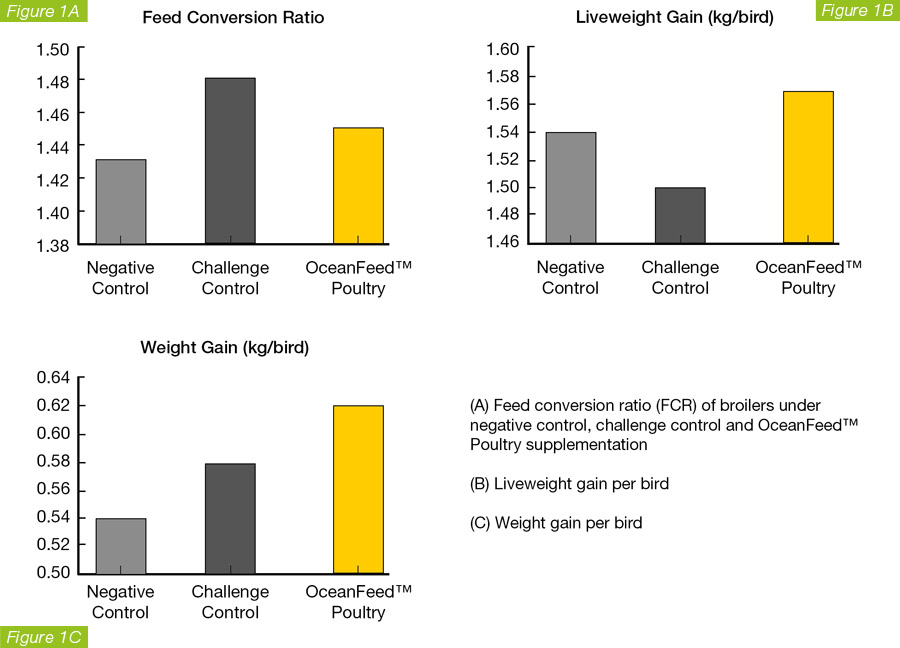 These findings are consistent with previous reports showing that sulphated polysaccharides from seaweeds, such as fucoidan and ulvan, can reduce Clostridium perfringens colonization, enhance gut integrity, and modulate inflammatory responses in broilers (Kulshreshtha et al., 2014; Blue et al., 2024; Li et al., 2025). Together, the trial data and scientific literature highlight the value of seaweed blends as a functional, antibiotic-free strategy to control gut health challenges in poultry production.
In swine, gut health is especially critical during the post-weaning period, when dietary stress and immature immunity often trigger diarrhoea and growth setbacks, as well as in reproductive performance of sows. In a study, supplementation with seaweed-based blends (OceanFeed™ Swine) was shown to increase IgG concentrations in colostrum, supporting stronger passive immunity transfer to piglets, while also improving sow reproductive outcomes by increasing the number of total piglets born and piglets born alive, reducing mortality, and supporting better sow condition (Figure 2A and 2B). These findings are consistent with results reported in previous research, confirming the reliability of these benefits across different settings (Bouwhuis et al., 2017; Ruiz et al., 2018; Corino et al., 2019).
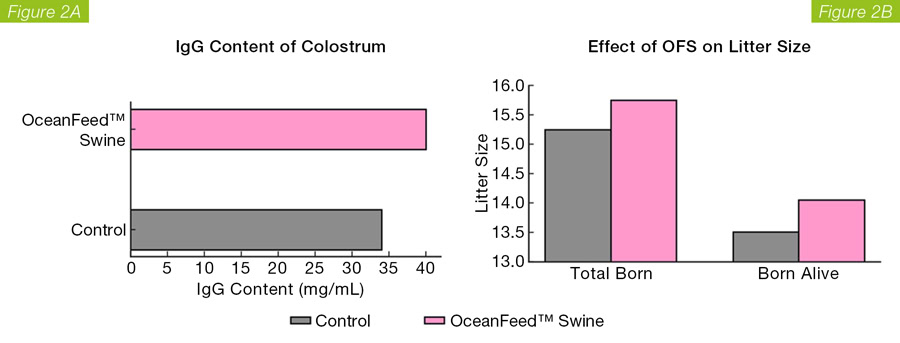
(B) Effect of OceanFeed™ Swine supplementation on litter size (total born and born alive)
SEAWEED AS A NATURAL APPROACH
Whilst many feed additives are designed to address gut health challenges, seaweed deserves far greater recognition as a sustainable and natural resource. Belonging to three main groups—Chlorophyta, Phaeophyta, and Rhodophyta—seaweeds are exceptionally rich in both the quantity and diversity of bioactive compounds, making them a unique yet underutilised asset in animal nutrition. Their value has been recognised for millennia, with evidence of human consumption dating back 10,000 years and use in animals for more than 5,000 years. Despite their global availability along coastlines, their application in modern feed remains limited. According to Food and Agriculture Organization of the United Nations (FAO) estimates, global seaweed production reached around 35.8 million tonnes in 2019, yet only a small fraction is directed toward feed applications (Cai, 2021), highlighting both a challenge and an untapped opportunity for the industry.
Seaweeds provide a remarkable spectrum of bioactive compounds not found in terrestrial plants, including unique polysaccharides such as ulvan and fucoidan with prebiotic, immune-modulating and antimicrobial functions; polyphenols like phlorotannins with strong antioxidant and antimicrobial activity; and carotenoids such as fucoxanthin with antioxidant and anti-inflammatory effects. In addition, seaweeds supply peptides, lectins, minerals, trace elements, and vitamins, positioning them among the most diverse natural reservoirs of functional bioactives available for animal nutrition.
• Green seaweeds (Chlorophyta): Rich in heteropolysaccharides such as glucuronic acid, which aids liver detoxification, and rhamnose, which acts as a prebiotic. Ulva species are especially notable for ulvan—a sulphated polysaccharide with immunomodulatory, antiviral, anti-inflammatory, and antioxidant properties.
• Red seaweeds (Rhodophyta): Contain sulphated galactans that promote beneficial gut bacteria, strengthen the intestinal barrier, and deliver anti-inflammatory, antioxidant, and antimicrobial effects, while also offering higher crude protein content.
• Brown seaweeds (Phaeophyta): Provide polyphenols, fucoidans, vitamins, and minerals that support gut health. Fucoidans and other polysaccharides are popular as extracts as a means of sidestepping high heavy metals content and characteristics that can hinder digestibility.
Polysaccharides remain the most studied compounds in seaweed, yet extracting them adds cost, complexity, and environmental impact, while also reducing the “100% natural” character of the raw material since chemical processing is often required. More importantly, the value of seaweed extends far beyond individual extracts, as its diverse compounds act synergistically to support gut health. To fully capture this potential, Ocean Harvest Technology has spent over a decade refining proprietary blends that combine species from all three major groups, delivering the complementary benefits of green, red, and brown macroalgae in a consistent and natural form. By using whole seaweed rather than isolated components, these blends provide a broader spectrum of functional properties and have been shown to beneficially modulate the gut microbiota, reinforcing their role as a natural tool for supporting animal performance and resilience.
OVERCOMING BARRIERS TO WIDER USE OF SEAWEED
One of the main factors that has limited the wider use of seaweed in feed is consistency. As with any natural raw material, composition can vary depending on species, origin, and season. Ocean Harvest Technology (OHT) addresses this challenge by sourcing from multiple regions and combining batches of different seaweed types. This “portfolio effect” reduces variability, ensures a reliable nutritional profile, and helps customers achieve consistent results, while also mitigating risks linked to weather, shipping, and raw material availability.
Another key challenge is scale. Although global seaweed resources are abundant, much of the biomass remains untapped and the supply chain is still developing. OHT works in close partnership with suppliers and customers to expand both supply and demand simultaneously, creating scalable and sustainable systems that can meet the needs of modern livestock production. By building these networks, OHT is helping to unlock the full potential of this marine resource for animal nutrition.
CONCLUSION
Gut health is a critical priority for modern animal protein production, and seaweed—with its remarkable diversity of bioactive compounds—offers a natural and sustainable way to support it. While scientific literature is rich in evidence of these benefits, adoption in animal nutrition has been relatively slow. OceanFeed™ addresses this gap by using whole seaweeds from multiple groups, ensuring a consistent, 100% natural product that captures the full spectrum of functional compounds, delivering clear benefits for both animals and producers. At the same time, by harvesting invasive species, OceanFeed™ contributes to healthier marine ecosystems, supports the livelihoods of coastal communities, and achieves a negative carbon footprint across its full life cycle, making it a truly climate-positive innovation.
By embracing blended seaweed solutions such as OceanFeed™, producers can capture the full benefits of this unique marine resource: Healthier animals supported by improved gut function, more efficient production through better feed conversion, and stronger environmental performance thanks to reduced resource use and a lower carbon footprint. At the same time, harvesting invasive species helps restore marine ecosystems and supports the livelihoods of coastal communities worldwide. In this way, OceanFeed™ delivers value across the entire chain — for animals, for producers, for consumers, and ultimately for the planet.
References are available upon request.
About Declan Hanniffy
With a BSc (Hons) in Applied Aquatic Ecology from Galway Mayo Institute of Technology, Declan Hanniffy joined OHT after working in the Irish Seaweed Centre in the University of Galway for 5 years. Hanniffy has significant expertise and experience in the areas of hatchery production and near-shore farming of cultivated seaweed. His role involves working with our suppliers to ensure the quality and safety of the incoming seaweed raw materials. He also ensures the high quality OceanFeed™ products comply with the relevant animal feed regulations and that our customers’ individual requirements are met.About Rafaela Kava
A veterinarian with a Master’s in Genetics and Animal breeding, Rafaela Kava has over 10 years of experience across marketing, product development, customer relations, hands-on animal care and scientific research in the animal health and nutrition sector. Passionate about innovation and communication, she has lived in several countries, combining technical expertise with a global perspective to create impactful and sustainable solution.