

Hatchability rates in broiler chickens could fall to 60% by 2050, but safeguarding sperm storage tubules may help reverse the trend, researchers say.
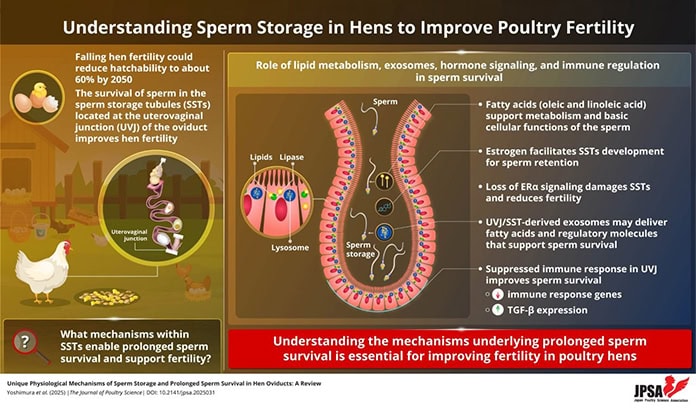 A new review in the Journal of Poultry Science (Vol. 62, October 23, 2025) highlights how hens store sperm in specialized sperm storage tubules (SSTs) at the uterovaginal junction of the oviduct, sustaining fertility for weeks. The study, led by Professor Emeritus Yukinori Yoshimura of Hiroshima University, outlines how fatty acids, exosome signaling, hormones, and immune tolerance contribute to sperm survival. “Because the duration of sperm survival in the oviduct is closely associated with fertility, understanding these mechanisms is essential to improve fertility and reproductive performance,” says Prof. Yoshimura.
MECHANISMS OF SPERM SURVIVAL
Sperm stored in SSTs are gradually released to fertilize ova at the infundibulum. Evidence shows SST cells supply fatty acids such as oleic and linoleic acid, improving sperm viability. Enzyme activity, including adipose triglyceride lipase, appears to break down lipids to release supportive fatty acids into the tubule lumen.
Exosomes—tiny extracellular vesicles—may also deliver materials directly to sperm. Lipid-containing blebs observed fusing with sperm membranes, along with exosome markers detected inside SSTs, support this mechanism.
Hormonal regulation is another factor. Estrogen and progesterone receptors within SST cells help maintain their structure and function. Frequent artificial insemination has been linked to reduced estrogen receptor expression in the uterovaginal junction, potentially weakening SSTs and shortening sperm survival.
IMMUNE TOLERANCE AND FERTILITY
The review emphasizes the importance of immune balance. While sperm must be protected from pathogens, they also need to evade the hen’s immune system. After mating, immune response genes are downregulated, and molecules such as TGF-β increase, creating a tolerant environment that allows sperm to remain in storage.
IMPLICATIONS FOR POULTRY MANAGEMENT
Disruption of SST function—through structural damage, altered hormone signaling, or immune imbalance—may shorten sperm lifespan and reduce hatchability. “These findings suggest that repeated insemination should be optimized to prevent immunological damage and abnormalities in SST function in association with estrogen receptor reduction, so that sperm may be retained in the SST, resulting in better fertility,” Prof. Yoshimura notes.
By refining insemination practices and protecting SST integrity, the poultry industry may be able to counter fertility decline and sustain reproductive performance to meet global food demands.