


The use of microencapsulated multi-strain probiotic premixes is emerging as an effective strategy to improve feed utilization across different animal production systems. By delivering targeted combinations of beneficial microorganisms under simulated gastrointestinal conditions, the effects of probiotic supplementation on the degradation of forage- and grain-based substrates and their fermentation dynamics can be evaluated. While responses may vary depending on species’ diet and gastrointestinal conditions, probiotic premixes show potential to improve substrate degradation, nutrient availability, and energy efficiency, particularly through favorable shifts in fermentation patterns. These findings highlight the growing role of probiotic-based feed additives as functional tools to support more efficient and sustainable animal nutrition.

Fermentation Coordinator
Bialtec
Improving feed efficiency and gut functionality remains a key objective in modern animal nutrition. Probiotic-based feed additives have gained increasing attention due to their ability to modulate gastrointestinal microbiota, enhance nutrient utilization, and support animal performance. Among these, multi-strain probiotic premixes are used across different species, showing efficacy that may vary depending on diet type, inclusion level, and animal physiology. Microencapsulated multi-strain probiotics can have a functional advantage as their use ensures the correct delivery of probiotics inside the gastrointestinal tract.
This article presents the consolidated results of several in vitro evaluations of a commercial microencapsulated probiotic premix (FF), focusing on its effects on dry matter degradability and fermentation characteristics under simulated gastrointestinal conditions representative of pigs, ruminants, and poultry.
IN VITRO STUDIES
In vitro gastrointestinal simulation systems are widely used to reproduce key physicochemical and microbial processes occurring along the digestive tract of animals under controlled conditions. These models allow the evaluation of feed ingredients and additives by mimicking species-specific gastrointestinal environments while minimizing animal-to-animal variability. The data presented in this study correspond to a compiled analysis of multiple in vitro experiments in which gastrointestinal conditions of different animal species were simulated. The systems were inoculated with fecal material or ruminal fluid obtained from the corresponding species to establish representative microbial communities. Species-specific physicochemical conditions were applied, including appropriate buffering systems, temperature, retention time, and feeding schedules. The simulators were periodically supplied with the substrates of interest (forage- or grain-based), and experiments were run for periods ranging from 14 to 20 days. Samples were collected at regular intervals to assess substrate dry matter (DM) degradation, pH, and short-chain fatty acid (SCFA) concentrations. In general, system stabilization was observed after approximately one week of operation; therefore, comparative analyses were performed using data collected from day 7 onward.
- The composition of the microencapsulated FF premix is defined according to the target species. The formulation used for ruminant systems contained Bacillus subtilis and Saccharomyces cerevisiae. For broilers, FF included Bacillus subtilis, Saccharomyces cerevisiae, Saccharomyces boulardii, Enterococcus faecium, and Lactobacillus spp. (L. casei and L. acidophilus). The FF formulation applied to pig fattening systems consisted of Bacillus subtilis, Saccharomyces cerevisiae, and Enterococcus faecium.
EFFECTS OF FF USE ON THE DEGRADATION OF FORAGE SUBSTRATES
Three different experimental runs were performed in in vitro simulators of the ruminal environment to assess the effect of adding FF on the fermentation of forage substrates. A total of 76 data points (51 of simulators with FF and 25 without) were compared.
Statistical analysis showed that FF supplementation improved DM degradation by an average of 3.44 %.
This value was statistically significant (p-value of 0.0023) with a 95 % confidence interval on the percentage of improvement of [1.29 ; 5.59] %.
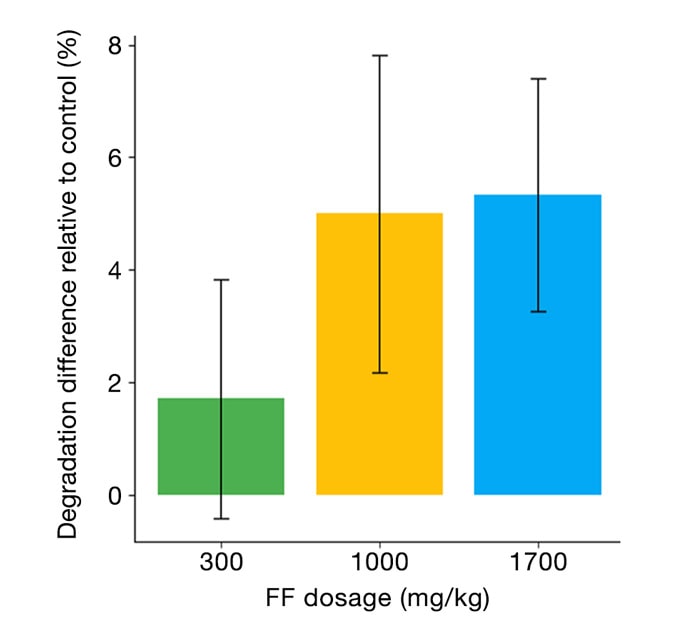
The data also showed that the improvement can be dosage dependent. Figure 1 shows the DM degradation difference (relative to the control with no FF) for different dosages of FF. It can be seen that a small dosage (such as 300 mg/kg of feed) can lead to an improvement close to 2 % (although this difference shows no statistical significance), but larger dosages, close to 1000 and 1700 mg of FF per kg of feed, can reach a DM degradation improvement of about 5 % (that is statistically significant compared to not adding FF).
Evaluating other variables, FF supplementation resulted in a significantly lower pH (6.41) compared to the non-supplemented control (6.68), while no significant differences were observed in individual short-chain fatty acids concentrations or in the acetate-to-propionate ratio. This indicates that FF enhanced dry matter degradation without markedly altering the overall fermentation profile. Similar responses to those observed in these in vitro simulation studies have been reported for different probiotic-based strategies, where improvements in fiber degradation or digestibility of forage diets, ranging from 2.2 to up to 8 %, occurred without major shifts in fermentation end products (Wu et al., 2025; Eyre et al., 2025; McCann et al., 2017). In general, the results highlight the potential of microbial additives to improve the utilization of fibrous feeds through increased microbial efficiency rather than through drastic changes in fermentation pathways.
EFFECTS OF FF USE ON GRAIN-BASED SUBSTRATES DEGRADATION
Four different experimental runs were performed in in vitro simulators of the gastrointestinal system of several species (broilers, pigs, and ruminants) to assess the effect of adding FF on the fermentation of grain-based substrates. A total of 50 data points (32 of simulators with FF and 18 without) were compared.
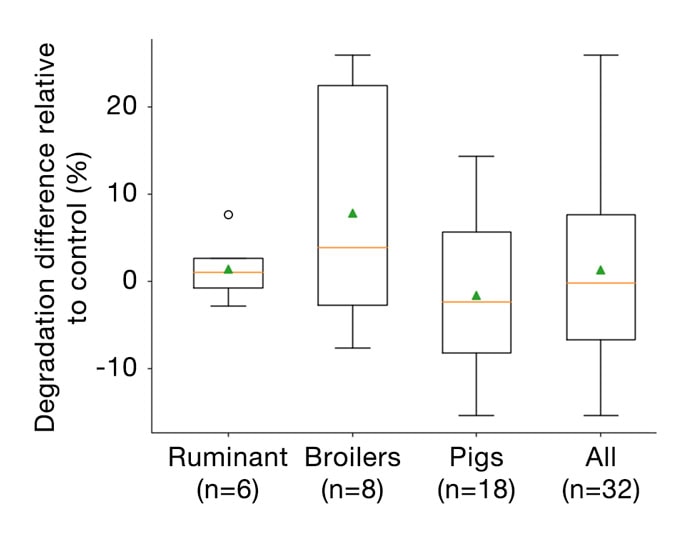
In contrast to forage substrates, FF supplementation did not result in statistically significant differences in grain dry matter degradation after system stabilization (days > 6). When data from stabilized systems were considered, the mean degradation difference was 1.34 % for FF-supplemented treatments (n = 32) compared with the non-supplemented control (n = 18). However, this difference was not statistically significant (p = 0.42), indicating that the effect of FF on grain substrates was limited and more variable than that observed for forage-based substrates.
When species-specific responses were examined, clear differences emerged that help explain the variability observed in the pooled analysis (Figure 2). The simulations for ruminants showed a relatively narrow distribution of degradation differences, with values clustered close to zero, indicating a limited and consistent response of grain degradation to FF supplementation. Simulations for broilers displayed the highest median and mean degradation differences, together with a broad upper range, suggesting a stronger but more heterogeneous response to FF in grain-based substrates, but with a clear trend to improve DM degradation. In contrast, the simulations for pigs exhibited a wide dispersion of values, including both positive and negative responses, highlighting a highly variable and inconsistent effect. Overall, these species-specific patterns confirm that the response to FF supplementation in grain substrates is strongly dependent on animal species’ diets, and gastrointestinal conditions.
In grain-based substrates, FF supplementation did not significantly affect pH, or the individual SCFA concentrations. Nevertheless, there was a trend towards lower values of the acetate-to-propionate ratio.
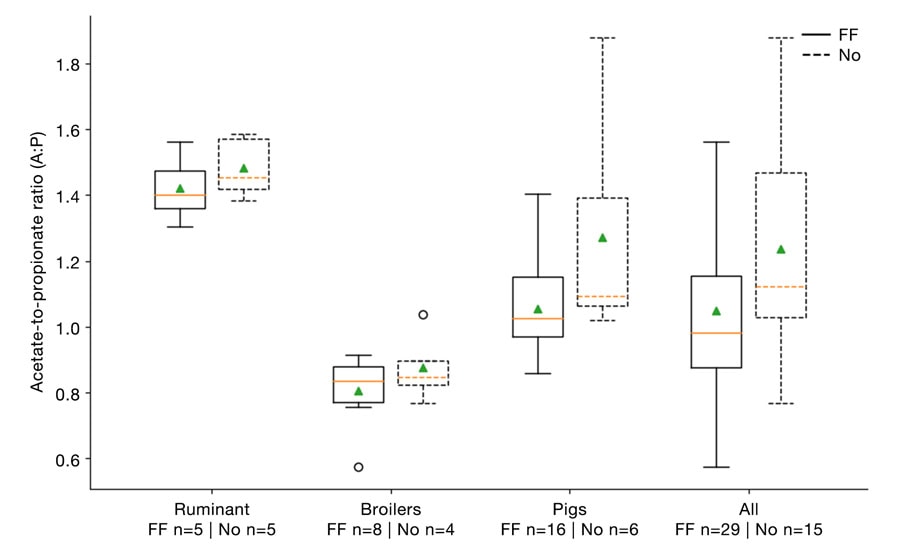
Figure 3 illustrates the box-and-whisker plot of the acetate-to-propionate (A:P) ratio found in different species when FF is supplemented (FF group) and not supplemented (No group). FF supplementation was associated with a lower average A:P ratio across species compared with the non-supplemented control. When data from stabilized systems (days > 6) were considered, mean A:P values consistently shifted downward in the FF group, both within individual species and in the pooled dataset, indicating a relative increase in propionate production at the expense of acetate. This shift in fermentation balance is generally associated with improved energetic efficiency, as propionate represents a more glucogenic short chain fatty acid, particularly relevant for monogastric species and high-energy diets. The observed reduction in the A:P ratio suggests that FF modulates microbial metabolic pathways toward a more efficient use of fermentable substrates, without inducing major disruptions in the overall fermentation profile.
Considering the data from all species, FF supplementation resulted in a lower average acetate-to-propionate ratio compared with the non-supplemented control (1.05 vs. 1.24), showing a consistent numerical reduction that approached statistical significance (p = 0.062). A similar shift toward a lower acetate-to-propionate ratio has been reported in vivo following probiotic supplementation (Mavrommatis et al., 2025).
CONCLUSION
Under simulated gastrointestinal conditions, the microencapsulated probiotic premix FF enhanced dry matter degradation of forage substrates and showed potential to increase the degradability of grain-based substrates, although additional evidence is required to confirm this effect in the latter case. In addition, FF supplementation was associated with a shift in grain fermentation toward a lower acetate-to-propionate ratio, suggesting improved energetic efficiency. Overall, these findings support the potential use of probiotic premixes as functional feed additives. Further in vivo studies can be conducted to confirm these effects under commercial production conditions.
References
• Eyre, K. E., Pan, L., Harper, K., & Prada e Silva, L. F. (2025). The effect of a Bacillus-based probiotic on feed intake and digestibility of a forage and a feedlot diet in Bos indicus steers. Veterinary and Animal Science, 29, 100463. https://doi.org/10.1016/j.vas.2025.100463
• Mavrommatis, A., Severgnini, M., Cremonesi, P., Kyriakaki, P., Christodoulou, C., Petropoulos, K., Dunière, L., Kotsampasi, B., Castiglioni, B., Balaskas, C., Chevaux, E., & Tsiplakou, E. (2025). The impact of probiotic live yeast in a barley grain-based diet on rumen microbial communities, fermentation, and histology of artificially reared lambs. Animal Feed Science and Technology, 322, 116269. https://doi.org/10.1016/j.anifeedsci.2025.116269
• McCann, J. C., Elolimy, A. A., & Loor, J. J. (2017). Rumen Microbiome, Probiotics, and Fermentation Additives. Veterinary Clinics of North America: Food Animal Practice, 33(3), 539–553. https://doi.org/10.1016/j.cvfa.2017.06.009
• Wu, X., Zhang, Y., Li, H., Chen, Q., & Liu, J. (2025). Effects of Lactobacillus plantarum and Saccharomyces cerevisiae on rumen fermentation parameters, microbial diversity and metabolites of fermented feed in vitro. Animal Feed Science and Technology, 325, 116366. https://doi.org/10.1016/j.anifeedsci.2025.116366
About Juan Esteban Vásquez
Biological engineer Juan Esteban Vásquez holds a Msc and PhD in Biotechnology. Fermentation Coordinator at Bialtec, Vásquez is a researcher with experience in gastrointestinal simulation models applied on animal nutrition, feed evaluation, and the assessment of functional feed additives. His work focuses on understanding fermentation dynamics, nutrient degradability, and the potential of probiotic-based solutions to support feed efficiency and gut health across different animal species.