


Dual microencapsulation represents a significant advancement in feed additive design, providing precision, consistency, and multifunctionality through the controlled, sequential release of bioactive compounds. By protecting sensitive molecules during feed processing and gastric passage, the technology ensures their targeted availability in specific regions of the gastrointestinal tract, where they can modulate microbiota, support digestive function, and enhance immune resilience.

R&D Director
Nuqo Feed Additives
The transition from traditional, high-dose feed additives toward precision-based nutritional strategies reflects a broader shift in animal production systems. Dual microencapsulation represents an advanced technology designed to provide controlled and site-specific release of bioactive compounds within the gastrointestinal tract. By safeguarding sensitive molecules and ensuring their targeted availability, this approach supports intestinal health, enhances feed efficiency, and contributes to more sustainable strategies for early-life nutrition in pigs.
MODERN CHALLENGES IN GUT HEALTH MANAGEMENT
Contemporary pig production is undergoing a transformation, shaped by stricter regulations, heightened consumer expectations, and sustainability imperatives. Among the most pressing concerns is the management of gut health and performance in piglets during weaning, without relying on pharmacological interventions such as antibiotics or high doses of zinc oxide.
Weaning remains one of the most critical and stressful phases in a piglet’s life. Piglets face abrupt separation from the sow, dietary transition to solid feed, environmental changes, and shifts in microbial exposure. These stressors compromise intestinal integrity, destabilize microbial populations, and strain immune responses. As a result, weaning is frequently associated with reduced feed intake, impaired nutrient absorption, intestinal inflammation, microbial imbalance, and increased susceptibility to enteric disorders such as post-weaning diarrhea (PWD).
Historically, pharmacological doses of zinc oxide and antibiotic growth promoters provided effective protection against pathogens such as enterotoxigenic Escherichia coli (ETEC). However, the ban on zinc oxide in Europe and the global effort to reduce antibiotic use in livestock have driven the need for novel approaches that maintain piglet health and productivity while minimizing ecological and food safety concerns.
A wide range of alternatives – organic acids, probiotics, phytogenics, postbiotics, and enzyme preparations – have been explored. While many of these exhibit partial benefits, their limitations often stem from inconsistent delivery, poor stability, or uncontrolled release within the digestive tract. This has highlighted the need for advanced delivery systems capable of maximizing efficacy while remaining adaptable to commercial conditions.
DUAL MICROENCAPSULATION: PRINCIPLES AND ADVANTAGES
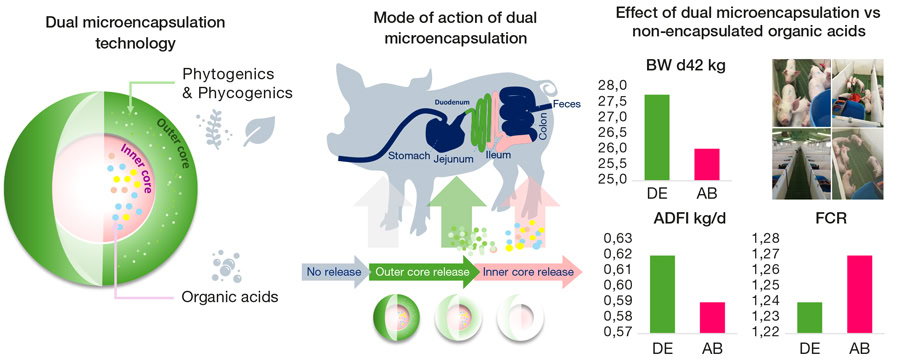
Dual microencapsulation is an emerging feed additive technology designed to overcome these limitations. Unlike unprotected or single-coated active compounds, dual-layered encapsulation provides a two-phase release mechanism that aligns with the physiological conditions of the gastrointestinal tract.
The outer layer, typically composed of functional phytogenic and phycogenic metabolites, can exert antimicrobial, antioxidant, and anti-inflammatory effects in the proximal small intestine, thereby stimulating digestive function and protecting mucosal tissues. A subsequent inner layer, containing organic acids or other antimicrobial molecules, is released later in the intestinal tract where pathogenic challenges are more prevalent.
This sequential release confers several advantages:
• Protection of sensitive compounds from degradation in the upper digestive tract.
• Targeted delivery of actives where their effects are most beneficial.
• Reduced variability compared to conventional products that rely on high inclusion levels or unprotected ingredients.
• Lower required dosages, minimizing costs and environmental impact while maintaining efficacy.
Such systems provide both local benefits, such as microbiota modulation and epithelial barrier support, and systemic outcomes, including improved nutrient utilization and immune function.
 EVIDENCE FROM FARM TRIALS
Field evaluations have provided valuable insights into the practical benefits of dual microencapsulation. In a trial conducted on a commercial pig farm in Spain during 2024, the performance of piglets receiving a diet supplemented with a dual-encapsulated formulation was compared against a diet supplemented with high doses of a non-encapsulated acid blend. The study involved two groups of piglets over a 42-day post-weaning period:
1. A control group fed a standard diet supplemented with 8 kg/t of an acid blend from days 1–14 and 4 kg/t from days 15–42.
2. A treatment group receiving the same basal diet with 800 g/t of a dual-encapsulated formulation while still receiving 2 kg/t of the acid blend from days 1–14, and 1 kg/t from days 15–42.
Performance indicators included average daily gain (ADG), feed intake, feed conversion ratio (FCR), fecal consistency, and veterinary interventions. Fecal samples were analyzed at the end of the trial to assess microbial composition. Results showed that piglets receiving the dual-encapsulated formulation exhibited:
• +8% increase in ADG compared to the control.
• +5.5% increase in feed intake, resulting in a 2.5% improvement in FCR.
• Improved fecal consistency, with fewer cases of diarrhea and reduced need for electrolyte treatments.
• Favorable shifts in gut microbiota, including lower E. coli counts and higher abundances of beneficial bacteria such as Lachnospiraceae (butyrate producers) and lactic acid bacteria.
An economic assessment further highlighted a return on investment exceeding 8:1, driven by improved growth, reduced veterinary costs, and enhanced feed efficiency.
IMPLICATIONS FOR PIG PRODUCTION
These findings underscore the potential of dual microencapsulation technologies to serve as reliable and sustainable alternatives to pharmacological additives. By combining site-specific delivery with multi-targeted functionality, they address the complex biological challenges of the weaning phase more comprehensively than single-mode solutions. From a practical perspective, dual encapsulation supports:
• More uniform piglet performance,
• Enhanced resilience to microbial challenges,
• Reduced dependence on high-dose additives,
• Improved economic sustainability of production.
As global pig production continues to evolve, technologies that integrate precision delivery with proven biological efficacy are likely to play a central role in shaping the future of swine nutrition.
CONCLUSION
Dual microencapsulation represents a significant advancement in feed additive design, providing precision, consistency, and multifunctionality through the controlled, sequential release of bioactive compounds. By protecting sensitive molecules during feed processing and gastric passage, the technology ensures their targeted availability in specific regions of the gastrointestinal tract, where they can modulate microbiota, support digestive function, and enhance immune resilience. This stepwise delivery allows diverse functional compounds – such as antimicrobials, antioxidants, and immunomodulators – to act synergistically at appropriate intestinal sites, improving nutrient utilization, gut health, and growth performance while reducing the need for high-dose additives or pharmacological interventions. The approach also minimizes variability in outcomes, enables lower inclusion levels, and aligns with sustainable production goals by supporting animal welfare and reducing reliance on antibiotics or zinc oxide. Ongoing field applications and research demonstrate that dual microencapsulation provides a science-based, practical solution for optimizing post-weaning piglet nutrition, integrating performance, health, and sustainability in modern swine production.
About Dr. Stephanie Ladirat
Currently working as Nuqo’s R&D Director, Dr. Stephanie Ladirat obtained her MSc degree in Food Technology with a specialization in Food Ingredient and Functionality and her PhD degree in Food Chemistry from Wageningen University (The Netherlands). During her PhD thesis, she studied in depth the human gut microbiota composition and its modulation upon prebiotic supplementation and/or antibiotic treatments. From 2014 till 2020, she worked at Cargill Animal Nutrition, first as technology lead for gut health additives and, then, as swine portfolio manager. She provided global technical product support for a broad range of products (phytogenics, organic acids, short and medium chain fatty acids, probiotics) and trained technical and sales teams. She most recently managed R&D projects and developed innovative feed additive solutions to answer specific customer needs related to animal gut health and performance.