

The fundamental challenge in advanced feed additive manufacturing is the technical imperative to ensure that fragile active ingredients, whether they are volatile essential oils, delicate seaweed extracts, or synergistic blends of organic acids and phytogenics, remain stable and bioavailable throughout the entire feed production and consumption chain. Without adequate and specifically engineered protection, these valuable compounds are highly susceptible to degradation, which can lead to a significant loss of efficacy and a diminished return on investment for producers.

R&D Director
Nuqo Feed Additives
In the complex and technically demanding field of modern animal nutrition, the efficacy of a feed additive is not an inherent property but a meticulously engineered outcome. Its true value is achieved only when its active compounds successfully complete a challenging journey from the manufacturing plant to their precise point of action within an animal’s digestive system. This journey is fraught with significant technical obstacles, including exposure to the high temperatures and pressures of industrial feed processing, prolonged storage, and the aggressive, low-pH environment of the gastrointestinal tract. To achieve consistent results, a delicate and precise balance must be struck: the active ingredients require sufficient protection to survive these challenges, yet must be designed for a controlled release exactly where and when they are needed for maximum biological impact. This is the core problem that a leader in plant-based and encapsulated feed solutions has set out to solve. Through a sophisticated and multi-faceted manufacturing platform, the company is establishing a new technical benchmark for the industry.
FROM MOLECULE TO GUT: ENGINEERING SURVIVAL AND RELEASE
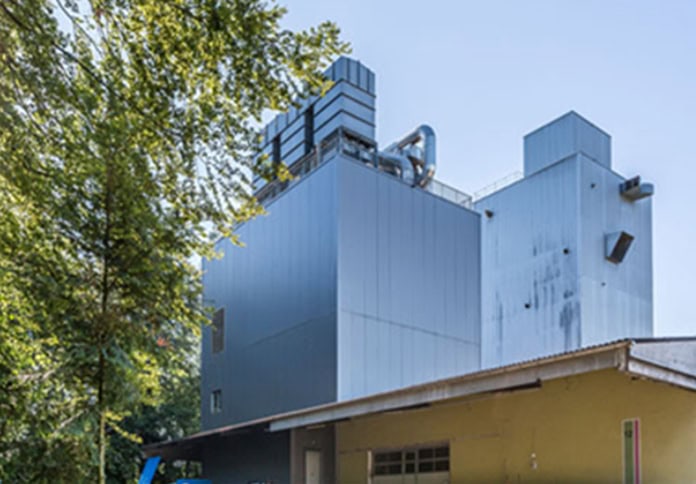
The fundamental challenge in manufacturing advanced feed additives is the technical imperative to ensure that fragile active ingredients, whether they are volatile essential oils, delicate seaweed extracts, or synergistic blends of organic acids and phytogenics, remain stable and bioavailable throughout the entire feed production and consumption chain. Without adequate and specifically engineered protection, these valuable compounds are highly susceptible to degradation, which can lead to a significant loss of efficacy and a diminished return on investment for producers. Conversely, generic or overly protective technologies can trap the active molecules, preventing them from being released in the specific gut regions where they are designed to perform their function. This intricate technical requirement necessitates a specialized and highly adaptable manufacturing approach that goes far beyond standard blending. Nuqo’s extensive and specialized expertise in encapsulation is centrally developed and leveraged at its advanced Swiss facility, where the focus is on mastering micro-encapsulation and granulation techniques to deliver highly stable, high-performance products. The facility is equipped with state-of-the-art pilot lines and industrial-scale spray chilling and spouted bed granulators, enabling a continuous cycle of innovation and refinement. This technical capability allows for the tailoring of production processes to the unique characteristics of each active ingredient and its intended application.
A NEW TECHNICAL STANDARD FOR FEED ADDITIVES
The commitment to solving these intricate technical challenges is formalized and encapsulated in the proprietary XPR standard, which stands for eXtra Protection & Release. This technical benchmark is not a single technology but a comprehensive and systematic development philosophy that guides the design, testing, and manufacturing of every product in the portfolio. The XPR standard is built upon three core technical pillars that work in synergy. The first pillar is the provision of high protection for high stability, which involves employing a toolbox of tailored methods such as spray chilling, fat coating, and advanced double encapsulation to effectively shield delicate active ingredients from the destructive forces of industrial processes. The second pillar is guaranteeing a specific release of actives in the animal, a feat achieved by deploying advanced technologies like micro-encapsulation and multi-layer coating. These techniques allow the targeted deployment of active compounds to the precise site of action, whether it is the olfactory receptors for enhancing palatability or specific segments of the gut for optimal bioavailability. Finally, the third pillar dictates that all solutions must be all-in-one, safe, and easy to use for the end-user. This is accomplished by engineering particles to be completely dust-free, free-flowing, and easily blended, thereby ensuring homogeneity within the final feed and enhancing safety for feed mill operators.
SCIENCE IN PRACTICE: TAILORED TECHNOLOGIES FOR SPECIFIC OBJECTIVES
The manufacturing expertise is most clearly demonstrated through a diverse range of flagship products, each of which has been meticulously designed with a specific application in mind. The innovative technologies enable the creation of highly targeted and effective solutions that address various animal health and performance needs across different species and production stages.
In the crucial domain of palatability and flavor, solutions utilize advanced technologies to significantly enhance feed intake. One such solution employs a sophisticated micro-pearl absorption technology to combine and protect volatile flavoring compounds within a retention-enhancing layer. This ensures the uniform dispersion and long-term stability of delicate aromatic molecules, providing a sustained immediate olfactory impact that is essential for stimulating feed consumption in sensitive or young animals. Another solution elevates this concept further by using micro-agglomeration to combine sweeteners and phytogenics into a single, cohesive particle, which features an inner core of bioactive compounds and an external layer of sweeteners. This dual-action approach not only effectively improves taste perception but also provides synergistic support for gut health, making it particularly effective in young animals during critical growth phases.
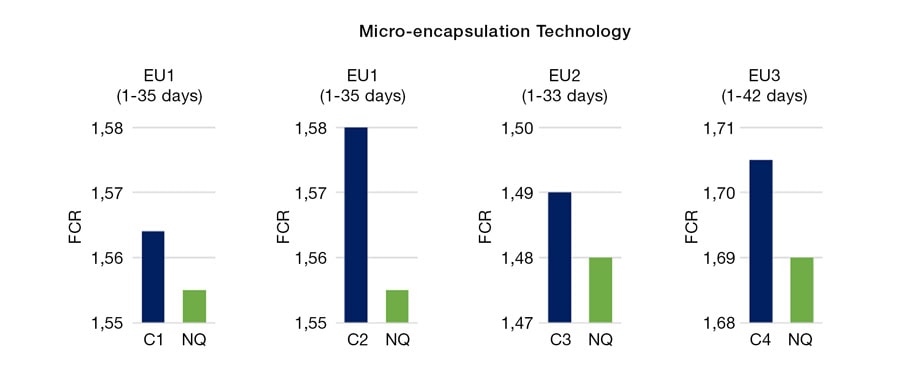
In the area of next-generation micro-encapsulated phytogenics, the power of high-concentration, high-stability encapsulation is on full display. The technology utilizes a proprietary spray-chilling fat encapsulation process to protect and deliver a potent blend of plant and seaweed extracts, designed for a targeted release within the animal’s gut. This advanced process results in a product with an exceptionally high concentration of active compounds and a superior level of stability, even at very low inclusion rates. This enhanced stability is a key technical differentiator and a significant competitive advantage. As demonstrated in extensive comparative studies, this technology consistently outperforms non-encapsulated competitors in key performance metrics such as feed conversion, final body weight, and mortality reduction (Figure 1). This is due to its ability to prevent the degradation of active compounds over time and through feed manufacturing processes.
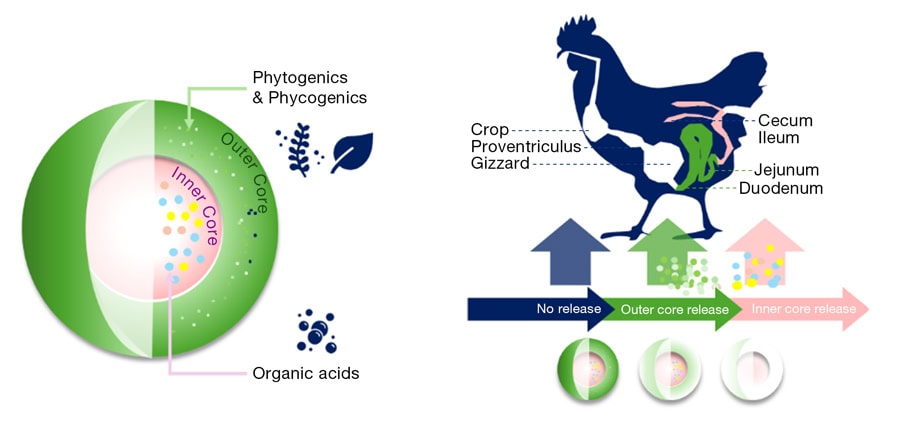
Finally, for controlled-release technology that provides a robust defense against pathogenic challenges, an innovative and highly effective double encapsulation system is employed. This technology is precisely engineered to provide a sophisticated two-phase release of its active components, which include a synergistic blend of five phytogenics, phycogenics, and six organic acids. One encapsulated layer is designed to release its contents in the early small intestine to stimulate digestibility and immunity, while the second, more robust layer releases later in the gut to provide continuous, broad-spectrum efficacy. This staged and strategically timed-release profile ensures that the active molecules are not only protected from degradation but are also deployed in a manner that maximizes their impact against a wide range of intestinal pathogens, including E. coli, Clostridium, and Salmonella, thereby maintaining animal performance under stressful conditions (Figure 2).
CUSTOMIZATION AND INNOVATION: A VISION FOR THE FUTURE OF NUTRITION
What truly distinguishes this approach is not just the breadth of its technological toolbox but its exceptional capacity for rapid prototyping and customization. Thanks to specialized pilot lines and deep industrial partnerships, the company can swiftly adapt existing formulations, rigorously test new concepts, and bring groundbreaking innovations to market faster than its competitors. This flexible and independent innovation model is in constant evolution, with ongoing developments focused on creating novel encapsulation matrices for highly heat-sensitive compounds, developing instantized formats for improved solubility in water applications, and engineering advanced carriers with enhanced odor-masking properties or targeted bioavailability. This forward-looking approach positions the company at the absolute forefront of the industry. By seamlessly integrating scientific rigor, technological versatility, and a deep understanding of customer needs, the company is not simply manufacturing feed additives; it is fundamentally reshaping the very way functional nutrition is delivered to animals. The ultimate goal is to provide a clear, scientifically validated, and highly effective answer to one of the most persistent and significant challenges in modern animal production: how to convert powerful molecules into tangible, real-world impact—a commitment that extends from the precision of the feed mill, to the health of the animal on the farm, and finally, to the integrity of the food chain.
About Dr. Stephanie Ladirat
Currently working as Nuqo’s Technology Director, Dr. Stephanie Ladirat obtained her MSc degree in Food Technology with a specialization in Food Ingredient and Functionality and her PhD degree in Food Chemistry from Wageningen University (The Netherlands). During her PhD thesis, she studied in depth the human gut microbiota composition and its modulation upon prebiotic supplementation and/or antibiotic treatments. From 2014 till 2020, she worked at Cargill Animal Nutrition, first as technology lead for gut health additives and, then, as swine portfolio manager. She provided global technical product support for a broad range of products (phytogenics, organic acids, short and medium chain fatty acids, probiotics) and trained technical and sales teams. She most recently managed R&D projects and developed innovative feed additive solutions to answer specific customer needs related to animal gut health and performance.