


“As global temperatures continue to increase year after year, so do economic losses due to heat stress. Providing proper nutrients to support and sustain pigs’ performance is an important part of helping pigs manage heat stress and the harm it can inflict on animal performance and producers’ businesses.”

Trace Mineral Programme Manager
Selko Feed Additives
Climate change is posing an increasing threat to livestock and pig producers’ businesses, as sustained periods of hot weather become more frequent. Beyond animal welfare considerations, heat stress can reduce animal performance, compromise herd health, and threaten producers’ margins.
When animals are exposed to temperatures higher than they are accustomed to, nutrients are diverted away from product synthesis (producing meat and milk, supporting fetus growth) to maintaining body temperature. This diversion of nutrients affects the animal’s productivity and can set in motion a range of negative consequences. Below, we consider how heat stress affects pigs’ performance and look at how science-based nutrition can help mitigate the effects of heat stress on herds and producers’ businesses.
HOW HEAT STRESS AFFECTS SWINE PERFORMANCE
Multiple heat waves occurring in the Americas and Europe in recent years demonstrate that heat stress is not restricted to tropical regions. As a specie, pigs are especially sensitive to heat, because they have fewer functional sweat glands. Pigs’ physical predisposition to heat sensitivity is further aggravated by a thick layer of tissue below the skin, called subcutaneous adipose tissue.
Genetic selection efforts to support leanness, improve milk yield and enhance fertility have led to an increase in pigs’ metabolic heat production. An unwanted consequence of these efforts is that herds are more susceptible to heat stress. In both fattening pigs and animals in the breeding herd, heat stress can adversely affect a variety of production parameters including growth, carcass composition, and reproduction. Evidence suggests that maternal exposure to heat stress has negative effects on postnatal offspring’s performance. These problems may include less skeletal muscle and more fat tissue being deposited during the growth stage.
During heat stress, pigs consume less feed and nutrients are allocated more toward fat deposition, rather than protein deposition. High temperatures induce finishing pigs and sows to reduce their intake of both feed and water. If heat stress is present for a prolonged time, pigs will start to drink excessive amounts of water that increases loss of electrolytes. Additionally, the accumulation of acids produced within the animal’s body may cause a loss of acid/base balance that may eventually result in death.
As heat stress reduces a sow’s feed intake, it can subsequently depress milk production, leading to reduced piglet body weight gain. In finisher pigs, a drop in feed intake will lower their growth rate. Every degree of increase in environmental temperature above 23 °C potentially reduces feed intake by 89 to 106 g (Huynh et al., 2005) in growing pigs, depending on the level of humidity. Feed efficiency is less influenced by hot conditions. Generally, a pig’s body tries to minimize the effects of heat stress by deploying two strategies: heat dissemination and reducing internal heat production. For heat dissemination, swine rely heavily on convective and conductive heat loss by increasing the body’s contact with the cool floor of the barn system, and by panting. A decrease in metabolic heat production is achieved mainly through reduction of feed intake. Under conditions of severe heat stress, animals can become more susceptible to immune challenges because of damage to the intestinal wall structure. When heat stressed pigs divert their blood flow to the skin to increase heat dissipation, the gastrointestinal blood vessels vasoconstrict to maintain blood pressure. This situation leads to fewer nutrients being absorbed to supply GI tract cells, which in turn leads to an observed reduction in growth or milk production. Adverse effects on cell wall integrity resulting from heat stress can lead to leaky gut and an increased risk for infections. If the animal’s respiratory rate continues to increase, it may lead to respiratory alkalosis that can be fatal.
 INFLUENCE OF TRACE MINERALS ON MITIGATING HEAT STRESS IN SWINE
In addition to the internal mechanism’s pigs rely on to combat heat stress, nutritional interventions can support the animal in managing heat stress. Nutrition can provide a practical and cost-effective way to support the animal’s productivity and the producer’s business. The goal of heat stress feeding strategies is to formulate rations that reduce internal metabolic heat generation by increasing dietary fat and reducing the amount of crude protein or crude fiber. Dietary fat generates less heat compared to other nutrients. Dietary elements to consider feeding include essential nutrients like selenium, vitamin E, vitamin C, and zinc. These nutrients provide antioxidant properties that have immunomodulatory effects and could potentially reduce production losses during heat stress.
Trace minerals play a crucial role in the development and maintenance of bones and maintenance of acid base balances. Trace minerals are also essential components for carbohydrate, lipid, protein, vitamins, metabolism, hormone production, immunity and intestinal function. But simply adding minerals isn’t sufficient. Precision matters when it comes to the type and level of trace mineral supplementation. During ration formulation, assuring that the minerals are provided at the right levels and that they are available to the animal is key to achieving pigs’ optimal health, welfare, and growth. Achieving the proper inclusion levels also minimizes the excretion of minerals into the environment, supporting environmental sustainability efforts.
A diet excluding trace minerals or containing an insufficient supply will lead to deficiency symptoms and reduced performance. Excess amounts of trace minerals, on the other hand, may also lead to a reduction in performance and toxicity may occur. The amount of trace mineral content in raw materials is generally low and unpredictable, making the mineral premix of vital importance for proper trace mineral feeding. There are several sources available to deliver the ion metal. The proper source is a function of a mineral’s content, solubility, relative bioavailability, and economic value. Hydroxychloride trace minerals (HTM) provide an interesting choice for leveraging all these attributes. IntelliBond hydroxy trace minerals were designed to form a unique crystalline structure and covalent bonds. This structure delivers low solubility in water. However, intelligent bonding allows the mineral to become soluble and disassociate in conditions where the pH is below 4. This capability to adjust at the critical pH level makes IntelliBond less reactive to other ingredients in the diet and ensures a high relative bioavailability. The combination of low solubility and bioavailability allows the necessary amount of the mineral to be delivered to support optimal animal performance.
Minerals play an important role in increasing resilience in pigs, especially in times of increased pressure, such as when an animal experiences heat stress. As heat stress affects the animal, it leads to tight junction dysfunction, increasing the passage of luminal content of lipopolysaccharide (LPS) from gram-negative bacteria into the portal and systemic blood circulation. Lipopolysaccharides induce sickness-like behaviors such as lower feed intake and increased body temperature. This situation also stimulates macrophages to synthesize and secrete pro-inflammatory cytokines like TNF-α and IL-1β that are responsible for suppression of appetite, inducing fever, and the production of other inflammatory molecules.
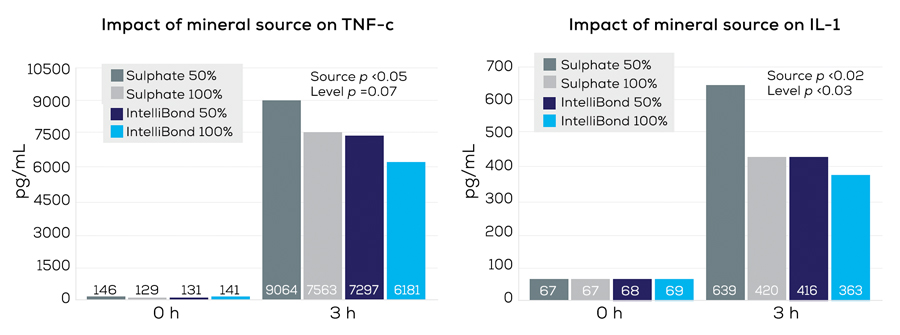
A trial comparing IntelliBond copper, manganese, and zinc to sulfate mineral sources demonstrates that IntelliBond alleviates the acute immune response by decreasing the expression of serum pro-inflammatory cytokines following an acute (LPS Injection) immune challenge (Figure 1).
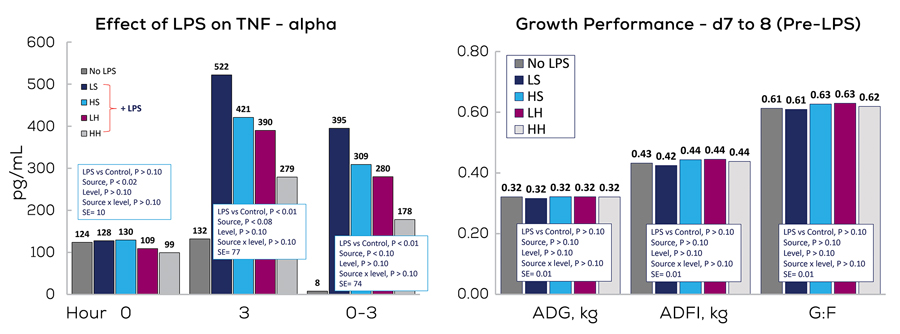
The source of trace mineral was shown to impact growth performance and immune response during animals’ exposure to a chronic immunity challenge. Pigs fed IntelliBond tended to have greater average daily gain (ADG), average daily feed intake (ADFI) and lower TNF alpha concentration versus those fed sulfates when subjected to an immune challenge. This seems to indicate a higher bioavailability of IntelliBond versus sulfates, leading to an improved immune response, which limits the effects of inflammation on growth (Figure 2).
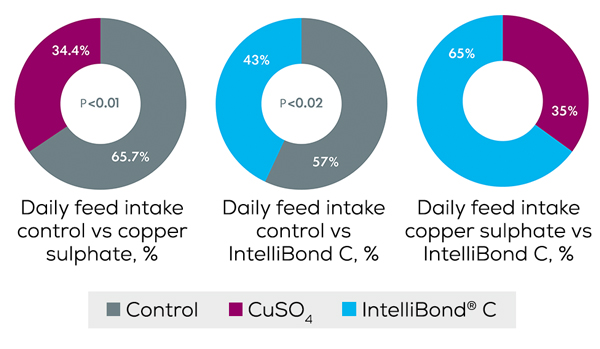
Feed intake preference (ADFI, %) of finishing pigs
Palatability is an important factor to consider, as pigs have a great perception of taste. During heat stress, strategies for promoting feed acceptance are a priority to maximize feed intake. Several studies have shown pigs prefer diets with IntelliBond C copper source compared to Cu sulfate copper source. The taste perception of the mineral is affected by its chemical structure and solubility. As sulfates are highly soluble in the oral cavity, their solubility can lead to a metallic and bitter taste that pigs are sensitive to, leading to a higher probability of feed refusal. A trial performed to evaluate feed preference showed that it was greater for pigs fed control diets (no source of copper added) compared to diets containing 150 ppm copper. However, when given a choice between copper sources, feed intake was greater for diets containing IntelliBond C vs copper sulfate (Figure 3). Mitigating the reduction of feed intake can reduce the impaired response on performance during heat stress.
Increasing dietary fat can also influence an animal’s performance during heat stress. This feeding practice reduces internal metabolic heat, increases energy density, reduces dust, and improves palatability. Adding 150 ppm of IntelliBond C to the diet improved ADG and G:F of pigs and increased mRNA abundance of genes involved in uptake, transport and oxidation of fatty acids (Espinosa 2019). This improved efficiency of fatty acid utilization allowed more energy generated to be used for maintenance and growth of pigs.
As global temperatures continue to increase year after year, so do economic losses due to heat stress. Providing proper nutrients to support and sustain pigs’ performance is an important part of helping pigs manage heat stress and the harm it can inflict on animal performance and producers’ businesses. The data presented here indicates that the use of IntelliBond minerals during times of stress can improve pig resilience, ensuring performance is sustained and the economic impact of stress is lowered.
About Luigi Moreira
Luigi Moreira received his D.V.M.Z degree in Veterinary medicine from University of Cuenca, Ecuador in 1994. Moreira started his career as a Technical Assistant at Hoffman La Roche. After 5 years he accepted a role as a Technical & Commercial Manager at DSM. Within DSM Moreira held various positions across Latin America. From 2006 to 2009 he was Director ANH Centro America & Caribbean, DSM in Costa Rica. Then be moved back to Ecuador as a Regional Tropical Aquaculture Manager LATAM. Last position he held within DSM was Director ANH Andean Countries in Colombia.
In 2015 Moreira joined Trouw Nutrition as an Area Manager LATAM Trouw Nutrition in Ecuador. Since 2020 he is Trace Mineral Programme Manager for Selko Feed Additives based in Mexico.