


Nucleotides play a strategic role in functional nutrition, going beyond basic maintenance to actively enhance growth and physiological resilience across animal species. By supplementing diets with exogenous nucleotides, producers can conserve metabolic energy, support immune function, and accelerate gut and tissue development. This approach is particularly valuable during critical stress periods, such as weaning in pigs, early growth in broilers, or high-density aquaculture, optimizing both performance and animal health in modern intensive production systems.

Animal Nutrition Technical Marketer
CJ Bio
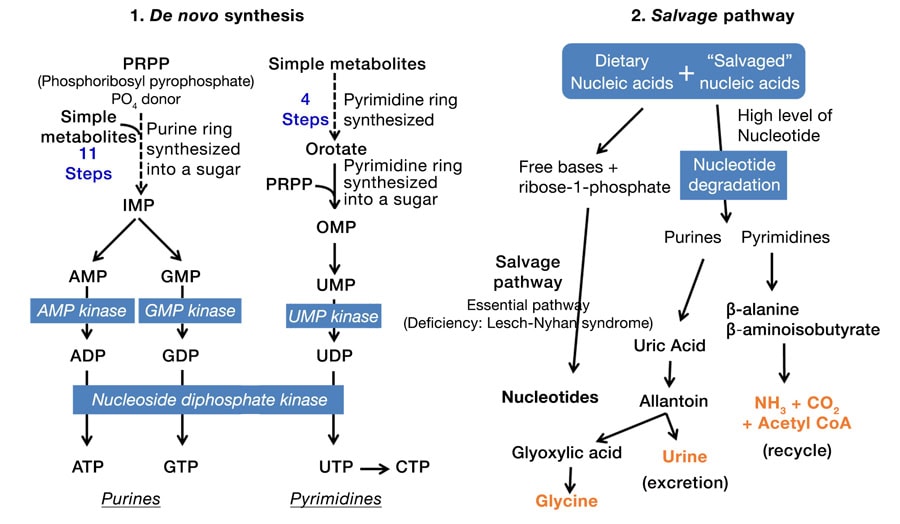
In intensive livestock and aquaculture, the nutritional paradigm is shifting. The focus has moved beyond merely meeting maintenance requirements and maximizing protein deposition toward actively optimizing physiological resilience against environmental and health challenges through functional products. At the heart of this shift are nucleotides – low-molecular-weight intracellular compounds that are rapidly gaining recognition. While traditionally categorized as non‑essential due to the existence of de novo synthesis and salvage pathways, nucleotides are now considered as conditionally essential for both terrestrial and aquatic animals.The metabolic cost of de novo nucleotide synthesis is high, requiring substantial energy and drawing heavily from the body’s amino acid pool. During periods of extreme stress – such as rapid neonatal growth, environmental fluctuations, or disease outbreaks – internal synthesis often fails to meet demand.
By providing exogenous nucleotides, producers can “spare” these metabolic resources, redirecting energy and amino acids toward growth, immune function and tissue repair rather than costly de novo nucleotide assembly (Salah et al., 2019; Weaver & Kim, 2014). This article summarizes the molecular basis and production responses to supplemental nucleotides in swine, poultry, and aquaculture, while presenting a strategic framework for their application in precision nutrition.
OPTIMIZING THE WEANING TRANSITION IN NURSERY PIGS
The weaning transition is a high-risk period characterized by social, environmental, and dietary stressors that frequently trigger a “post-weaning growth check”. This physiological setback is driven by impaired nutrient absorption and heightened oxidative stress, both of which can increase morbidity and compromise lifetime performance.
Performance evaluation and economic impact
Strategic supplementation with nucleotide mixtures high in inosine 5′-monophosphate (5′-IMP) has demonstrated a clear capacity to offset this growth check. Weaver & Kim (2014) evaluated a nucleotide additive containing 53% total nucleotides (of which 51% was 5′-IMP) and reported linear improvements in both average daily gain (ADG) and average daily feed intake (ADFI) (See Table 1).
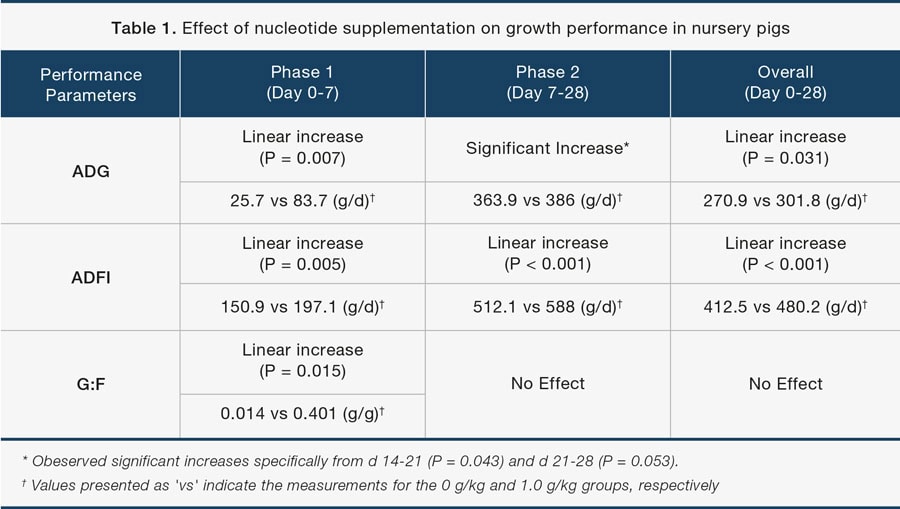 During the first week (Phase 1), ADG in the 1.0 g/kg group more than tripled, surging by 225.7% (83.7 g/d vs 25.7 g/d) compared to the control group. For producers, this early stage boost is critical; accelerating the growth curve during Phase 1 reduces total days to market and optimizes nursery throughput.
Health markers and stress mitigation
Beyond growth performance, nucleotides play a vital role in modulating the immune-inflammatory axis. Research indicates that high‑IMP supplementation at 0.5–1.0 g/kg provides the following benefits:
• Reduced systemic inflammation: A linear trend toward decreased pro‑inflammatory cytokines, particularly Tumor Necrosis Factor‑α (TNF‑α), suggests a more controlled inflammatory response during the weaning transition.
• Enhanced cellular protection: The oxidative DNA damage marker 8‑hydroxy‑deoxyguanosine (8‑OHdG) was lowest at the 0.5 g/kg supplementation level, indicating improved genomic stability under stress.
• Improved gut health stability: Diarrhea scores were lowest on Day 8 for pigs receiving 0.5 g/kg. This reflects reduced morbidity and leads to lower associated labor and treatment costs for the producers.
COMPREHENSIVE BENEFITS OF DIETARY NUCLEOTIDES IN FISH AND SHRIMP
Synergistic growth and cellular mechanisms
Dietary nucleotides significantly improve weight gain and FCR across multiple aquaculture species, including Pacific white shrimp and Nile tilapia (Xiong et al., 2018, Asaduzzaman et al., 2017). In tilapia, these growth-promoting mechanisms have been observed at the cellular level. Nucleotide supplementation stimulates both muscle hyperplasia (formation of new muscle fibers) and hypertrophy (expansion of existing fibers) (Asaduzzaman et al., 2017). Furthermore, nucleotides upregulate key growth‑related genes, including pituitary Growth Hormone (GH) and hepatic Insulin‑like Growth Factor‑1 (IGF‑1) (Asaduzzaman et al., 2017).
Fortification of innate immunity & disease resistance
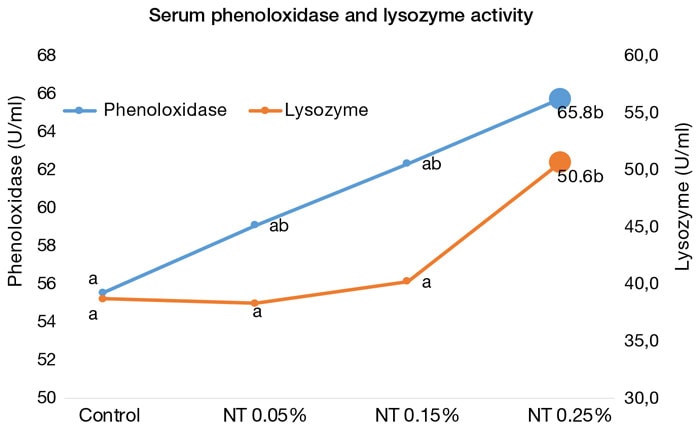
Because invertebrates, such as shrimp, lack an adaptive immune system, they depend entirely on innate immunity for pathogen defense (Xiong et al., 2018). Nucleotide supplementation effectively activates this non‑specific immune defenses, significantly increasing serum activities of phenoloxidase (PO) and lysozyme (Xiong et al., 2018) (See Figure 2). By upregulating immune‑related genes, nucleotides markedly enhance disease resistance and survival in both shrimp and fish during severe pathogenic challenges (Xiong et al., 2018; Shiau et al., 2015; Burrells et al., 2001).
Alleviation of environmental stress in high-density farming
In intensive aquaculture systems, the accumulation of nitrogenous waste products, such as ammonia, represents a significant environmental stressor. During acute ammonia exposure, shrimp fed a nucleotide-supplemented diet exhibited significantly higher survival rates – up to 93.3% compared to just 66.7% in the control group (Yong et al., 2020). Nucleotides help modulate hemolymph metabolites, including glucose and total protein, providing the critical energetic support required to maintain physiological homeostasis during periods of extreme stress (Yong et al., 2020).
Intestinal morphological development
Nucleotides are essential substrates for rapidly dividing tissues, particularly the intestinal mucosa. In shrimp, nucleotide supplementation significantly increases the height and width of intestinal villi, as well as microvilli height (Xiong et al., 2018). These structural enhancement expand the absorptive surface area, optimizing nutrient utilization and strengthening the intestinal barrier to prevent pathogen invasion (Xiong et al., 2018).
BROILER: MAXIMIZING EARLY GROWTH
The interdependence of early growth and gut development
In commercial broiler production, maximizing early growth is a primary objective. However, achieving this high genetic growth potential depends fundamentally on the rapid early development of the gastrointestinal tract (Jung & Batal, 2012). A well‑developed small intestine with an intact mucosal structure is essential for efficient nutrient digestion and absorption (Kreuz et al., 2020). Therefore, early growth and gut health are not competing priorities; rather the rapid establishment of robust gut integrity is the prerequisite for achieving maximal early growth.

Impact of environmental stress on gut health and performance
In modern intensive farming systems, broilers are frequently exposed to environmental stressors – such as high stocking densities – which impair physiological function and intestinal health (Kamel et al., 2021). These stressors induce significant morphological damage, including reduced villus height and mucosal thickness, which severely hinders nutrient absorption (Kamel et al., 2021). This deterioration directly translates into stunted early growth, reduced weight gain, and an increased feed conversion ratio (FCR) (Kamel et al., 2021).
Accelerating early growth through nucleotide supplementation
Functional nucleotide supplementation is an effective nutritional strategy to rapidly establish gut health and counteract stress‑induced growth depression. Nucleotide supplementation significantly increases intestinal villus height and the villus height:crypt depth ratio during the critical starter phase (e.g., 0-14 or 7-20 days of age) (Jung & Batal, 2012; Kreuz et al., 2020). This morphological improvement expands the absorptive surface area, enabling chicks to utilize nutrients more efficiently.
Direct performance improvements and barrier integrity
Rapid intestinal development translates into superior early growth metrics. Broilers fed nucleotide‑supplemented diets show significantly higher daily weight gain and improved FCR during critical early phases (Jung & Batal, 2012; Kreuz et al., 2020). Furthermore, nucleotides upregulate the expression of tight junction genes such as ZO‑1 and Occludin, strengthening the intestinal barrier against pathogens and maintaining homeostasis during rapid growth (Wu et al., 2018).
THE BIOAVAILABILITY GAP: WHY PURIFIED IMP OUTPERFORMS YEAST SOURCES
While yeast-derived nucleotides are a common choice in market, not all sources offer the same efficiency. A critical factor to consider is the “Bioavailability Gap.” Most common yeast-derived sources are protein-bound, which leads to limited intestinal release and often results in bioavailability levels around 20% or less. In contrast, purified, fermentation-based nucleotide (IMP or GMP) is protein-free and ready for immediate absorption, providing significantly higher intestinal availability.
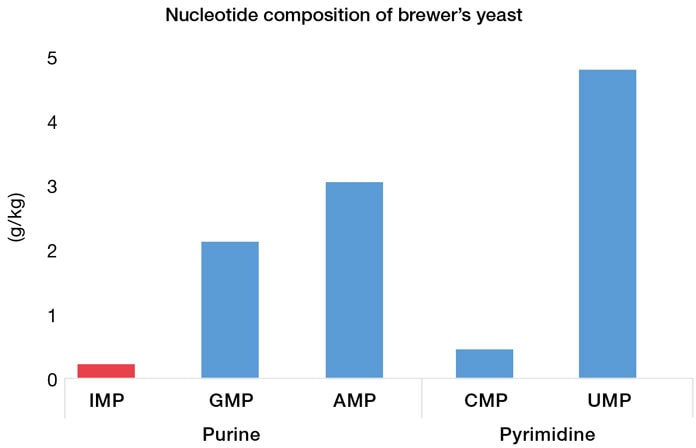
Beyond absorption rates, the “Profile Balance” is equally important. Figure 3 illustrates this imbalance; it shows that Brewers Yeast contains disproportionately low levels of IMP, while other pyrimidines dominate the profile. Purified IMP, however, provides a consistent and high-potency supply that ensures efficient salvage pathway activation through direct nucleoside supply. For producers looking for reproducible results and maximal growth, choosing a purified form is a more reliable way to bridge the nutritional gap and achieve superior performance.
CONCLUSION
The strategic addition of nucleotides is no longer an “optional” luxury in high-efficiency antibiotic-free intensive production system. Nucleotides optimize natural growth and resilience by conserving metabolic energy and providing the essential building blocks for rapid cell turnover.
References
1. Asaduzzaman, M., et al. (2017). Dietary nucleotide administration influences growth, muscle fiber hyperplasia and hypertrophy in Nile tilapia. Aquaculture, 479, 1-9.
2. Collins, S. L., et al. (2023). Bile acids and the gut microbiota. Nature Reviews Microbiology, 21(4), 236-247.
3. Dawson, P. A. (1998). Bile secretion and the enterohepatic circulation of bile acids. Sleisenger and Fordtran’s Gastrointestinal and Liver Disease.
4. Jung, B., & Batal, A. B. (2012). Effect of dietary nucleotide supplementation on broiler chicken performance. Poultry Science, 91(6), 1288-1297.
5. Kandell, R. L., & Bernstein, C. (1991). Bile salt/acid induction of DNA damage. Infection and Immunity, 59(1).
6. Luppi, A., et al. (2023). Diagnostic Approach to Enteric Disorders in Pigs. Animals (Basel), 13(3), 338.
7. Park, S. J., et al. (2011). Prevalence of Enteric Bacterial Pathogens in Grower Pigs in Jeju-do. J Vet Clin, 28(1), 81-86.
8. Sun, Y., & Kim, S. W. (2017). Nutritional intervention to prevent postweaning diarrhea. Animal Nutrition, 3(4), 322-330.
9. Use of Nucleotides in animal feed, Feed Mix, Vol.15 No.4, 2007.
10. Weaver, A. C., & Kim, S. W. (2014). Supplemental nucleotides high in inosine 5′-monophosphate to improve health and growth of newly weaned pigs. Journal of Animal Science, 92(2), 645-651.
11. Xiong, J., et al. (2018). Dietary nucleotide-rich yeast supplementation improves growth, innate immunity and intestinal morphology of Pacific white shrimp. Aquaculture Nutrition.