

Preserving cereals and feed is no longer just about inhibiting spoilage, but about delivering long-term safety, performance, and health across the production chain. As limitations of traditional organic acids and formaldehyde become increasingly clear, next-generation natural preservatives are redefining feed protection. By combining broad-spectrum microbicidal efficacy with safety, durability, and added intestinal benefits, innovative technologies now offer a more sustainable and effective approach to safeguarding feed quality and animal productivity.

Veterinary Manager
Biovet S.A. Laboratories
Preserving feed consists of maintaining its characteristics; i.e., preventing the loss of nutrients and energy value caused by the action of microorganisms (bacteria and fungi) present in the feed. Preserving these nutritional and energy properties is essential to achieve good productive parameters, while simultaneously preventing important pathologies.
The preservation of cereals and compound feed is carried out through the inclusion of products that minimize this deterioration — preservatives — which also help prevent digestive infectious diseases and other derived problems, such as mycotoxicosis.
ANALYSIS OF THE MOST COMMON PRESERVATIVES FOR FEED AND RAW MATERIALS
The most common preservatives on the market can be divided into three main types: organic acids, formaldehyde, and natural preservatives.
The first group has been used for decades to preserve both raw materials and compound feed. Their mechanism is based on reducing the intracellular pH of pathogens to inhibit their metabolic processes and, therefore, their multiplication. In other words, they mainly exert a bacteriostatic and fungistatic effect. Formaldehyde is usually applied to grains for the control, among others, of Salmonella, a bacterium of great concern to poultry and swine industries due to its consequences for animals and the zoonotic potential of some strains.
Finally, some natural preservatives have emerged in the industry, standing out for achieving equal or, in many cases, superior efficacy compared to the previously mentioned solutions. In this regard, a technology has been developed based on the synergy between cineole, cimenol ring, and isopropyl methyl-phenol, botanical molecules which, when combined with citric acid, are capable of eliminating a wide variety of microorganisms that cause feed deterioration through membrane disruption.
ORGANIC ACIDS: CHARACTERISTICS AND LIMITATIONS
Organic acids inhibit microbial growth in feed by reducing the internal pH of bacteria and fungi, thereby reducing their enzymatic activity to minimal levels and limiting their ability to reproduce. These products prevent the multiplication of microorganisms, but do not eliminate them completely.
Their spectrum of action is more or less limited: some acids are effective only against specific groups of microorganisms (i.e., gram-positive bacteria). The combination of propionic acid with formic acid is the most commonly used, as it broadens the preservative’s spectrum of action.
The main limitations of these products are:
• They inhibit but do not completely eliminate microorganisms.
• A relatively short duration of effect: after approximately two months they lose efficacy, and microorganisms may use the acids as an energy source to multiply again.
• A limited spectrum of action: they are only effective against specific groups of microorganisms, meaning others may remain in the feed, or acid combinations become necessary.
• Corrosive potential: acids may damage machinery and their application can sometimes be hazardous for workers.
FORMALDEHYDE: SERIOUS CONSEQUENCES FOR ANIMALS AND HUMANS
Formaldehyde has a high capacity for controlling Salmonella and has therefore been widely used to eliminate this pathogen in grains and compound feed, as well as to prevent digestive infections.
Its harmful effects on human and animal health have led to a progressive reduction in the availability of formaldehyde-based products for animal feed. This is because it is a toxic and irritating substance upon contact with skin and the respiratory tract, and is potentially carcinogenic for both humans and animals.
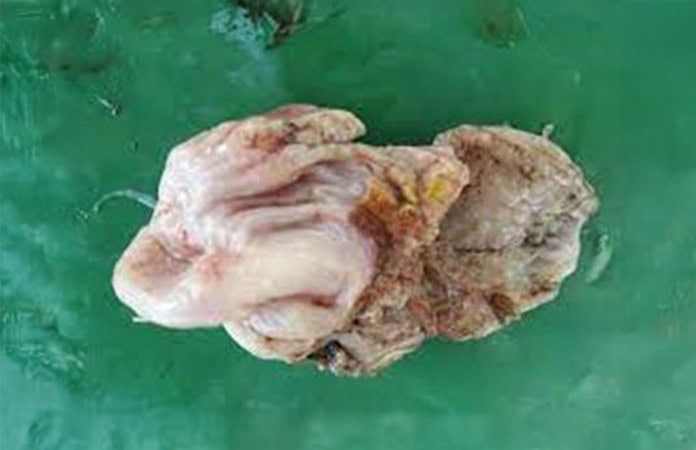
Additionally, in the digestive tract, formaldehyde reacts with hydrochloric acid, causing thermal and chemical burns in the digestive epithelium, leading to significant deterioration of productive parameters (Image 1).
NATURAL PRESERVATIVES: SYNERGY BETWEEN ANTIMICROBIAL PHENOLIC COMPOUNDS
Natural preservatives represent a solution that has become more popular in the industry compared to organic acids and formaldehyde, as they offer advantages that overcome the limitations of other preservatives. Alquermold Natural Plus is a clear example: a product based on the combination of cineole, cimenol ring, and isopropyl methyl-phenol, natural microbicidal molecules that synergistically eliminate a wide variety of microorganisms present in feed and cereals, including gram-positive and gram-negative bacteria, fungi, and yeasts.
As a microbicidal product, it completely eliminates microorganisms, its efficacy lasts for a long time, allowing preservation of grains and compound feed for at least six months. Its mechanism is based on the disruption of the cell membrane, leading to pathogen death.
RECENT SCIENTIFIC EVALUATION IN COLLABORATION WITH THE UNIVERSITY OF HELSINKI
Recently, Biovet carried out an in vitro evaluation of the preservative efficacy of Alquermold Natural Plus compared with a combination of organic acids widely used in the industry.
The objective of the study was to compare the percentage reduction of different microorganisms achieved by both preservatives. The effect against the most common sector-relevant microorganisms was also evaluated, including Aspergillus, Clostridium, Escherichia coli, Salmonella, Pseudomonas, Rhizopus, and Fusarium.
For the experimental design, two types of substrates, ground corn and compound feed, were contaminated with 106 CFU/g of these microorganisms. After product administration, microbial counts were performed at 24 hours and 7 days to assess microbial reduction.
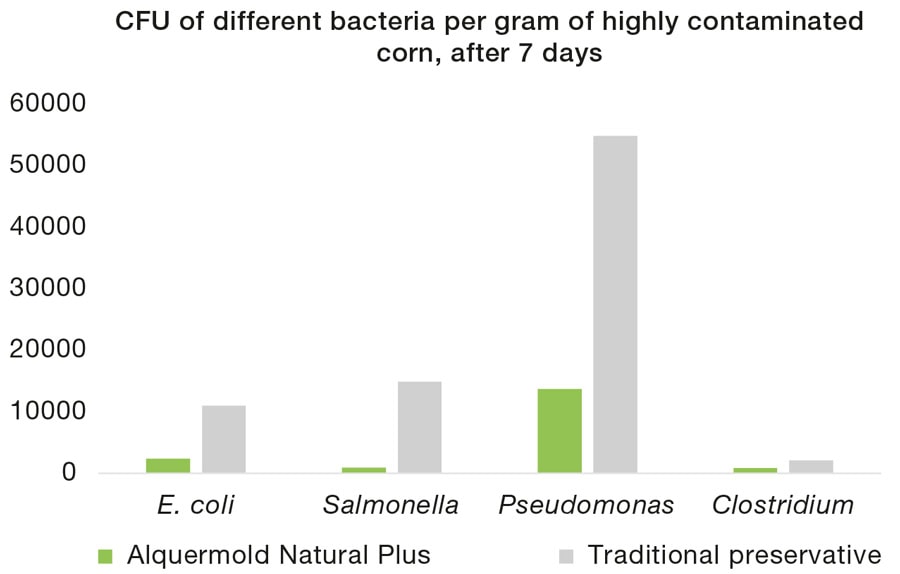
Results showed that in the case of bacteria, Alquermold Natural Plus achieved notably lower bacterial counts on day 7 compared with the other preservative for each bacterium tested, even starting from high initial contamination. Compared to control, reductions were: 99.91% for Clostridium, 99.8% for E. coli, 99.93% for Salmonella, and 98.88% for Pseudomonas.
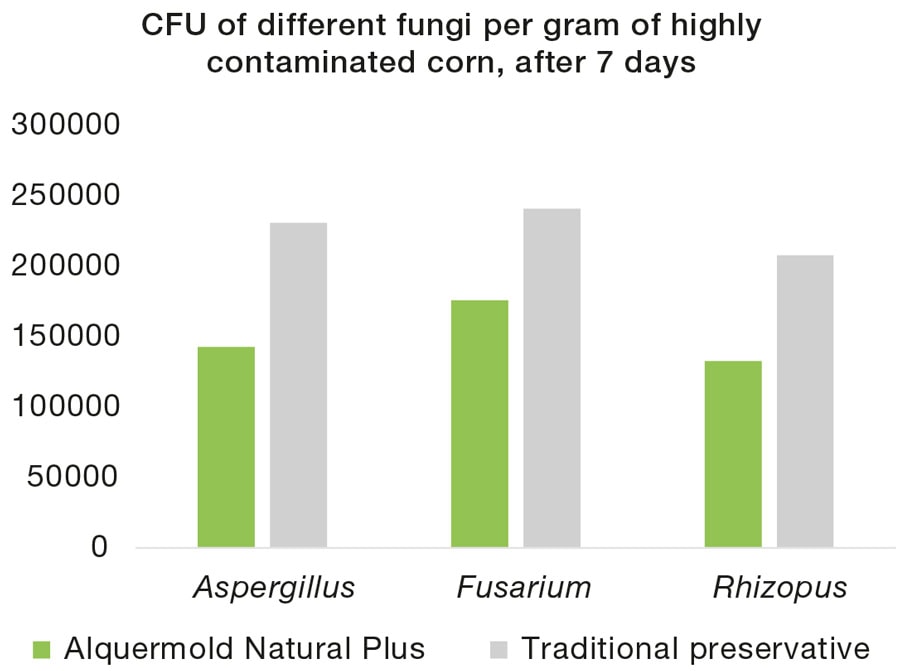
Similarly, for fungi, Alquermold Natural Plus also achieved the lowest counts on day 7 after application in highly contaminated corn samples. Compared with control, reductions were: 91.13% for Aspergillus, 88.48% for Fusarium, and 91.07% for Rhizopus.
Additionally, the preservative compared against Alquermold Natural Plus was administered at four times the dosage, yet still produced lower bacterial and fungal reduction percentages than the natural product. These same results were observed in compound feed, with practically identical outcomes.
ADDED VALUE OF ALQUERMOLD NATURAL PLUS: INTESTINAL MICROBICIDAL EFFECT
An added value of this microbicidal technology is that, besides acting as a feed preservative, its efficacy persists in the digestive tract, acting as an intestinal antimicrobial and controlling pathogenic microorganisms that may colonize the intestine. Thus, animals consuming feed supplemented with Alquermold Natural Plus develop a more balanced intestinal flora, while digestive infections are prevented.
Field trials have shown that its inclusion in feed improves digestive flora balance without affecting beneficial flora such as Lactobacillus spp. Applications include prevention of infectious diseases associated with bacterial overgrowth in the intestine, such as necrotic enteritis (Clostridium), as well as reducing Salmonella, E. coli, and Campylobacter on farms.
In a trial conducted at Universidad Científica del Sur (Lima, Peru), broilers were challenged with Clostridium perfringens to evaluate the capacity of Alquermold Natural Plus for prevention and treatment of necrotic enteritis and its impact on performance.
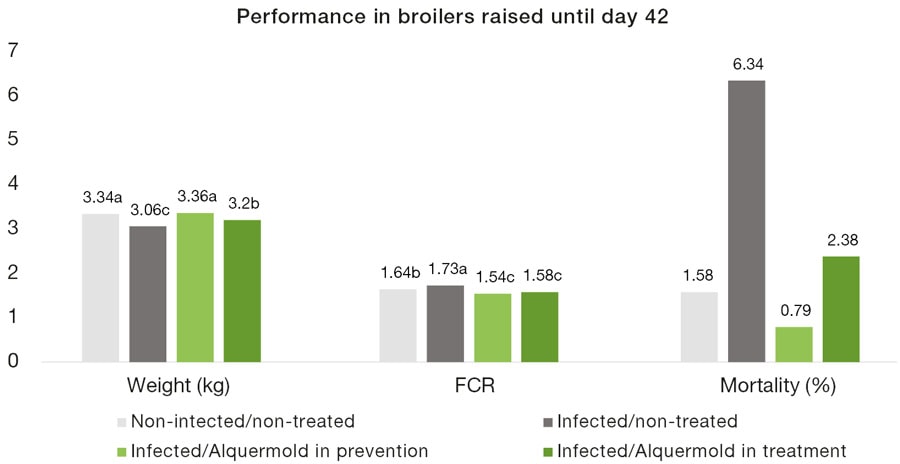
Administration of Alquermold Natural Plus as prevention and treatment reduced mortality compared to the infected control by 87.5% and 62.5%, respectively. In addition, the preventive group, despite the challenge, showed lower mortality than the negative control (non-infected), thanks to better control of digestive flora balance.
Parameters such as uniformity also improved, being 12% higher in the preventive group compared to the challenged control and 6% better than the negative control; carcass yield improved by 6.7%.
Regarding body weight and feed conversion ratio, after the Clostridium perfringens challenge, animals receiving Alquermold Natural Plus as prevention maintained productive performance and weighed nearly 300 grams more on day 42 compared with the infected group, with a 6.36% better feed conversion ratio.
Animals receiving the product in drinking water as treatment also improved daily weight gain, body weight and, feed conversion compared to the infected group, demonstrating that Alquermold Natural Plus offers versatility for both prevention and treatment.
CONCLUSIONS
Traditional preservatives are mainly based on combinations of different organic acids. However, they only exert an inhibitory effect on microorganisms without eliminating them, have limited spectrum and duration of action, and may be corrosive to facilities, animals and workers.
In contrast, Alquermold Natural Plus is a natural-based technology that, being microbicidal, completely eliminates microorganisms with a broad spectrum of action lasting at least six months, and is neither corrosive nor harmful to animals, workers, or machinery.
Scientific results have shown that in feed preservation it achieves higher reduction percentages for all tested microorganisms, even at doses four times lower than products based on organic acids. This represents not only improved feed preservation but also significant economic benefits.
Additionally, Alquermold Natural Plus remains effective after ingestion and controls enteric infections caused by Salmonella, E. coli or Clostridium, among others. In this sense, it can prevent important poultry sector diseases such as necrotic enteritis and improve performance and mortality rates. It has also been demonstrated that supplementation via drinking water as a treatment helps control digestive challenges during outbreak situations.