


According to the newly released data by Elanco Animal Health, the company’s Canine Parvovirus Monoclonal Antibody (mAb) Treatment significantly improves puppy survival rates and relieves operational stress in veterinary clinics. In the first year, the Canine Parvovirus Monoclonal Antibody reportedly saved thousands of puppies.
 Elanco Animal Health has unleashed the first ever real-world data demonstrating the efficacy and impact of its Canine Parvovirus Monoclonal Antibody (CPMA), the first and only USDA Conditionally Approved targeted treatment for canine parvovirus. Annually, canine parvovirus reportedly affects more than 330,000 puppies, contributing up to a staggering 91% mortality rate without supportive care1, 2. The real-world data, collected over the first year of CPMA availability, shows improvements in survival rates for puppies battling the deadly virus as well as enhanced operational efficiency and high satisfaction within veterinary clinics – serving as a proof point that the Canine Parvovirus Monoclonal Antibody is re-writing the protocol for parvovirus treatment.
“Earlier this year, Elanco launched a bold mission to save 1 million puppies from parvovirus by 2030. I’m proud that in the first year, thousands of puppies have been saved as a result of the Canine Parvovirus Monoclonal Antibody, including Cookie, Mono and Luna, to name a few,” explains Bobby Modi, Executive Vice President, U.S. Pet Health at Elanco.
The real-world data reportedly shows:
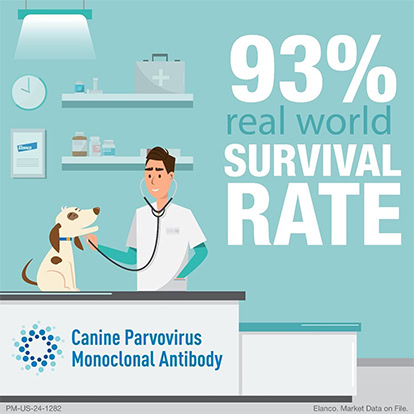
• 93% of puppies treated with CPMA survived in real-world usage.3
• When treated with CPMA, parvo patients spend on average 1.87 less days in the hospital.4
• 92% of veterinarians using CPMA report that the treatment reduces overall clinic stress.3
• A 90% satisfaction rating among clinics who incorporated Canine Parvovirus Monoclonal Antibody into their treatment protocols.3
• 83% of those who have used the Canine Parvovirus Monoclonal Antibody recommend it to their peers.3
“Our recent real-world data shows that the Canine Parvovirus Monoclonal Antibody is giving puppies and veterinary clinic staff a new lease on life,” expresses Dr. Jennifer Miller, Technical Veterinarian at Elanco, who has witnessed first-hand the power of CPMA after seeing clinics nationwide administering the treatment. “We deeply understand the immense stress and pressure veterinarians endure, especially when it comes to treating the relentless challenge of parvovirus. That’s why we are thrilled to offer a solution that truly makes a difference in veterinary clinics – empowering veterinarians to provide the care these vulnerable puppies need.”
As part of the “Defend Puppies. Defeat Parvo” mission, Elanco points out that it also created the Parvo Defenders Task Force and the rollout of the first-of-its-kind innovative online tracking tool, ParvoTrack-powered by Elanco, which to date has 900 reported cases collectively reported from veterinarians and pet owners. Additionally, to date, 7,062 pet owners have signed up for parvo alerts via ParvoTrack-powered by Elanco – where visitors can self-report and identify parvo outbreak areas in real time, with a few simple steps.
“As a veterinarian and a proud member of the Parvo Defenders Task Force, seeing the significant impact of Elanco’s CPMA treatment has been nothing short of transformative,” says Dr. Fred Metzger, Veterinarian at VCA Metzer Animal Hospital. “Not only have we witnessed remarkable survival rates among puppies, but CPMA has eased a huge burden. We’ve felt a tangible reduction in stress and workload within our clinic – freeing us to dedicate more time and resources on other animals in need. I wholeheartedly recommend it to my fellow veterinarians who are looking to enhance patient outcomes and clinic operations.”
References
1. Elanco Animal Health. Data on File.
2. Sykes, JE. Canine Parvovirus Infections and Other Viral Enteritides. Canine and Feline Infectious Diseases. 2014:141-151
3. Elanco Animal Health. Market Data on File.
4. Elanco Animal Health. Industry Data on File