


Although mycotoxins affect most organs and systems in poultry, some organs/systems are more vulnerable for a specific group of mycotoxins. Aflatoxins are known as potent hepatotoxins while ochratoxins are known to affect kidneys severely. Similarly, GIT is more susceptible to trichothecene mycotoxins while fumonisins affect sphingholipid metabolism in various organs. The one system that is affected by all these mycotoxins is the immune system and it can be affected even at very low concentrations of mycotoxins.

Global Programme Manager
Trouw Nutrition Global

Global Product Manager
Trouw Nutrition Global
Poultry feed and its raw materials are susceptible to fungal colonization. Major plant-based poultry feed raw materials around the world include maize, wheat, broken rice, millets, soybean meal, sunflower meal, rapeseed meal, rice bran, wheat bran, and DDGS. Broiler diets predominantly include maize, wheat and soybean meal to meet high energy and protein demands. In most countries, however, low energy diets are preferred for feeding commercial layers to minimize fat deposition and to maximize egg production. Such an objective forces feed formulators to use high-fiber raw materials such as rice bran, wheat bran and DDGS in commercial layer diets. High-fiber raw materials, grain by-products, been have proven to contain higher concentrations of mycotoxins as compared to their parent grains as mycotoxins tend to concentrate on outer portion of grains. This factor coupled with the long rearing period of commercial laying hens make them more susceptible to mycotoxicosis.
MYCOTOXICOSIS – THE CONSEQUENCES AND COSTS
Mycotoxicosis is a condition observed in poultry upon the ingestion of different concentrations of mycotoxins in the complete feed. Mycotoxins, a diverse group of toxic secondary metabolites of fungi, are a world-wide challenge in the poultry industry due to the increased global trade of raw materials as well as climate change and changing agricultural practices. Although poultry can be exposed to more than 600 different mycotoxins, most research has focused on six groups of mycotoxins (mentioned in the decreasing order of sensitivity); ochratoxins (OTA), T-2 toxin, aflatoxins (AF), deoxynivalenol (DON), fumonisins and zearalenone (ZEN) (Table 1). The emerging mycotoxins such as moniliformin, cyclopiazonic acid (CPA) are also known to cause toxicity in poultry.
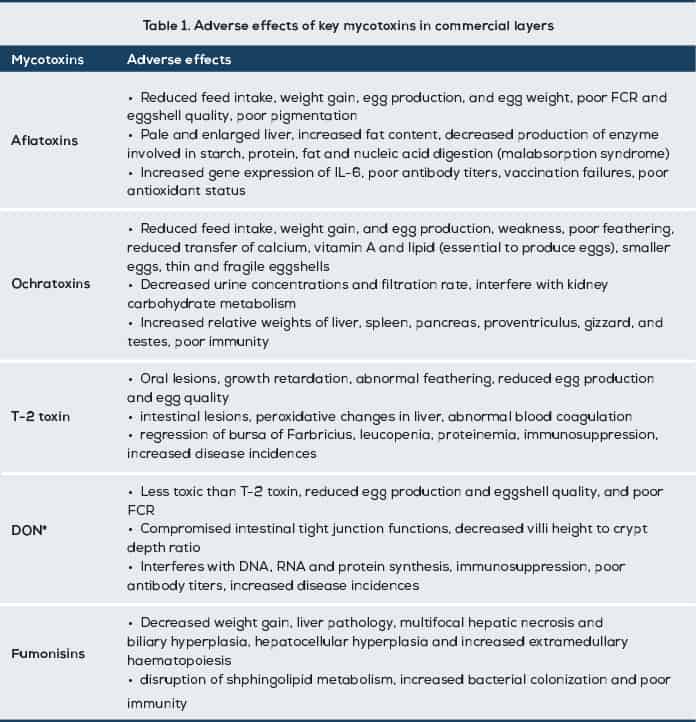 Although mycotoxins affect most organs and systems in poultry, some organs/systems are more vulnerable for a specific group of mycotoxins (Table 1). Aflatoxins are known as potent hepatotoxins while ochratoxins are known to affect kidneys severely. Similarly, GIT is more susceptible to trichothecene mycotoxins (DON and T-2) while fumonisins affect sphingholipid metabolism in various organs. The one system that is affected by all these mycotoxins is the immune system and it can be affected even at very low concentrations of mycotoxins. Unlike many may think, poultry can tolerate ZEN even at higher concentrations and hence not a challenge to be worried for poultry producers. All above groups of mycotoxins, barring ZEN, albeit at different concentrations have been implicated in lowering egg production, egg weight, eggshell quality, and immune responses and increased FCR and mortality ultimately leading to a poor economic return to producers.
MYCOTOXIN MANAGEMENT – BEYOND BINDING
As Table 1 clearly shows, AF, OTA and T-2 can compromise bird performance while DON and fumonisins will have significant negative effects on gut integrity and immunity at the levels of toxins seen in commercial feeds. As a result, mere mycotoxin binding strategy may not help in protecting the birds and there is need for ingredients capable of improving immune and gut health. Additionally, poultry feed is usually contaminated with multiple mycotoxins and egg producers are looking for a broad-spectrum solution to safeguard their business.
 In developing TOXO®-XL, a broad-spectrum mycotoxin risk management product, Trouw Nutrition, integrated three science-based modes of action. First, it effectively reduces mycotoxin entry into blood circulation by high quality bentonite (smectite-based). Second, it maintains intestinal epithelial integrity with the help of selected glucose biopolymers of yeast origin. Intestinal epithelial integrity, more specifically the tight junctions, which are multi-protein complexes, inhibits the intercellular transport of toxins and pathogens into the blood circulation. Lastly, TOXO-XL can modulate the immunity by purified beta-glucans.
Mycotoxins-induced immunosuppression can be due to various mechanisms, one of which is poor effector cell function of macrophages. Macrophages, a group of phagocytes that play a crucial role during antibody production by presenting antigen to lymphocytes, can recognize beta-glucans by their membrane receptors and get activated without causing negative effects such as inflammation, loss of appetite and growth. This activation, however, requires the exposed but intact beta-glucans as the prerequisite. Beta-glucans selected in TOXO-XL originate from the middle layer of cell walls of Saccharomyces cerevisiae, where Saccharomyces cerevisiae are dismantled by enzymes to free up beta-glucans. Unlike the traditional technique of using chemicals to destroy Saccharomyces cerevisiae structure, this enzymatic technique ensures a maximum production of intact beta-glucans and the following efficacy and efficiency of beta-glucans in immune modulation.
IN VIVO VALIDATION PROOF
TOXO-XL has been validated through various established in vivo models, with the collaboration between Trouw Nutrition and independent scientific partners. Most recently, a trial was conducted at Department of Animal Nutrition and Feed Science, College of Animal Science and Technology, Huazhong Agricultural University (Wuhan, Hubei, China). In this trial, 26-week-old Roman laying hens were enrolled and randomly allocated into five experimental groups. Each group contained ten replicates of nine birds. The experimental groups received a basal diet (Negative control/NC), a NC diet supplemented with the combination of 0.15 mg/kg AFB1, 1.50 mg/kg DON and 0.12 mg/kg OTA (Positive control/PC), a PC diet with the inclusion of 1.0 kg/t TOXO-XL (PC + TOXO-XL), a PC diet with the inclusion of 1.0 kg/t enzyme biotransformation-based product (PC + EB) and a PC diet with the inclusion of 1.0 kg/t yeast cell wall-based product (PC + YCW), respectively. The animal experiment lasted 12 weeks. At week 12, ten birds from each group were slaughtered to harvest liver organs and serum samples.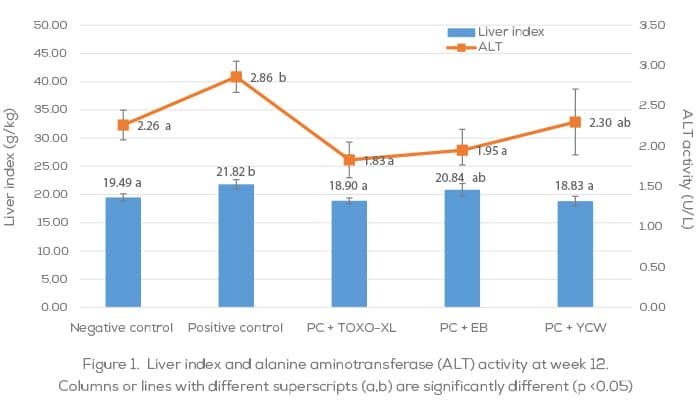 The trial results showed that after a 12-week exposure to mycotoxins, the liver index (measured as gram / kg body weight) of laying hens was significantly increased from 19.5 to 21.8 g/kg (p<0.05), indicating liver toxicity of mycotoxins (Figure 1). Alanine aminotransferase (ALT) activity, a serum biomarker for liver function, was also significantly increased from 2.1 to 2.9 U/L (p<0.05). The inclusion of TOXO-XL, however, significantly decreased liver index and ALT activity to 18.9 g/kg and 1.8 U/L, respectively (Figure 1, p<0.05). At performance level, mycotoxin exposure also significantly decreased egg-laying rate from 90.6 to 85.8% (p<0.05). TOXO-XL inclusion, again, improved egg-laying rate significantly to 88.8% (Figure 2, p<0.05). Feed conversion efficiency in terms of feed intake to egg weight ratio is crucial for egg producers to evaluate the economic impact of mycotoxins. Mycotoxin contamination increased this ratio from 2.18 to 2.26 kg/kg. TOXO-XL inclusion was able to reduce this ratio back to 2.18 kg/kg, while two benchmarks ended at 2.29 and 2.27 kg/kg, respectively (Figure 2). The return on investment (ROI) for TOXO-XL inclusion was positive and reached 3.88:1, while for both benchmarks’ ROI were negative.
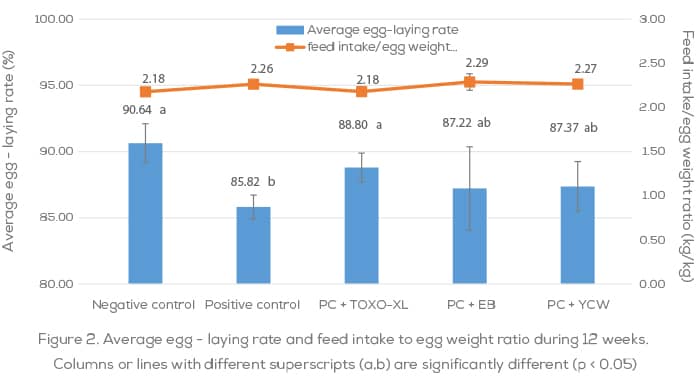 In the present study, however, three mycotoxins were combined and each of them was applied at moderate level. The adverse effect on liver weight observed in this study is mainly attributed to AFB1 and OTA, while the deteriorated egg production and feed conversion efficiency are considered as the consequence of combined effects of all three mycotoxins. The study also proves that in addition to mycotoxin binding, technologies to improve animal intestinal integrity and immunity should be included as part of a total solution to multiple mycotoxins.