


Poultry is more susceptible to heat because of its rapid metabolic rate and high growth. The detrimental effects of heat stress can be seen on production performance, body temperature, intestinal health, appetite hormone regulation, immune responses, and antioxidative characteristics. Bioactives in phytogenic feed additives with antioxidant activity, such as polyphenols, could serve as a means to alleviate heat stress.

Global Technical Manager – Poultry
Delacon Biotechnik GmbH
According to an analysis by NASA (2022), the past eight years have been the warmest since modern recordkeeping began in 1880. This remarkable escalation in global environmental temperature poses severe implications to the farming sector due to stress-associated problems such as growth depression and poor efficiency. High ambient temperature is one of the major stressors in the poultry production system, which increases production costs and severely damages the meat quality.
The massive economic losses induced by extremely high temperatures during the summer are often disastrous for poultry farming. St-Pierre et al. (2003) calculated that the U.S. livestock production industry suffers a severe loss of $1.69 to $2.36 billion due to high environmental temperature, out of which the poultry industry accounts for the loss of $128 to $165 million.
Poultry is more susceptible to heat because of its rapid metabolic rate and high growth. Due to the lack of sweat glands, body covered with feathers, and bred for increased productivity, birds face problems releasing heat from the body and are therefore more sensitive to heat stress. The detrimental effects of heat stress can be seen on production performance (growth reduction, meat quality loss), body temperature, intestinal health, appetite hormone regulation, immune responses, and antioxidative characteristics.
HEAT STRESS RESULTS IN THE PRODUCTION OF REACTIVE OXYGEN SPECIES (ROS)
ROS production increases when a bird experiences heat, triggering and modulating cell signaling activities. During severe heat stress, ROS production in mitochondria overwhelms antioxidant reserves, resulting in oxidative damage to proteins, lipids, and DNA.
Acute heat stress results in ROS production, which antioxidant enzymes could neutralize. Chronic heat stress results in excessive ROS generation, further producing oxidative injury.
Oxidative stress damages the intestinal mucosa, prevents the efficient digestion and absorption of nutrients and adversely influences average animal growth. High ambient temperature causes oxidative stress leading to reduced aerobic metabolism and enhanced glycolysis, resulting in poor meat quality characterized by low pH and high drip loss (Vandana et al., 2020).
ROLE OF HEAT SHOCK PROTEINS DURING HEAT STRESS
To maintain thermal homeostasis, the bird’s body must enter a stage of oxidative stress. It starts producing and releasing heat shock proteins (HSP) to protect itself from the delirious cellular effects of ROS.
Numerous studies in broiler chickens exposed to heat stress reported an upregulated gene expression of HSP70 and HSP90 has been observed in muscle, liver, heart, kidney, and blood vessels during acute heat stress (Surai et al., 2015).
METABOLIC HEAT PRODUCTION IS REDUCING FEED INTAKE AND NUTRIENT DIGESTIBILITY
As an adaptive mechanism to minimize metabolic heat production, reduced birds’ feed intake is one of the biggest causes of economic losses.
With every increase of 1°C above 30°C, feed intake is expected to decrease by 4-5%, causing a deficiency of nutrients needed for optimum production. A study from Awad et al. (2019) on broilers reported around 8% reduction in feed intake, 17% reduction in body weight gain, and around 10% increment in feed conversion ratio when the birds were exposed to 34°C for 6 hours per day from 22 to 35 days of age.
Another study from de Souza et al. (2016) on broilers revealed that heat stress significantly compromises growth performance by reducing protein digestibility up to 9.7%. It also showed an increase in metabolizable energy intake (20.3%) and heat production (35.5%) and a decrease in energy retention (20.9%) and energy efficiency (32.4%). Poor nutrient availability disrupts normal lipid metabolism (lipolysis) and causes a sharp decline in muscle glycogen reserves, leading to dark, firm, and dry (DFD) meat.
 HEAT STRESS DETERIORATES MEAT QUALITY
Heat stress reduces the deposition of protein and intramuscular fat in the breast muscle, significantly increasing the muscle’s lactic acid production, resulting in pale, soft, and exudative meat (PSE), which has become a significant concern in the poultry industry (Vandana et al., 2020). Heat stress during transport has been associated with increased mortality rate, decreased meat quality, and reduced welfare status.
Similarly, before slaughtering, heat stress may increase the metabolic rate and rigor mortis resulting in protein denaturation (Nawaz et al., 2021). This hinders the ability of proteins to bind water and culminates in a poor water-holding ability characterized by higher drip loss and cooking loss.
HEAT STRESS NEGATIVELY AFFECTS THE SMALL INTESTINE AND GUT MICROFLORA
Heat stress may result in impaired peripheral blood circulation, locally depriving the small intestine of oxygen, leading to ischemia and consequently oxidative stress. This further may lead to a reduction in small intestinal weight, the number of villi, and enterocyte proliferation, which considerably reduces performance due to inadequate intestinal development and nutrient absorption (Ayo and Ogbuagu, 2021).
Heat stress also changes ion pump activity and increases the permeability of tight junctions of the small intestinal epithelium (Goel, 2020). This condition tends to compromise the tight junction barrier, which leads to leakage of luminal substances onto the bloodstream, the so-called “leaky gut.”
During stressful situations, microbial communities in the intestine can become dysfunctional, increasing the risk of colonization of harmful pathobionts. Increased production of ROS during heat stress can raise intestinal permeability leading to the translocation of bacteria and their endotoxins from the intestinal tract into the circulation. This will likely enable the penetration of potentially harmful bacterias such as Salmonella sp., Clostridium sp., and Escherichia coli through the gastrointestinal tract.
PHYTOGENIC FEED ADDITIVES (PFA): A PROVEN TOOL TO OVERCOME HEAT STRESS
Several nutritional strategies effectively reduce the negative effect of heat stress by maintaining energy intake and electrolytic/water balance. Vitamin E and C were found to be the foremost compelling, enhancing feed intake and body weight of broilers reared under heat stress conditions (Nawaz et al., 2021). Apart from these common ingredients, other additives such as probiotics, prebiotics, botanical substances, betaine, etc., have also been presented to alleviate some of the adverse effects of heat stress (Goel, 2020)
Bioactives in PFA with antioxidant activity, such as polyphenols, could serve as a means to alleviate heat stress. By elevating antioxidant enzyme activities and inhibiting lipid peroxidation, these substances can reduce intestinal mucosal oxidative injury and ROS‐associated gene expression (Vandana et al., 2020).
Specific PFA bioactives can also module the heat shock proteins to protect the integrity of the intestinal mucosa of heat‐stressed broilers. They can boost the expression of stress response proteins such as HSP via HSP70-leptin signaling pathways and antioxidant enzymes to improve feed intake in heat stress in broilers (Surai, 2015).
By Tang et al. (2018), purified rosemary extract could induce high levels of HSP70 and CRYAB in chicken in vivo myocardial cell model and, therefore, could be used to alleviate heat stress in broiler chickens. Resveratrol could inhibit the higher HSP expression, antagonise the NF-kB and initiate the expression of tight junction mRNA, resulting in alleviation of heat stress-induced impairment of the intestine and better performance of broilers (Zhang et al., 2017). The incorporation of cinnamon powder improves oxidative stability by increasing superoxide dismutase (SOD), catalase, and total antioxidant capacity and lowering corticosteroid concentrations (Vandana et al., 2020).
Phytogenic feed additives such as essential oils or spices can improve nutrient digestion and utilization by stimulating digestive enzyme production and activity, higher secretion of bile acids, and enhanced activities of trypsin and amylase. PFA can thus effectively counteract heat stress-related reduction in feed intake and enhance nutrient digestibility (Windisch et al., 2008).
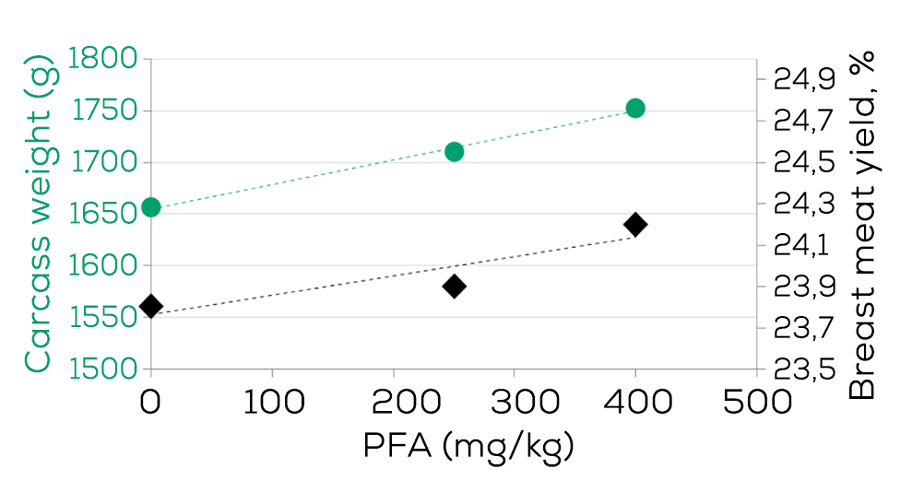
PROTECTIVE EFFECTS OF PFA ON GROWTH PERFORMANCE IN CYCLIC HEAT-STRESSED BROILERS
A commercial PFA (“Comfort”, Delacon Biotechnik GmbH, Austria) has been evaluated for growth parameters and carcass quality traits, as well as its potential underlying molecular mechanisms in broilers exposed to chronic cyclic heat stress in a trial at the University of Arkansas, USA. Greene et al. (2020) study, is published and available in the public domain. A summary of the content of the published article is discussed below.
600 1-d-old Cobb 500 male chicks were randomly assigned to 12 environmentally controlled chambers. The ambient temperature in the chambers gradually decreased from 32°C on day 1 to 24°C on day 21. At 8 AM on day 21, the temperature was increased to 35°C in 6 of the chambers to induce heat stress. This temperature was maintained for 12 h (from 8 AM – to 8 PM) daily and was reduced to 24°C each night to mimic the summer season. Pens were randomly assigned to treatments: 3-phase corn- and soy-based diet control or added with two different inclusion rates of PFA (250 and 400 ppm) diet in the grower (days 12–23) and finisher (days 24–42) phases.

Under heat load conditions, adding PFA reduced core body temperature by 0.5°C to 0.7°C in an additive inclusion rate-dependent manner compared with the control group. Adding PFA stimulated appetite and increased energy intake in heat stress conditions in an inclusion rate-dependent way, resulting in higher B.W. ( ̴100 g, P < 0.05 ) and averaged 4 FCR-points better in PFA -fed birds compared with the control group.
PFA addition at both inclusion rates significantly downregulated the hypothalamic HSP70 expression (mRNA and protein levels) compared with the control group (Fig.2), reducing hypothalamic intracellular stress. The effect of PFA on growth performance in this study seemed to be mediated by hypothalamic feeding- and drinking-related polypeptide expression.
Under the conditions of this study, the addition of botanical substances as novel nutrients to alleviate heat stress has proven to be advantageous in reducing the impacts of climate stress on broilers. PFA are formulated to mitigate heat stress productivity losses in broilers via reduction of intracellular stress and stimulation of digestion during heat stress.
References upon request.
About Mojca Osredkar Mergole
Mojca Osredkar Mergole is a doctor of veterinary medicine and started her professional career as a livestock and pet veterinarian. In 2013, she joined a company producing natural feed additives as a product manager responsible for natural feed additives for poultry. She focuses on feed additive development, operational and technical support to internal company departments and foreign agents (worldwide).
She started working at Delacon in November 2021 as Global Technical Manager for Poultry.