


Micro encapsulated phytogenics are transforming poultry nutrition, moving beyond early herbal blends toward precision formulations that stabilize active compounds and target their release in the digestive tract. These innovations promise improved feed efficiency, growth performance, and gut health while addressing handling and processing challenges. Trials show measurable economic benefits, yet the full potential of combining plant and marine bioactives continues to evolve, inviting further exploration.

R&D Director
Nuqo Feed Additives
THE CHANGING FACE OF PHYTOGENICS
In the 1980s and 1990s, when phytogenic feed additives first emerged on the market, they were greeted as a natural and promising alternative to antibiotic growth promoters (AGPs). Formulated from herbs, spices, and other aromatic plants, these early blends brought a welcome “green” dimension to poultry production. They were embraced for their antimicrobial effects, ability to stimulate digestion, and potential to improve feed efficiency. But they were also products of their time – created with limited manufacturing technologies, reliant on volatile compounds that often degraded during feed processing, and typically built on formulations shrouded in mystery. For many years, the sector saw incremental progress rather than transformational change.
The global ban on AGPs brought phytogenics into the spotlight, especially in broiler production, where nutritionists sought natural tools to close the performance gap left by antibiotics. These plant-based solutions broadened their scope: They could modulate gut microbiota, reduce inflammation, stimulate enzyme activity, and strengthen gut lining integrity. Yet, despite their promise, first-generation phytogenics were hampered by three recurring challenges: Stability during feed processing, palatability and handling safety, and a lack of transparent formulation backed by solid scientific evidence.
Today, the sector stands at a turning point. The market is no longer satisfied with generic herbal blends that depend on marketing rather than measurable results. Instead, poultry producers are demanding precision, consistency, and proof. This has given rise to a second generation of phytogenics, products designed with advanced extraction techniques, rigorous quality control, and above all, manufacturing innovations such as micro-encapsulation that allow active compounds to survive processing and reach their target site in the digestive tract. This shift is not just a matter of science; it is transforming poultry farm economics by delivering higher feed efficiency, better growth rates, and measurable returns on investment.
MOVING BEYOND THE “BLACK BOX” ERA
The early generation of herbal blends reflected the technological capabilities of their time. Simple grinding, milling, or crude distillation were used to obtain plant extracts, but these methods often failed to protect sensitive molecules from the heat, moisture, and pressure of feed manufacturing. Volatile oils would evaporate, phenolic compounds would oxidize, and efficacy could vary dramatically from one batch to the next. Worse, many products were dusty and irritant for feed mill workers, and their strong aromas sometimes reduced feed intake in poultry.
Modern poultry farming demands more. Today’s second-generation phytogenics address these shortcomings with a combination of scientific transparency and cutting-edge processing. One of the most transformative innovations is micro-encapsulation. Unlike simple coating, which offers limited protection, micro-encapsulation allows active ingredients to be embedded in a protective matrix. This stabilizes volatile compounds during storage and processing, ensures uniform distribution in feed, and enables targeted release exactly where they are most effective; usually in the small intestine, where nutrient absorption is most critical.
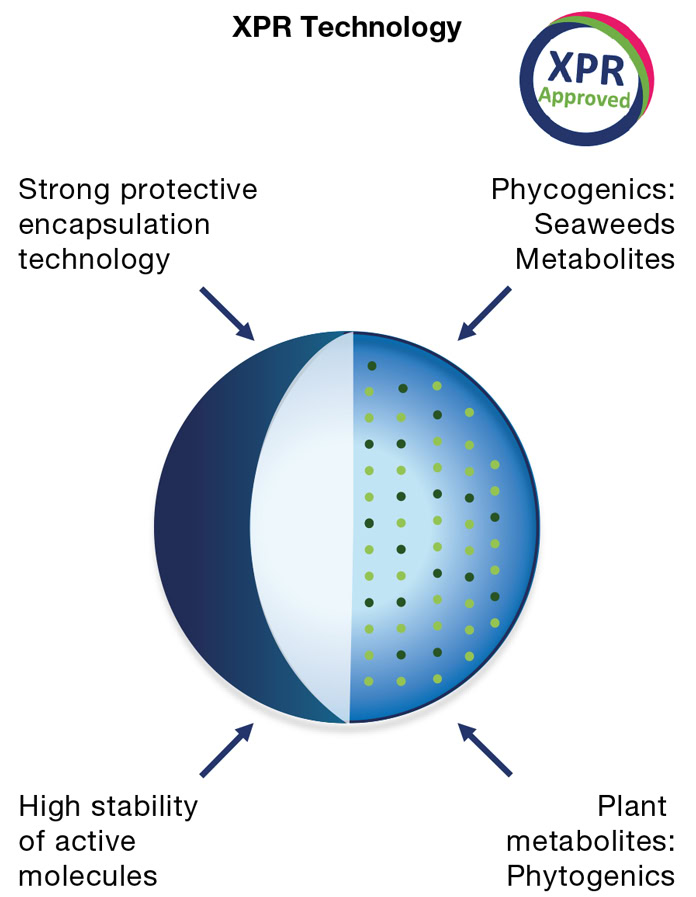 This precision is particularly valuable in poultry farming; indeed without targeted release, much of a phytogenic’s potential can be lost before it can act. Encapsulation also solves key safety and handling issues. Dust-free granules improve working conditions in feed mills, while the controlled aroma prevents negative effects on feed intake. Nuqo’s solution lies in XPR Technology, a proprietary micro encapsulation process that physically protects these sensitive bioactives and delivers them where they are needed most in the animal’s gastrointestinal tract. Unlike simple coatings or standard encapsulation, XPR creates multiple protective layers, ensuring thermal stability during pelleting or extrusion, preserving efficacy, targeted release in the intestine, where bioactives can exert the greatest effect and synergistic action between plant and seaweed components, boosting immune function, modulating gut microbiota, and improving nutrient utilization (Figure 1).
The technological leap is not only in the delivery system but also in the source of active molecules. While plants remain at the core of phytogenic development, the exploration of marine algae (phycogenics) is opening new frontiers. Certain algae metabolites have shown unique effects on gut health and immunity, adding complementary modes of action to those of traditional herbs and spices. The combination of plant and algae bioactives, delivered through robust micro-encapsulation, is setting a new industry standard for efficacy, stability, and profitability.
TRIAL RESULTS – MEASURING PERFORMANCE, PROVING PROFITABILITY
The transition from first-generation herbal blends to high-precision phytogenics is not just theoretical. Trials around the world have repeatedly demonstrated the tangible benefits of these advanced formulations in commercial poultry production. One example is Nuqo NEX (NQ), a second-generation solution combining high concentrations of active metabolites from both plants and marine algae, protected by proprietary micro-encapsulation technology. The formulation ensures superior concentration and stability compared to conventional solutions, integrating phytogenic compounds derived from thyme, cinnamon, and clove with phycogenic bioactives from Ascophyllum nodosum.
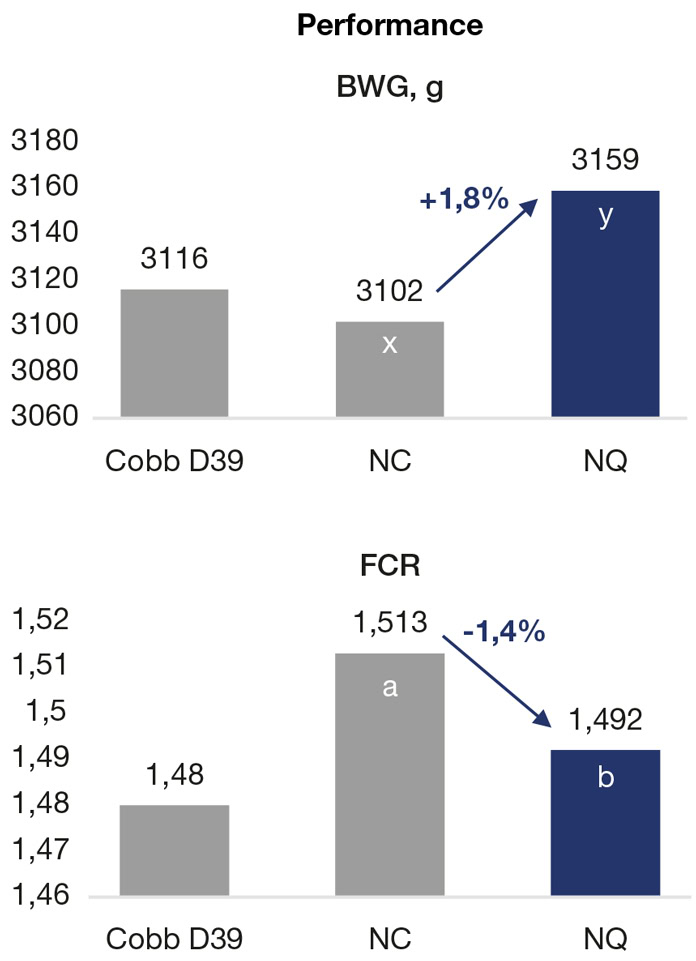 In a 39-day trial at the University of Arkansas, male Cobb 500 broilers were raised on a standard US three-phase diet (Starter, Grower, Finisher). Starter feeds were pelleted and crumbled, while Grower and Finisher diets were fed as pellets – conditions that typically challenge the stability of volatile phytogenic compounds. NQ was applied at 100 g/ton from day 0 to day 39 in the treatment group, while the control group received the basal diet only (Figure 2).
By the end of the trial, control birds achieved body weight gains close to their genetic potential. Yet, the NQ group gained an additional 57 grams per bird and improved feed conversion ratio by 2.1 points compared to controls. In practical terms, this meant that the supplemented birds not only matched but exceeded their genetic performance expectations for body weight, while moving closer to optimal feed efficiency. Economic analysis, based on prevailing US feedstuff prices, calculated a return on investment of 3:1 for the farm, demonstrating that the additional cost of supplementation was more than offset by gains in performance.
Beyond growth and feed efficiency, NQ supplementation improved carcass and breast yields without increasing the incidence of meat quality defects such as woody breast or white striping. Other meat quality parameters, including pH, drip loss, and color, were unaffected, confirming that the performance improvements did not come at the expense of product quality.
This trial is part of a broader body of evidence, with over 30 studies worldwide documenting the benefits of this second-generation technology across broilers, layers, and other species. The consistency of results, across different diets, climates, and feed processing methods, highlights one of the most important advantages of high-precision phytogenics: they work reliably in real-world conditions, not just in laboratory settings.
A NEW STANDARD FOR POULTRY NUTRITION
The evolution of phytogenics from generic herbal blends to high-precision, micro-encapsulated formulations marks a decisive turning point in poultry nutrition. The first generation played an important pioneering role, introducing the concept of plant-based performance enhancers and paving the way for antibiotic-free production. But the demands of modern farming, greater transparency, consistent efficacy, worker safety, and demonstrable economic returns, have rendered many of these older solutions obsolete.
Second-generation phytogenics, exemplified by products like NQ technology, offer a fundamentally different value proposition. They combine carefully selected plant and algae bioactives, produced and processed with scientific precision, and delivered through micro-encapsulation that protects, stabilizes, and targets their activity. The result is a reliable improvement in performance metrics such as body weight gain and feed conversion, alongside enhanced meat yield and quality, all translating into measurable profitability for the farmer.
For an industry facing tight margins, volatile feed prices, and increasing consumer demand for sustainable production, these innovations are more than just an upgrade – they are a necessity. Continued research into new natural metabolites, coupled with further refinement of encapsulation and delivery technologies, promises to push the boundaries of what phytogenics can achieve.
The era of herbal blends as “black box” solutions is over. Poultry producers now have access to transparent, scientifically validated, and economically proven phytogenic technologies. The next decade will likely see these high-precision products become the norm, setting new standards for performance, profitability, and sustainability in poultry farming.
About Dr. Stephanie Ladirat
Currently working as Nuqo’s Technology Director, Dr. Stephanie Ladirat obtained her MSc degree in Food Technology with a specialization in Food Ingredient and Functionality and her PhD degree in Food Chemistry from Wageningen University (The Netherlands). During her PhD thesis, she studied in depth the human gut microbiota composition and its modulation upon prebiotic supplementation and/or antibiotic treatments. From 2014 till 2020, she worked at Cargill Animal Nutrition, first as technology lead for gut health additives and, then, as swine portfolio manager. She provided global technical product support for a broad range of products (phytogenics, organic acids, short and medium chain fatty acids, probiotics) and trained technical and sales teams. She most recently managed R&D projects and developed innovative feed additive solutions to answer specific customer needs related to animal gut health and performance.