


How can we meet the requirements of cows during transition period and especially at hot summer times? It is important to provide high-quality feed and to closely monitor the animals. Good barn conditions help to create an environment that is as stress free as possible. The provision of palatable and high-quality roughage to supply dairy cows with both, nutrients and structural feed is also important. Supplements which support the forestomach functions and/or supply additional energy are helpful for rumen stimulation.

Product Manager Ruminants – Dietary Feed Supplements
Biochem Zusatzstoffe Handels- und Produktionsgesellschaft mbH
During transit period cows face enormous physiological challenges. This period influences the lactation and its success. Cows undergo changes in the energy requirements, the utilization and metabolism of fat and protein and in the utilization of calcium, as well as at hormonal level. If these changes are not ideally managed, many health problems can occur.
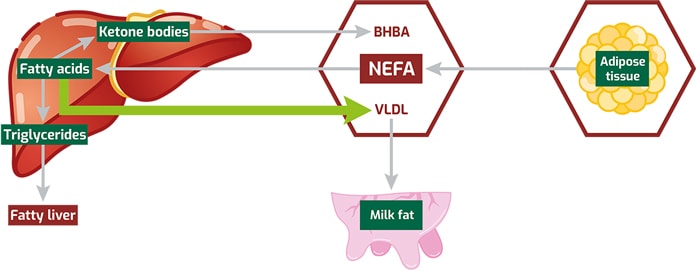
Milk yield and energy intake influence the energy balance of dairy cows enormously. If the energy requirements exceed the energy consumption (which is often the case due to low feed intakes around calving), fat reserves are mobilized and used for energy production in the liver. But at high rates of body fat-mobilization, not all fatty acids can be used in the energy metabolism. The consequence is the production of ketone bodies and an increased risk of ketosis and the development of other diseases such as abomasal displacement or uterine inflammation1. A decreasing milk performance is another consequence1!
IMPORTANCE OF THE FEED INTAKE
Dry matter intake positively effects the energy balance, metabolic health and lactation performance2. But during parturition and in periods of higher environmental temperatures the feed intake might be reduced immensely. Cows with low feed intake have higher risk of developing typical fresh cow diseases like ketosis. Consequently, the aim is to ensure high dry matter intakes!
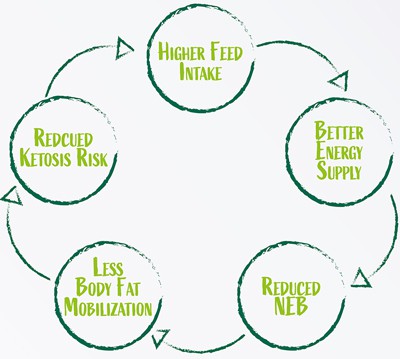
How can we meet the requirements of cows during transition period and especially at hot summer times? It is important to provide high-quality feed and to closely monitor the animals. Good barn conditions (herd size, feeding space and management) help to create an environment that is as stress free as possible. The provision of palatable and high-quality roughage to supply dairy cows with both, nutrients and structural feed is also important. Supplements which support the forestomach functions and/or supply additional energy are helpful for rumen stimulation.
Energy-Top is a combination of energy providing substances, feed preserving effects and liver supporting agents to support the cow during the transition period and the lactation in an optimal way.
The glucogenic precursor glycerin included in Energy-Top is a sweet tasting liquid which improves the feed intake. In the rumen, one part of glycerin is fermented into volatile fatty acids3. Propionate is used in the energy metabolism and butyrate can be used as energy source by the ruminal epithelium. The other part of the glycerin can be absorbed and enters the gluconeogenic pathway4 in the liver where it is converted to glucose. Consequently, glycerin not only increases the feed intake due to its sweet taste but also improves the energy supply. Providing enough substrate and substances for glucose production is crucial in heat stressed dairy cows.
Energy-Top contains organic acids which lead to a higher freshness of the total mixed ration. Spoilage agents can cause loss of nutrients and can affect health and performance of dairy cows. In preventing the reheating of the diet, these risks are reduced. Especially during periods of rising temperatures, the freshness of feed is very important!
Moreover, betaine is included in Energy-Top. Betaine can be easily used as a source of nitrogen by the ruminal microbes. The part of betaine which is absorbed directly, supports the liver to eliminate the metabolized body fat and therefore has a positive impact on the liver function, too.
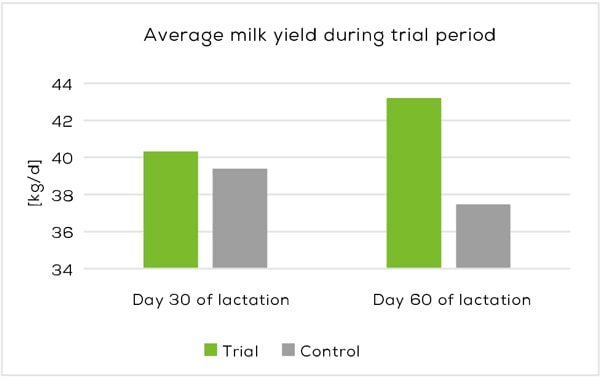
Another benefit is, that the supplementation of Energy-Top in dairy cows results in higher performances due to its well selected formulation (see results of a trial group supplemented with Energy-Top in figure 3).
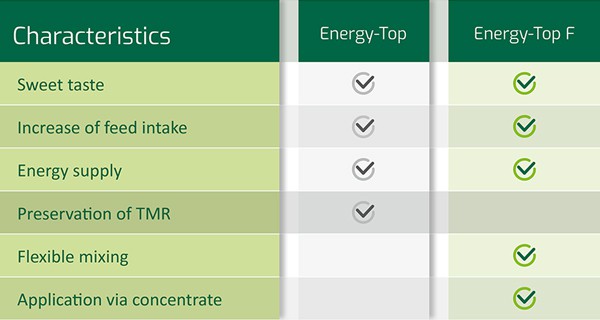
With Energy-Top F an optimal solution for the use in milking robots or feeding stations is created. Energy-Top F also provides energy and betaine to support fresh-calved dairy cows. It is very flexible in application and can be easily sprinkled on concentrate feed or sprayed over roughage for example. The benefits of both solutions are shown in table 1.
To sum up, Energy-Top and Energy-Top F provide energy for dairy cows and increase the feed intake in order to improve ketosis management on dairy farms and to support the cow during periods of heat stress.
Literature:
1 LeBlanc, S. Monitoring metabolic health of dairy cattle in the transition period. Journal of reproduction and Development 56, S29-S35 (2010).
2 Engelhard, T. in 3. Dummerstorfer Seminar – Futter und Fütterung. (Dezember 2014).
3 Wang, C. et al. Effects of glycerol on rumen fermentation, urinary excretion of purine derivatives and feed digestibility in steers. Livestock Science 121, 15-20 (2009).
4 Goff, J. P. & Horst, R. L. Oral glycerol as a gluconeogenic precursor in the treatment of ketosis and fatty liver. Acta Veterinaria Scandinavica 44, 1-2 (2003).
About Dr. Tanja Krägeloh
Dr. Tanja Krägeloh holds a doctoral degree in Veterinary Medicine from the University of Veterinary Medicine Hanover, Germany. After her graduation, Tanja Krägeloh worked for several years as a practical vet in Northwest Germany. Since 2020, Krägeloh has been responsible for the Ruminants and Equine Dietary Feed Supplement portfolios at Biochem.