


Sustainability is a growing key issue for poultry and swine productions. One of the main social expectations is to remove antibiotics from feeds. Many feed additives could be an alternative to support gut health. Thanks to their proprieties, fatty acid esters can be an excellent solution to alleviate this challenge in monogastric productions.

Research Innovation
Development Manager
Mixscience, Avril Group

Product Manager
Mixscience, Avril Group

Product Manager
Mixscience, Avril Group
Gut health refers to the physical state and physiological function of the gastrointestinal tract and in the livestock system; this topic is often focused on the complex interacting components of the intestinal system that influence animal growth performance and host-microbial homeostasis. With the antibiotic restriction use in animal production in many countries worldwide, research on the four major components of gut health, including diet (i.e., nutrition), mucosa, microbiome, and the immune system, has received many interest, particularly when alternatives to antibiotic are studied. Amongst these alternatives, solutions based on short and medium fatty acid and their derivatives continued to be widely investigated for a better understanding of their various and beneficial effects on animal health and performance and for the optimization of the efficacy of these compounds for innovative feed additives development.
SHORT AND MEDIUM CHAINS FATTY ACIDS ESTERS: DEFINITION AND PROPERTIES
Fatty acids are commonly categorized as short chain (SCFA; up to 4 C), medium chain (MCFA; from 6 to 12 C) and long chain (LCFA; more than 12 C). The role of SCFAs and MCFAs in control of infection and maintenance of health and integrity of digestive tract has been extensively studied in vitro as well in different animal species. Amongst limiting points that have been reported for their use, it can be cited their handling in industrial environment due to their pungent odor and unpleasant taste.
Moreover, the potential effect of SCFA and MCFA without any protection would be limited because of prompt absorption and metabolism or both in the gastric area of the intestinal tract. New products have been developed through the formation of calcium and/or sodium salt with the fatty acids or esterification of these acids prior to addition to feed. Esterification has an important advantage as the esterified SCFA and MCFA escape gastric digestion thus reaching the small intestine where they can exert their effect. When these acids, in salt or esterified form are fed to animals, positive effects on growth performance, intestinal microbial growth and health status of the animals are observed.
Different mode of actions has been described to explain how short and medium fatty acids and their esterified forms can improve animal health and performance. These mechanisms involved the ability of these compounds to:
 • Maintain a healthy balance of bacteria in the gut
Fatty acid esters contribute to a healthy gut balance by their antimicrobial properties, their ability to limit the invasion of intestinal epithelial cells by pathogens and to maintain microbiota with sufficient level of beneficial bacteria.
Regarding their activities toward pathogens, the effect of fatty esters is both bactericidal (killing) and bacteriostatic (growth-inhibiting) depending on the length of the carbon chain, concentration, synergism among them, and target bacterium. The SCFAs and AGCM of C6-C10 act preferentially on Gram-negative bacteria such as E. coli, Salmonella and Campylobacter by limiting the adhesion and therefore the colonization of these bacteria on the intestinal cells. AGCMs with C12, such as lauric acids and derivatives, are particularly known for their effectiveness against Gram-positive staining bacteria, such as Clostridium perfringens, Staphylococcus spp. and Enterococcus spp. due to the easy-to-reach amphiphilic phospholipid double layer. Indeed, Gram negative bacteria have a more complex membrane structure that is more difficult to access.
Membrane destabilization by the incorporation of fatty acid esters into the bacterial cell wall and cytoplasmic membrane, as well as the inhibition of bacterial lipases, which are necessary for the colonization of the skin and the intestinal mucosa, may be the main mode of action.
Lipid-encapsulated viruses and some parasites can also be targets for fatty acids esters; involving also activities of fatty acids esters on membrane degradation, disrupting the functioning of microorganisms and compromising their infectivity.
• Promote the gut maturation and integrity
Challenges due to environment, nutritional stresses or related to health status of animal, can cause changes in intestinal morphology. Initially, a large size of villi is a sign of good digestive health. The absorption surface being important, the food will be well valued. Conversely, a great depth of the crypts is a sign of maldigestion. These crypts are the site of cell renewal. Thus, the shallower the crypts, the faster the renewal and the faster the nutrients are. SCFAs and MCFAs can be directly absorbed and supply energy to promote the renewal and repair of intestinal epithelial cells, maintain the integrity of intestinal mucosal barrier function.
• Modulate the immune system and prevent inflammation
The gastrointestinal tract is not only an important organ for the digestion, absorption, and metabolism of food nutrients, but also the largest immune organ in the body, comprising more than 70% of immune cells. However, in pig and poultry production, animals are always subject to challenges due to the presence of pathogenic microorganisms or environmental factors, which lead to activation of the immune system in the gastrointestinal tract. This activation leads to the production of a diverse set of specialized cells and signaling molecules, in particular pro-inflammatory cytokines such as tumor necrosis factor (TNF)-α, interleukins (IL): IL-1β IL -6, IL-8… The overproduction of these cytokines leads to lesions and dysfunction of the intestinal mucosa and, consequently, poor growth of animals.
There are a lot of evidence regarding the effects of SCFA or MCFA and their derivatives on immunity, antimicrobial activities, animal health and performance. However, according to the types/forms/combinations/ dosages of glycerides, different modes of action, and also, different levels of efficacy can be met. It’s thus indispensable to check the expected activities of these associations through in vitro and in vivo trials. The results described below indicate that short and medium fatty acid esters blend, like Lumigard Most, demonstrates antimicrobial, physiological, and immunological properties and has positive effects on animal health and performance in broiler chickens and piglets.
ANTI-MICROBIAL AND ANTI-INFLAMMATORY ACTIVITES OF FATTY ACID ESTERS: IN VITRO-RESULTS
Minimum inhibitory concentrations (MICs) are defined as the lowest concentration of an antimicrobial that will inhibit the visible growth of a microorganism after overnight incubation. MICs values are considered the “gold standard” for determining the susceptibility of bacteria to the antimicrobials and are commonly used to test alternatives to antibiotics. When evaluating the antimicrobial effect of a blend of fatty acid esters solution, it appeared particularly efficient toward Gram positive bacteria, with MICs value ranged from 32 ppm for Clostridium perfringens to 250 ppm for Streptococcus suis and Campylobacter jejuni (Table 1).

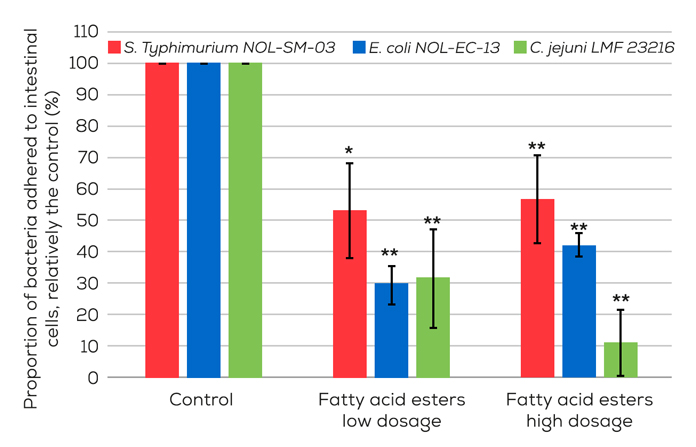
The symbols “*” (p ≤ 0.05) and “**” (p ≤ 0.01) indicate significant differences
compared to the control.
By limiting the colonization on epithelial cells, the specific association of different fatty acids esters allowed to broaden the spectra of action specially toward Gram negative bacteria, such as Salmonella spp., a main issue in a sanitary point of view. Bacterial competition assays were carried out in order to evaluate the capacity of the fatty acid esters blend to limit the adhesion of strains of S. Typhimurium, E. coli and C. jejuni on HT-29 intestinal cells. For this, the blend was introduced simultaneously with the bacterial strains then left in contact for 2 hours. For each of the strains tested, the percentage of adhesion varied from 30% to 55% compared to the control (without fatty acid esters). This result highlights that the tested solution significantly reduces the proportion of bacteria adhered to intestinal cells (Figure 1).
Another key component of gut health is the effect of solution on inflammation. An overreaction of the immune system consumes energy that would otherwise have been used for animal growth. A positive effect on the immune response also reduces the risk of secondary infection. Fatty acid esters have shown to limit the overreaction of the immune system by reducing the level of pro-inflammatory mediators as illustrated in Figure 2.
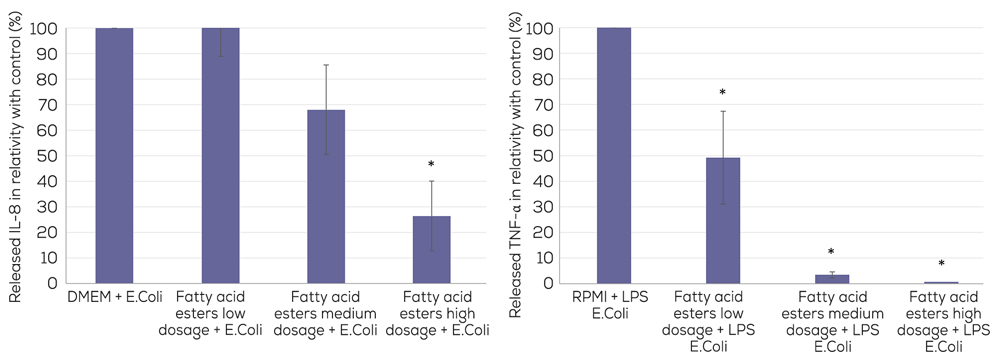
The symbols “*” (p ≤ 0.05) and “**” (p ≤ 0.01) indicate significant differences compared to the control.
BENEFITS IN PIGLETS: FATTY ACID ESTERS REDUCE THE COLONIZATION OF STREPTOCOCCUS SUIS (SS9)
Streptococcus suis is a widespread swine pathogen causing sepsis, meningitis, and other infections, often requiring antibiotics use to control diseases. The upper respiratory tract is believed to be the primary transmission route of S. suis and the gastro-intestinal tract the secondary one. To be able to cause clinical infection S. suis has first to adhere and colonize in the animal and then to translocate through epithelial barrier, spread in connective tissues, lymphatic system and blood stream and to infect different organs. After being transmitted nasally or orally, S. suis can colonize the palatine tonsils of pigs and induce negative effects on animal.
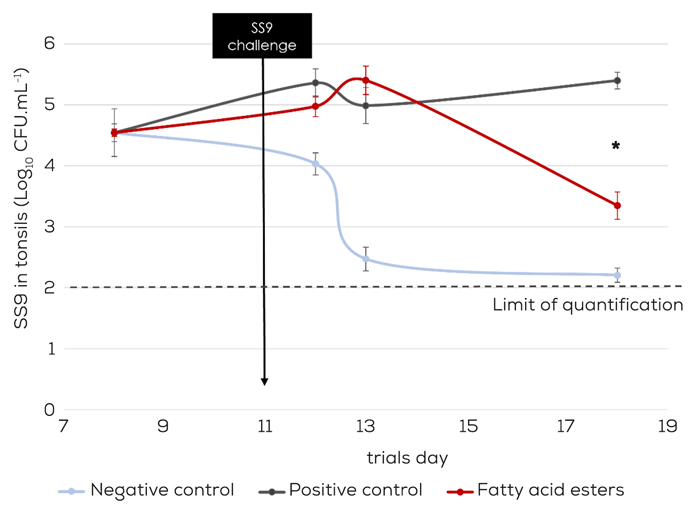
To comfort previously CMIs data obtained in vitro toward this pathogen, a trial was conducted to describe effects of a fatty acid esters-supplemented premixture in weaned piglets challenged with serotype 9 (SS9). At weaning, 30 piglets were allocated to 3 groups: unchallenged with control diet, challenged with control diet (positive control), challenged with fatty acid esters supplemented diet (FA-esters). All piglets received an adaptation diet during the first week after weaning, then groups positive control and FA-esters were inoculated with SS9 (isolate 2524) via oral and nasal routes with 3 mL at the dose of 1.0 x 10⁹ CFU/mL per route. Piglets from negative control receiving phosphate buffer saline instead.
Results showed that SS9 concentration decreased in negative control and +FA esters, from 4.0 to 2.2 and 4.9 to 3.2 Log10 CFU.mL-1, respectively. In +C, SS9 concentration remained constant (5.4 Log10 CFU.mL-1) (Figure 3). This trial highlighted the beneficial effects of fatty esters supplementation to reduce S. suis colonization in piglet tonsils.
BENEFITS IN POULTRY: FATTY ACID ESTERS CONTRIBUTE TO GUT HEALTH BY THEIR EFFECTS ON MICROBIOTA AND INTESTINAL CELLS
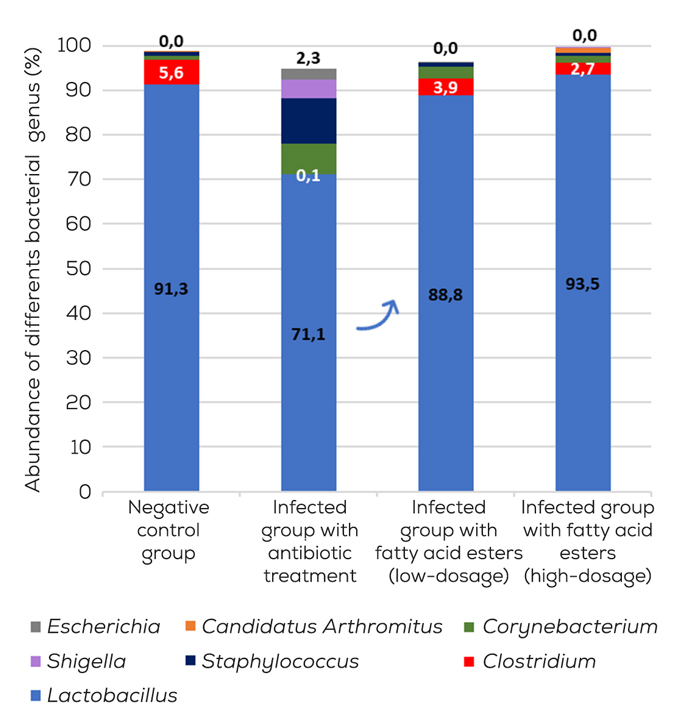
Through an in vivo trial performed on a necrotic enteritis (NE) model on broilers, comparing 4 groups on 110 animals per group: Control (infected untreated), Positive Control (control with antibiotic), 2 groups with low and high dosage fatty acid esters- supplementation, it has been observed a positive effect of supplementation on the reduction of Clostridium perfringens. Microbiota relative abundance of Clostridium was reduced by an average of 30% and 50% in fatty acid esters groups, respectively, compared to control. In treated group, antibiotic was highly efficient toward Clostridium spp. (less than 0.05% of abundance). However, the beneficial Lactobacillus bacteria were also significantly reduced (71% relative abundance vs 91.3% in control), associated with an increase of the genus Corynebacterium, Staphylococcus, Shigella and E. coli, that represented respectively above 7%, 10%, 4.5% and 2.5% of the microbiota. Fatty acid esters supplementation limited the predominance of these opportunistic bacteria (Figure 4).
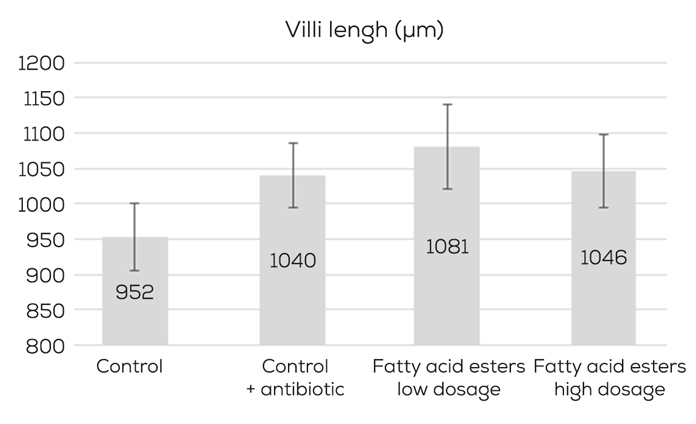
In concert with the antimicrobial effect and their ability to balance the microbiota with the maintaining of the beneficial microflora, inclusion of fatty acid esters has shown direct effects on the histomorphology of the gut by increasing the villus length (Figure 5). Herein, supplementation of fatty acids esters may facilitate the nutrient absorption, maximizing nutrient utilization and that in turn growth performance in broiler chicken (-0.02 to 0.04 pts of ICC).
CONCLUSION
With growing evidence, fatty acids esters solutions appeared as useful in preventing and mitigating microbial disease in animal production and represent, thus, a relevant alternative to antibiotics use. The complementary effects of association carefully selected ingredients in various animal challenges, allow to combine multiple modes of action in the gut, such as antimicrobial, physiological, and immunological properties contributing also to better health and performance in broiler chickens and piglets.
About Dr. Clarisse Techer
Clarisse Techer obtains a Msc degree in Microbiology at the Rennes 1 University (Fr) in 2009. After this period, she works on the impact of dietary fibers in piglet feed and on the establishment of sensitive and specific immunological methods for the detection of staphylococcal enterotoxins in dairy products. In 2012, she joins the Animal nutrition and processing domain of the Avril group (Fr) and undertakes PhD research in the joint research unit “Science and Technology of Milk and Egg” between Agrocampus Ouest and the National Research Institute for Agriculture, Food and Environment (INRAE). Her PhD work concerned the control of spoiling bacteria in refrigerated food composed of egg products. Since 2015, she works in the Department of Research, Innovation and Development (RID) of Mixscience (Avril group) as researcher in microbiology and then as RID manager. Her main current research interests include animal gut health management, search for alternative solutions to the use of antibiotics in animal feed and mycotoxin risk management.
About Pauline Duménil
Pauline Duménil recently graduated with a degree in agricultural engineering specializing in marketing and sales management of food and agricultural products at VetAgro Sup (Fr) in 2020. She started by working for a veterinary pharmaceutical company. Her mission was to launch a new product for cattle and swine respiratory diseases worldwide. She joined MiXscience in March 2021, first for a temporary assignment but stayed to strengthen the product manager team. Now, her current main mission is to pilot the swine offer of MiXscience innovative feed solutions. She works in collaboration with MiXscience swine experts and commercial teams to promote products in the best way to customers and prospects.
About Claire Le Dain
Claire Le Dain has a Master’s Degree in Agricultural engineering, specialized in animal production, from ESA, in Angers (Fr). She started working as feed formulation specialist in a French firme-services. She joined Avril Group in 2008, first as poultry product manager in France, and has moved to a position of poultry specialist, providing technical support for the Mixscience customers. She has a substantial background in nutrition and zootechnics. She has now the responsibility of monogastric products portfolio, and is in charge of promoting them from their development to their sales in France and abroad.