


Rising costs, antibiotic restrictions, and environmental pressures are reshaping production, highlighting the need for nutritional strategies where functional phytogenics for sustainable animal nutrition play a measurable role. Standardized Quillaja saponins support health, immune balance, and efficiency, helping producers achieve stability, resilience, and sustainability under real farm conditions.

Regional Business Manager
Plantae Labs – Chile
Rising costs, antibiotic restrictions, and environmental pressures are reshaping the animal production industry. Phytogenic ingredients like Quillaja saponins are emerging as standardized, science-based tools to support animal health, efficiency, and sustainability in feed formulations.
EVOLVING CHALLENGES IN SUSTAINABLE PRODUCTION
Animal production today faces a difficult balance between productivity, health, and cost efficiency. Feed variability, fluctuating raw-material prices, and stricter regulations on antibiotic use have intensified the need for nutritional strategies that help animals remain resilient and efficient under farm conditions.
DEFINING QUALITY IN PHYTOGENIC INGREDIENTS
Phytogenic ingredients have gained attention as one of the main strategies to achieve this balance. Yet, their effectiveness relies on controlled production and clear identification of their active ingredients and modes of action.
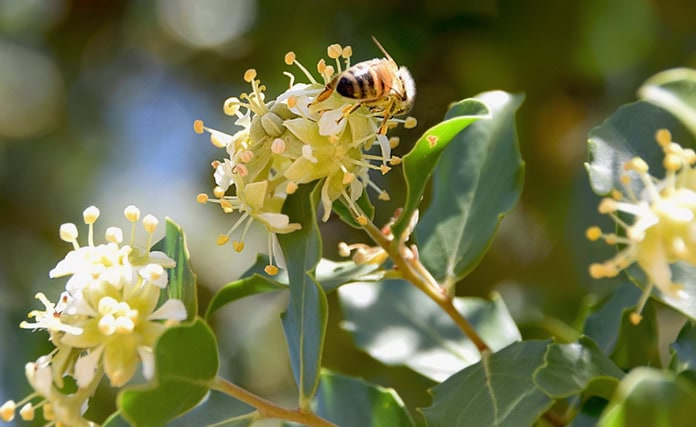
The origin of the material, the production process, and the precision in defining active ingredients determine whether a phytogenic can truly be considered functional. Within this framework, Quillaja saponaria is among the most well-characterized sources used in animal nutrition, supported by extensive scientific evidence and a renewable origin.
The triterpenic saponins of Quillaja saponaria have been widely studied for their biological activity. Highly purified fractions of these molecules are used as adjuvants in licensed human vaccines, including vaccines for malaria, shingles, and COVID-19. Their capacity to modulate immune responses explains the growing interest in using standardized Quillaja ingredients to promote animal health through nutrition.
TWO NATURES OF QUILLAJA-DERIVED INGREDIENTS
From the same raw material, two ingredient types can be obtained through different production processes tailored to distinct functional outcomes:
• Quillaja Extracts: Powder and liquid forms standardized in triterpenic saponins. Their defined composition provides predictable immune modulation and health support while helping control pathogen-related challenges, making them valuable during periods of increased biological pressure or vaccination programs.
• Quillaja Pulverized: Powders containing saponins and polyphenols. They help maintain gut condition and improve environmental quality in barns and ponds through better litter characteristics and significantly reduced emissions.
Both ingredient types share the same origin, sustainability model, and technical control, allowing nutritionists to adapt their use according to health priorities, production phase, and cost sensitivity without changing the underlying scientific foundation.
BIOLOGICAL MECHANISMS AND FIELD OUTCOMES
The biological activity of Quillaja saponins has been described extensively in the literature and further investigated through research programs led by Plantae Labs in collaboration with independent centers.
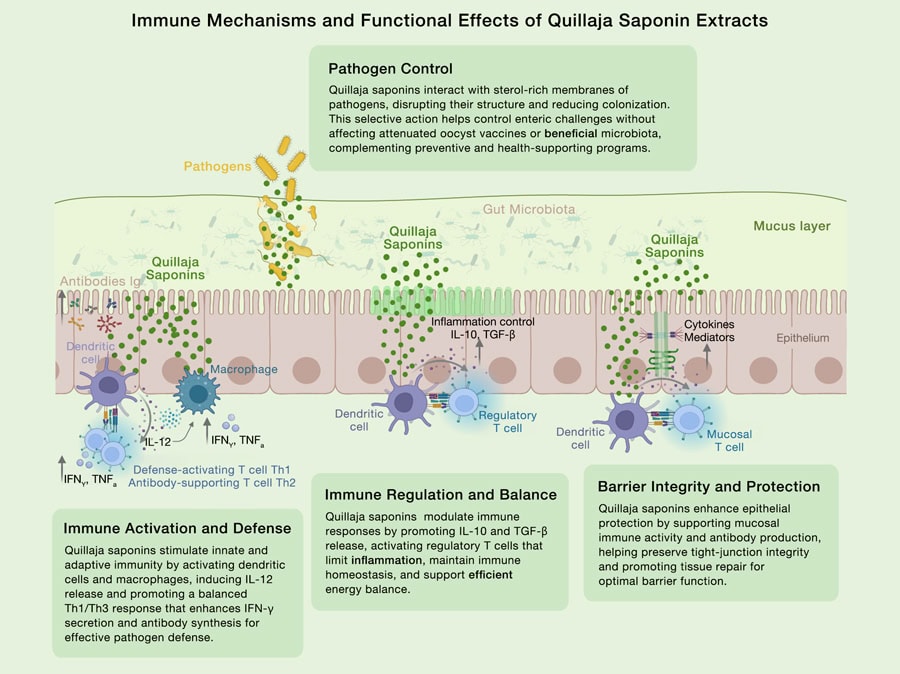 Their primary mechanism is immune modulation. By activating macrophages and T lymphocytes, these compounds help maintain an alert but balanced immune system, capable of responding efficiently to natural challenges without excessive inflammation. This equilibrium supports metabolic efficiency and reduces the energy diverted to immune stress.
The systemic benefits of this immune balance are reflected in healthier animals with more stable growth, improved nutrient utilization, and lower variation within flocks or herds. Better villus architecture and fewer intestinal lesions have been consistently observed, indicating enhanced digestive function and a stronger gut barrier.
As a result, animals show greater resilience, fewer health events, and improved feed efficiency, all contributing to economic and welfare gains.
These mechanisms have been validated in several in vivo studies across poultry, swine, aquaculture, and ruminants, confirming their capacity to mitigate the effects of enteric and pathogen-related challenges. Together, these findings show that defined phytogenic activity can translate into measurable stability and performance in real production systems.
SUSTAINABILITY MODEL AND SUPPLY RELIABILITY
At Plantae Labs, the biological consistency of Quillaja ingredients is supported by a long-term sustainability program. The company’s reforestation and stewardship initiatives for Quillaja saponaria have established more than 400,000 trees and continue expanding every year. This renewable model ensures a continuous and traceable biomass while protecting native biodiversity.
All extraction and quality systems at Plantae Labs are standardized and certified under GMP+ and OMRI Listed, guaranteeing batch-to-batch uniformity and reliable access to markets that demand verified sustainability.
The program also stabilizes raw material supply and cost over time, linking environmental responsibility with commercial reliability.
BRIDGING PERFORMANCE AND SUSTAINABILITY
Achieving sustainable animal production requires more than replacing synthetic additives with natural ones. It depends on ingredients defined by measurable science, reproducible effects, and responsible sourcing.
Quillaja saponins represent this new generation of phytogenic solutions, capable of improving health and efficiency while preserving the ecosystems from which they originate.
By aligning immune balance, gut condition, and cleaner environments with a renewable supply model, standardized Quillaja ingredients allow producers to pursue performance and sustainability as a single, trackable objective.
About Diego González Morgado
Diego González Morgado is Regional Business Manager for America & Oceania at Plantae Labs, Chile. He leads technical and commercial strategies for the Animal Health & Nutrition division, driving adoption of Quillaja-based solutions across poultry, swine, and aquaculture markets while supporting sustainable and science-based animal nutrition programs.