


In this article, I draw on my experience in animal nutrition to explain why critical periods in young animals matter. I also share practical feed strategies to support growth, immunity, and resilience in young animals during these challenging phases.

Category Manager Monogastrics
Hamlet Protein
Everyone who has worked with production animals knows that certain stages in the life cycle of production animals are more critical than others. Universal examples include brooding in poultry, weaning in piglets, and transition periods such as early gestation, farrowing, and onset of laying. Location-specific or operation-specific challenges, such as seasonal challenges, disease outbreaks and management events also demand attention. In my experience, we must address these critical periods from multiple angles, including biosecurity, health, management, and nutrition.
WHAT DEFINES A CRITICAL PERIOD?
A critical period occurs when biological, environmental, and management factors combine to influence performance, health, and profitability.
Characteristics defining critical periods are high physiological demands, abrupt transitions, and limited adaptability. Critical periods are not defined by age alone, but by the interaction between biology and management. When physiology is changing rapidly and coping capacity is low, health, nutrition, and management interventions become crucial for long-term productivity. For poultry and swine, these periods include:
• Early growth stages
• Transition phases
• Reproductive stages
• Stress events
During these times, feed must provide not only energy and protein but also essential vitamins, minerals, and functional additives that support immunity, gut health, and overall resilience.
In this article, I share insights from my years working with feed formulation and animal nutrition. My goal is to provide practical strategies that help farms anticipate critical periods and improve performance and resilience. These ideas come from years of observing farms and feed mills where solutions are tested and refined every day.
BASIC FEED FORMULATION PRINCIPLES FOR CRITICAL PERIODS
Feed formulation goes beyond meeting basic nutritional needs; it’s about strategically supporting animals, especially during their most vulnerable stages, as this can influence growth rates, reproductive performance, and overall health in the short and long term. Understanding these periods and adjusting feed accordingly can make a difference in productivity and profitability.
Formulating feed for critical periods also requires a balance between science and practical experience, considering the next principles:
• Adjust nutrients density: During critical periods animals often cannot consume enough feed to meet their nutrient requirements. High-quality and easily digestible protein, together with clean energy-dense ingredients, and the right balance of essential amino acids, are crucial, adjusting for a minor feed intake.
• Increase digestibility: Young and stressed animals have immature or compromised digestive systems. Ingredients should be highly digestible, and enzymes such as phytase and xylanase, among others should be included.
• Support gut health: The gut is especially vulnerable during early life and stress events. Support gut health with the use of highly and fast digestible protein sources, minimizing anti-nutritional factors. Include feed enzymes to improve nutrient availability and use functional additives such as probiotics, prebiotics, and organic acids.
• Ensure feed intake: Palatability is crucial during periods of low appetite, such as post-weaning or early laying, thus palatable ingredients and the right feed form should be in the checklist for feed formulations during critical periods.
WEANING IN PIGLETS IS A CRITICAL PERIOD
Why is it critical? During weaning, piglets undergo a set of rapid and profound physiological changes driven by the abrupt separation from the sow, transition from milk to solid feed, and exposure to a new environment.
FORMULATION STRATEGIES FOR PIGLETS
• Support early growth: At weaning, piglets transition from milk proteins that are biologically matched to their immature digestive systems to plant proteins that demand digestive and enzymatic capacities that are not yet fully developed.
The inclusion of high-quality protein sources, providing fast-digestible protein, quickly converted into peptides and amino acids, compensates for the low digestive capacity of piglets while stimulating gut development and avoiding free protein in the hindgut.
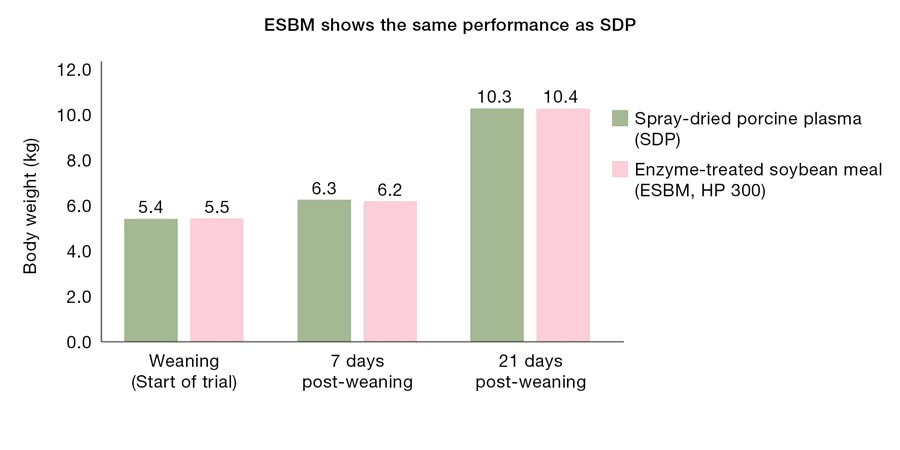
We know that the use of spray-dried blood plasma (SDP) is a well-established nutritional strategy to mitigate weaning stress, however due to different circumstances (e.g. inconsistency, regulations, price, sustainability) many operations have started to look for alternatives. From my experience, enzyme-treated soybean meal, such as HP 300 from Hamlet Protein, can effectively replace spray-dried plasma. Its low anti-nutritional factor load and high digestibility support piglet performance during weaning. Trials show comparable results between these options (Figure 1).
Organic acids in piglet feed also support protein digestion. At weaning, gastric acid production is insufficient, and the stomach pH is often higher than 4.5. Including blends of organic acids best matches piglets’ physiological needs, compensating for low gastric acid production and high pathogen pressure.
The use of enzymes, matching anti-nutritional factors in feed ingredients, is a proven nutritional strategy to enhance nutrient utilization and improve post-weaning performance. They also compensate for the immature digestive system of the piglet, which quickly needs to transition to grain-based feeds.
• Support the immunity gap: The immunity gap in piglets refers to a transitional period of high susceptibility that occurs when passive immunity from the sow declines before the piglet’s own immune system is fully functional. This gap is a biological challenge around weaning and has major implications for health and performance. In my experience, two strategies work together: on one hand, functional ingredients, such as pro- and prebiotics, organic acids, phytogenics, and immunoglobulins, help to lower the pathogenic pressure; on the other hand, functional proteins (e.g. HP ESBM), vitamins (e.g. vit A and vit E), and minerals (e.g. Cu, Se, Zn) help to build the immune system in the young piglet.
• Support gut health: Besides improving digestibility and supporting immunity, it is critical to stabilize the gut microbiota. The use of probiotics, prebiotics, and enzymes shapes microbial composition, activity, and stability by introducing beneficial live microorganisms, providing substrate and the right environment for their growth.
EXPECTED OUTCOMES
Based on my experience, when we prioritize nutrient availability, protein digestion, immunity, and gut health, we can expect:
• Improved growth performance
• Lower incidence of post-weaning diarrhea
• Better feed efficiency and health in later stages
BROODING IN POULTRY IS A CRITICAL PERIOD
Why is it critical? Newly hatched poultry has high nutritional demands for organ growth, especially the gastrointestinal tract, which is developing in terms of size, structure, immune response, and microbial population. Additionally, a transition from yolk-based to feed-based nutrition is occurring, immunity is developing, and thermoregulation is absent.
FORMULATION STRATEGIES FOR POULTRY
• Support early growth: The use of high-quality protein sources, providing fast-absorbable peptides and amino acids to compensate for the low digestion capacity, and to avoid free protein in the hindgut -as it can favor the growth of potential pathogens-, supports the important nutritional demands of this critical period.
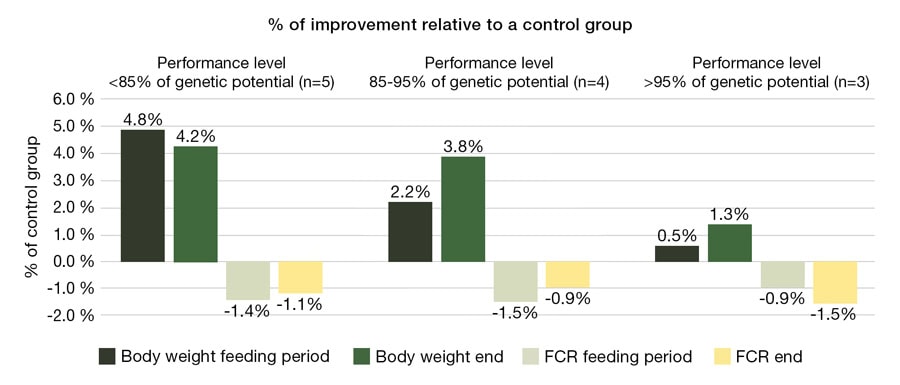
Early protein nutrition affects muscle fiber number and organ development, which are the basis of future growth, and support the development of immunity in young animals. For instance, enzyme-treated soybean meal (ESBM), fed to broilers at a 5% inclusion during the starter period, has demonstrated better performance both after the feeding phase and at the end of the cycle, in high and low-performing flocks (Figure 2) in comparison with SBM alone.
• Support immunity: Nutrition plays a central role in supporting both innate and adaptive immunity. Proteins provide the blocks for antibodies, immune cells, and enzymes involved in immune responses. Amino acids like lysine, methionine, threonine, and arginine are especially critical as they support mucin production, antibody synthesis, and overall immune competence.
In my experience, the use of high-quality, digestible protein sources supplemented with crystalline amino acids to meet precise requirements is fundamental for the development of the immune function; additionally, essential vitamins and minerals as vitamins A, E, D and the B complex, Cu, Zn and Se should be included in bioavailable sources for better absorption and immune efficacy.
• Support gut health: One of my mentors firmly believes that nothing supports gut health better than proper nutrition; however, he adds, nutrition is never proper: expect always variability in raw materials, pressure from antinutritional factors, contaminants, etc. Add to this, environmental and management pressures, and you make the perfect storm for gut health imbalances. For this, feed additives can certainly contribute to preventing these issues. One of my favorites, in young animals, is the use of probiotics, which introduce beneficial bacteria that compete with pathogens for nutrients and adhesion sites, improving health, nutrient utilization, immunity, and resilience.
The use of exogenous enzymes improves digestibility and reduces the effects of anti-nutritional factors, also supporting gut health. It is important to consider xylanases, which break down arabinoxylans, non-starch polysaccharides (NSPs) abundant in cereals such as wheat, rye, and barley. NSPs increase digesta viscosity, impairing nutrient absorption and promoting pathogenic bacterial growth in the gut.
EXPECTED OUTCOMES
Higher nutrient availability, protein digestion, immune and gut health lead to better growth performance with lower inputs, improving not only body weight gain, but also feed conversion rate. The performance improvements when formulating for critical periods occur in different types of operations, improving performance and profitability.
FEED FORMULATION FOR STRESS MANAGEMENT IN YOUNG ANIMALS
During early life stages, animals may experience stress due to management events such as vaccination, transport, or disease outbreaks. If performance declines, a thorough field investigation is essential. In the meantime, immediate action can include supplementing feed with rapidly digestible proteins, antioxidants, or functional additives to help reduce physiological stress.
We know that good feed formulation cannot eliminate stress entirely, but it can help young animals cope better, recover faster, and maintain performance. Nutrition remains one of the most practical and effective strategies for managing stress during critical periods, helping animals recover faster and maintain optimal performance.
ADDITIONAL FORMULATION STRATEGIES
In addition to the strategies already discussed, I believe it is important to consider a few more approaches for managing periods of increased challenges:
• Prevention is better than a cure: By anticipating stress events and tailoring nutrition, we can avoid drops in growth performance, support immune function, and reduce mortality and morbidity. Strategic nutrition not only helps animals cope with immediate stress but also improves long-term resilience, growth, and productivity.
• Provide building blocks: Higher protein of fast absorption and key amino acids support growth and immunity. Including functional proteins like enzyme-treated soybean meal or hydrolyzed animal proteins to increase digestibility and reduce gut stress. Additionally, highly bioavailable minerals and an additional boost of functional vitamins aid the immune response.
• Feed additives add: Feed additives are valuable tools that help young animals cope with stress, maintain gut health, and recover more quickly. Using combinations of additives, selected based on the type of stress and production system will give the best results.
THE BOTTOM LINE
Proper feed formulation helps minimize stress-related challenges during critical periods by aligning nutrient delivery with actual animal needs. When we anticipate physiological constraints and stress in our formulations, feed becomes a powerful preventive management tool, protecting performance and economic returns.
By identifying your farm’s critical periods and tailoring strategies to your unique needs, we can boost productivity, profitability, and animal health and welfare throughout the life cycle. It is important to continue the discussion, make the changes, test strategies, and find the best formulations for your critical periods.
About Marisabel Caballero
With over two decades of experience in animal production, Marisabel Caballero specializes in broiler breeder management, monogastric nutrition, and the strategic application of feed additives. Her academic background in agriculture and postgraduate studies in animal welfare, production, and business reinforces her commitment to improving productivity and health in monogastric species. With an evidence-based approach, she uses Hamlet Protein’s soy-based specialty proteins to improve gut health and efficiency during critical production phases.