


“The future of phytotechnology is bright. Advances in genomics, metabolomics, and artificial intelligence are opening new frontiers in plant-based solutions. These tools enable us to predict biological effects, optimize formulations, and accelerate development timelines without compromising safety or efficacy.”

Global Product Manager PhytoComplex Solutions
Trouw Nutrition
In the September 2025 issue of Feed & Additive, Trouw Nutrition introduced the concept of PhytoComplexes. These plant-based solutions are designed to support animal health and resilience by working in tune with the animal’s physiology and adopting a host-focused, preventive approach instead of targeting pathogens. Our Phytotechnology program goes beyond antimicrobial replacement, embracing complexity to address the multifaceted challenges of modern livestock production. This article provides an in-depth look at how Trouw Nutrition develops its PhytoComplexes – from initial discovery to final delivery. Spanning continents and disciplines, the process reflects a deep respect for the intelligence of nature.
A NEW PARADIGM FOR A COMPLEX WORLD
Today’s dynamic and interconnected animal production systems are shaped by climate variability, evolving regulations, microbial pressures, and shifting consumer expectations. In this context, simplistic solutions often fall short. Producers face a balancing act: maintaining productivity while meeting higher standards for animal welfare, sustainability, and food safety. Feed additives have become an essential tool in this equation, but the industry is moving beyond single-function products.
Trouw Nutrition’s PhytoComplexes represent a response to this complexity. These multi-compound, multi-target plant-derived solutions are designed to interact with animal biology through conserved receptors and signal transduction pathways. Their development relies on a model that integrates discovery science, biological modeling powered by artificial intelligence, plant domestication, and global supply chain design. Trouw Nutrition has anchored this integrated approach at Nutreco’s Garden of the Future. This proprietary center of excellence in phytotechnology located in Switzerland brings together all necessary expertise under one roof.
WHY COMPLEXITY MATTERS
Livestock production is influenced by multiple stressors: immune challenges, dietary transitions, microbial imbalances, and environmental conditions such as heat stress. These factors rarely act in isolation. For example, heat stress can impair gut integrity, which in turn affects nutrient absorption and immune function.
Addressing such interconnected challenges requires solutions that can act on multiple physiological pathways. PhytoComplexes are designed with such challenges in mind. They combine diverse plant metabolites that interact with conserved receptors and signaling cascades in the animal, supporting functions such as gut integrity, metabolic balance, and immune modulation.
This complexity is not accidental; it is intentional. By leveraging nature’s diversity, PhytoComplexes aim to deliver consistent benefits across varied production environments without relying on antibiotics or synthetic growth promoters.
FROM ROOT-CAUSE TARGETS TO BOTANICAL CANDIDATES
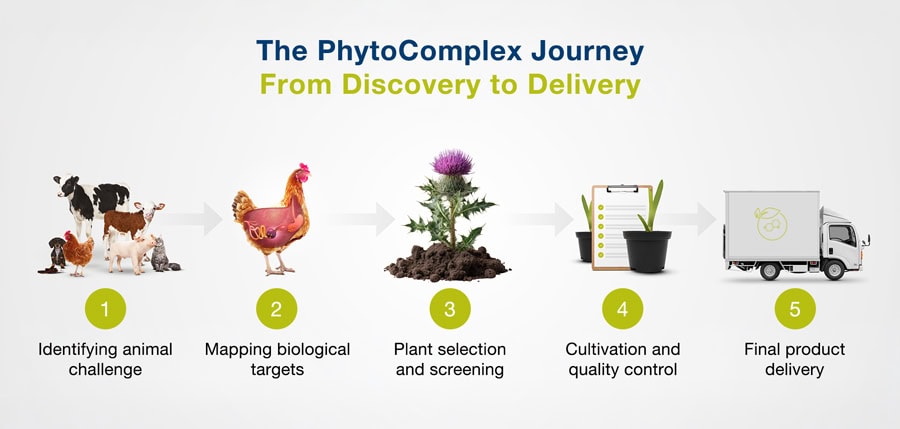
The development of a PhytoComplex begins with pinpointing a specific challenge that may hinder an animal from reaching its full genetic potential. For example, supporting liver function is crucial in laying hens and dairy cows, where fatty liver syndrome and metabolic stress can compromise productivity and health. In weanling piglets, the transition at weaning exposes them to dietary and environmental stress, increasing the risk of intestinal barrier dysfunction and digestive disorders. Broiler chickens often face subclinical, chronic inflammation, which can reduce growth rates and feed efficiency even in the absence of overt disease. Meanwhile, dairy and beef calves experience rapid physiological changes and immune challenges during early development, making enhanced resilience essential for improved survival, growth, and long-term performance. These challenges are defined in collaboration with business teams and customers to ensure relevance to real-world production environments.
Once the challenge is defined, biological mechanisms are mapped, including receptors in the gut, enzymes in metabolic pathways, and immune signaling cascades. This target-driven approach ensures that discovery efforts are grounded in biology and tailored to the needs of animal nutrition. However, scientific understanding of the exact mechanisms is often incomplete. That is why we always anchor our approach in measurable physiological outputs, for example, triglyceride accumulation in the liver for fatty liver prevention, or GLP-2 secretion for gut integrity. This ensures that our search for botanical candidates remains open and inclusive, allowing us to capture promising solutions regardless of whether all mechanisms are fully understood.
Candidate plants are identified using ethnobotanical knowledge, phytochemical databases, and advanced data modeling. Screening is conducted to evaluate the full constellation of specialized metabolites each plant can produce. Genetically distinct samples, or accessions, are collected from around the globe. Each accession undergoes rigorous evaluation, including in vitro bioassays with animal-specific cell lines and phytochemical profiling. Only those candidates demonstrating consistent and relevant biological effects progress to the next stage.
 FROM FIELD TO FEED: DOMESTICATION, STANDARDIZATION, AND QUALITY ASSURANCE
Once candidates are chosen, plants are cultivated under controlled conditions, following practices that safeguard their unique properties. The focus shifts from maximizing biomass to optimizing the yield of bioactive compounds most relevant to animal health outcomes.
Cultivation protocols are implemented with a global network of experienced growers. These partners follow plant-specific production guidelines, which often differ significantly from conventional agricultural practices. Technical support and quality monitoring are provided throughout the growing season to maintain high standards. Growing plants specifically for animal nutrition – according to the physiological needs of animals – is both unique and challenging. It requires precision, adaptability, and a deep understanding of plant complexity to consistently produce feed additives that deliver the desired effects.
Throughout this process, stringent quality control measures are applied. These include safety checks, microbiological testing, and phytochemical fingerprinting to confirm identity and assure consistency. The objective is to deliver a feed additive that is effective, safe, and traceable. What’s more, the complexity of the plant must be preserved while ensuring that the final product performs reliably in diverse production environments.

THE POWER OF AN INTEGRATED APPROACH
The distinguishing feature of Trouw Nutrition’s phytotechnology program is its integration. Discovery, development, and production are all housed within a single center of excellence, enabling seamless collaboration and full control over the supply chain – from initial plant selection to final product delivery. PhytoComplex development aims to deliver targeted, science-based solutions that help animals thrive in demanding production environments. The conversation around phytogenic feed additives often starts with antibiotic replacement, but our vision goes much further. PhytoComplexes are not substitutes for traditional health management tools; they are solutions designed to enhance resilience, optimize performance, and contribute to sustainable production systems. This holistic perspective aligns with global trends toward preventive health strategies, reduced environmental impact, and improved animal welfare. It also reflects a commitment to innovation that is both science-based and nature-inspired.
A NEW ERA IN PHYTOTECHNOLOGY
The future of phytotechnology is bright. Advances in genomics, metabolomics, and artificial intelligence are opening new frontiers in plant-based solutions. These tools enable us to predict biological effects, optimize formulations, and accelerate development timelines without compromising safety or efficacy.
Cultivating plants specifically for animal nutrition, with the goal of producing effective and consistent feed additives, is a complex endeavor. It requires interdisciplinary expertise, robust infrastructure, and a commitment to continuous improvement. PhytoComplexes are more than products: they are the result of collaboration between science, agriculture, and animal nutrition. They are science-based, nature-inspired, and solution-driven, designed to meet the evolving challenges of animal production and contribute to a more resilient and sustainable future.
About Dr. Ellen Hambrecht
With a PhD from Wageningen University, the Netherlands, Ellen Hambrecht brings over 20 years of experience in the agricultural industry. Her career at Trouw Nutrition spans diverse roles in R&D, QA, Sustainability, and Global Marketing. In her current role as Global Product Manager, Dr. Hambrecht is responsible for Trouw Nutrition’s PhytoComplex portfolio, innovative phytotechnology-based solutions designed to harness the power of plants for sustainable animal production.