


Pig production faces constant economic, social, and geopolitical challenges beyond farmers’ control. Therefore, focusing on controllable aspects like feed safety is critical. Since viral contaminations cannot be predicted, medium-chain fatty acids (MCFAs) offer a practical tool to manage such risks at the point of feed delivery.

Category specialist MCFA
Agrifirm
Pig production is facing constant economic, social, and geopolitical challenges, over which farmers have limited control. Therefore, it is critical to focus on the controllable aspects of farm operations, such as feed safety. The occurrence, severity, and pathogen involved in viral contaminations cannot be predicted in advance. Therefore, medium-chain fatty acids (MCFAs) offer a practical tool to help manage such risks at the point where feed is supplied to the animals.
Managing a farm today requires other skills compared to 20 years ago. Just as any other CEO, farm owners and managers spend most of their time and energy focusing and monitoring the aspects of their farm via data. This data forms the basis for farm optimization and continuous improvement projects.
Obviously, proper management, high-quality nutrition, and complete biosecurity can be included. All of these are of paramount importance when it comes to technical results in swine production. Raw material quality is at a crossing point between high-quality nutrition and biosecurity. Unfortunately, due to legislation, geo-political events, climate change, and other global events, finding high quality raw materials is becoming more and more a burden for our industry. Therefore, it is of utmost importance to monitor and measure all incoming raw materials on multiple levels like nutritional content, mycotoxin contamination, oxidation degree, Salmonella, and many more. New raw materials and/or feeds are entering our farms almost on a daily basis, so also on biosecurity they cannot be overlooked.
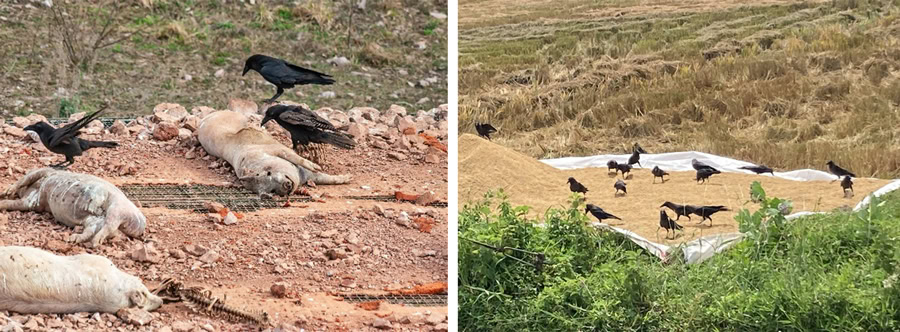
For example, what about the risk of pathogen transmission via feed? In the case of viruses, reference studies – such as Niederwerder et al., 2019 – have confirmed that, even when feed is contaminated with a virus at low levels, the frequent direct contact among animals in the feeder can make the feed a more significant risk factor for transmission than water or other biosecurity considerations. It is very often extremely difficult to find out how the crops have been treated before, during, and after harvest. These factors can increase significantly the chance of contamination by important diseases (picture 1). Consequently, very often mitigation measures against viral pathogens in the feed must be implemented – and they must follow local regulations that increasingly prohibit the use of chemical mitigants that can put operators at risk from feed mills to barns.
MEDIUM CHAIN FATTY ACIDS (MCFAs) – A NATURAL SOLUTION AGAINST VIRUS-ASSOCIATED RISKS
Medium Chain Fatty Acids (MCFAs) are molecules available naturally – for instance, in coconut oil. These molecules are used today in food, nutraceutical, and pharmaceutical industries for their proven action against various types of pathogenic microorganisms. Because MCFAs damage the phospholipid bilayers of potential pathogens, we recently developed a blend of free MCFAs (FeedLock; Royal Agrifirm Group, The Netherlands) that is specifically optimized in vitro against enveloped viruses (Tran et al. 2021). Furthermore, we investigated the impact of this blend using the “ice-block challenge” model described by Dee et al., 2021, a model that mimics the natural contamination of animals with multiple viruses.
In brief, the experimental set-up involved preparing 1-lb ice blocks (–80 °C) inoculated with several viruses: PRRSv, PEDv, and SVAv (Seneca virus, the only non-enveloped virus included in the study) at a concentration of 10⁵ TCID₅₀/mL × 100 mL each. These blocks were placed in feed bins at the start of the study and again after 6 days, allowing the progressive release of viruses into the feed as it was consumed by the animals.
A total of 12 pens, each housing 7 to 8 weaned pigs, were used. Half of the pens received the contaminated diet alone (Control), while the other half was fed the same diet supplemented with FeedLock MCFA (Royal Agrifirm Group, NL). Clinical scores were recorded: dyspnea, weight loss, and rough hair coat for PRRSv; diarrhea for PEDv; and lameness for SVAv; along with post-mortem sampling of relevant biological compartments (e.g., serum for PRRSv, rectal swabs for PEDv, and tonsils for SVAv).
In addition, in order to assess the link between feed contamination and oral exposure, viral RNA was detected using dedicated PCR procedures in feeders and in chewing ropes available to the pigs in the different pens.
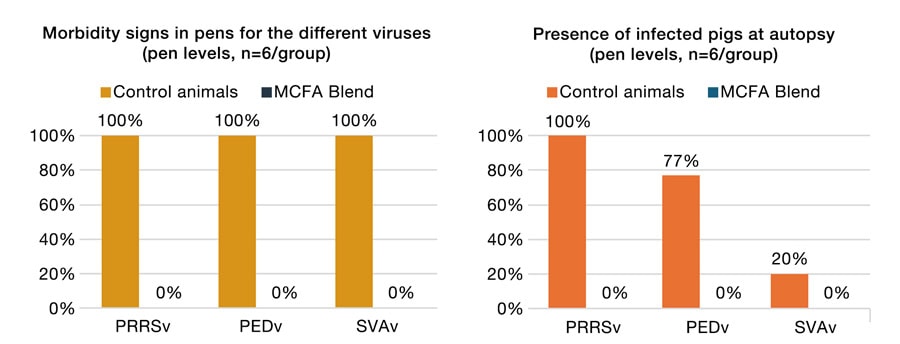
Supplementing the contaminated feed with FeedLock was associated with the absence of morbidity signs in the related pens, while 1 (or more) animal per pen expressed morbidity in the control group (Figure 1, left). Similarly, for PRRSv and PEDv, autopsies confirmed the absence of signs of infection in the target biological compartments of pigs fed with FeedLock compared to the control group. In this test, infection by SVAv appeared to be insufficient to fully assess the impact of MCFA (Figure 1, right). These very discriminating results confirmed that incorporation of FeedLock in the feed exerts a preventive effect against the associated symptoms of PRRSv, PEDv and SVAv.
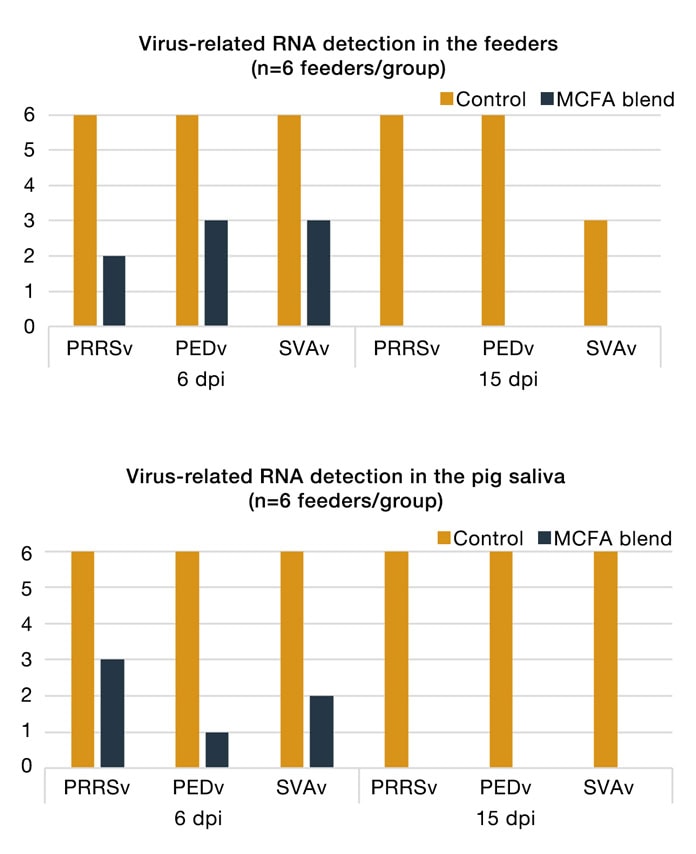
We also analyzed the presence of viral RNA in the feeder and in the pigs’ saliva, in order to confirm that the lower incidence of viruses at the animal level was a result of the MCFA action on the viral particles at the feed level – minimizing, as a consequence, the risk for pigs to be exposed to the pathogens at the feeder level, where the interaction between the feed, the pathogens, and the animals is most likely to occur.
RESULTS: VIRAL RNA IN FEED AND SALIVA
Similarly to what was observed at the pig level, no viral RNA was detected 15 days post-infection (dpi) for any of the viruses tested in the MCFA-supplemented group, whereas RNA particles were detected in all the control samples at feeder or saliva level. Interestingly, at 6 dpi, some viral RNA could also be identified in the MCFA-supplemented group, although this was not finally associated with morbidity or symptoms in the animals. This can be explained by the fact that, in this study, we did not check for the complete viral particles, but rather for RNA using PCR. The target of the MCFA action was the phospholipid envelope of the virus and not the nucleic acids. With a half-life of minutes to hours for RNA and ice-block contaminations at d0 and d6, it is not surprising to still detect those nucleic acids in samples taken at 6 dpi, even when the virus envelopes have been destroyed.
The use of FeedLock as a natural and globally available technology to mitigate the risks of virus in feed provides one of the most efficient solutions to enhance the biosecurity of swine farms by increasing feed safety in the operations. On top of this strong mitigation effect, farm owners will receive the same strong payback in performance, compared to other MCFA-based additives, making this feed biosecurity measure an insurance with payback in performance. By keeping farmers in control of their operations, FeedLock ensures their peace of mind for biosecurity without impacting their wallet.