


Studies show that feeding choline around calving helps cows eat more and produce more milk when the dose is right. A 2025 review of thirty experiments by the Institute of Animal Science at the University of Bonn, Germany, evaluated the dose–response to identify how much choline is needed to maximize feed intake and milk production, providing producers with practical guidance for transition cow programs.
Feeds Specialist and Nutritionist
Dellait Animal Nutrition and Health
The weeks around calving are the toughest part of a cow’s life. Feed intake usually drops just as milk production starts, forcing cows to burn body fat. This breakdown releases free fatty acids (FFA), also known as NEFA in scientific literature, into the bloodstream. When too much reaches the liver, it can build up as “fatty liver,” lowering appetite, health, and productivity. Supporting the liver during this time directly improves performance. Helping the liver means making it easier for the cow to manage the extra fat that floods in after calving. When the liver can move this fat out instead of storing it, the cow eats better, stays healthier, and produces more milk.
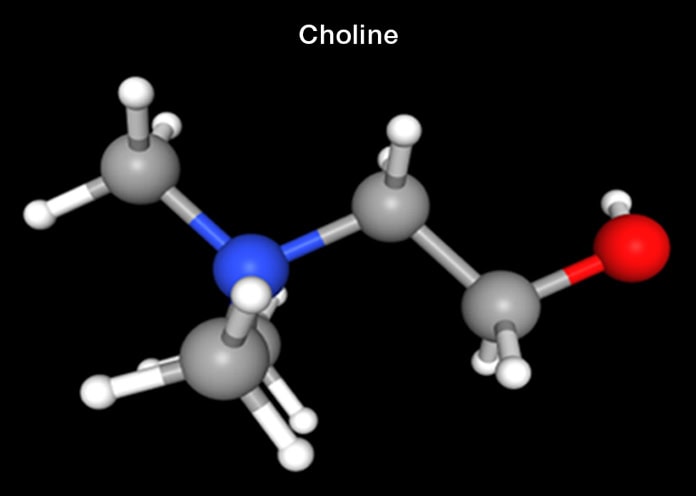 Choline is a small, water-soluble molecule with a structure that helps the cow in three key ways: it acts as a building block for cell membranes, as a carrier to move fat out of the liver, and a supporter of key metabolic pathways.
In short, its functions are:
1. Moving fat safely by forming phosphatidylcholine, which the liver uses to package fat into very-low-density lipoproteins (VLDL). These particles carry fat out of the liver and into the bloodstream, where it can be used for energy or milk production instead of building up in the liver (Figure 1).
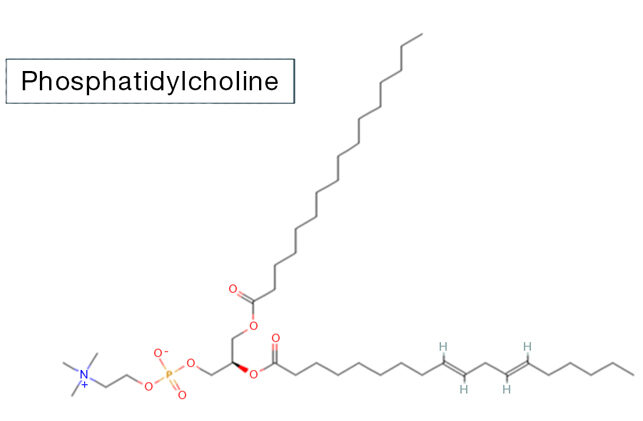
2. Building healthy cells because choline is a key part of cell membranes in the liver, mammary gland, and immune system, helping these tissues function properly during the stressful transition period.
3. Supporting metabolism by serving as a methyl donor through its conversion to betaine, which helps the cow use nutrients efficiently for energy and protein synthesis.
Because normal choline is destroyed in the rumen, it must be supplied as rumen-protected choline (choline). Research shows that feeding choline from three weeks before calving through early lactation helps cows in several ways.
EXPERIMENTAL RESULTS
Studies show that feeding choline around calving helps cows eat more and produce more milk when the dose is right. A 2025 review of thirty experiments by the Institute of Animal Science at the University of Bonn, Germany, evaluated the dose–response to identify how much choline is needed to maximize feed intake and milk production, providing producers with practical guidance for transition cow programs.
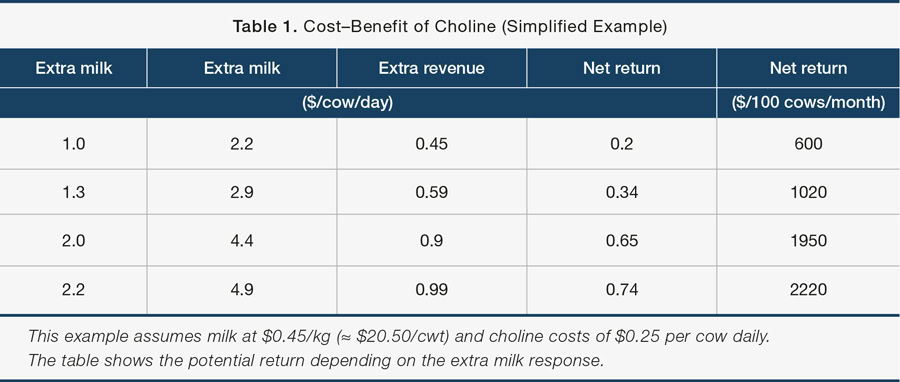
The best results were seen at about 13–14 g per day, where cows ate almost half a kilo (1 pound) more feed dry matter and gave about 1.3 kilos (2.9 pounds) more milk per day. At slightly higher levels, 15–21 grams per day, cows produced over 2 kilos (4.4 pounds) more fat-corrected milk, with direct improvements in the milk check. Importantly, feeding choline before calving alone did not change intake, it is the consistent feeding through early lactation that pays off. For example, if choline costs about $0.25 per cow per day and the extra milk brings in $0.60 to $0.80, the net return is $0.35–0.55 per cow per day. Across 100 fresh cows, this adds up to an additional $1,000–1,500 in profit monthly, making it a cost-effective tool in transition cow programs (Table 1).
 MILK FAT AND PROTEIN
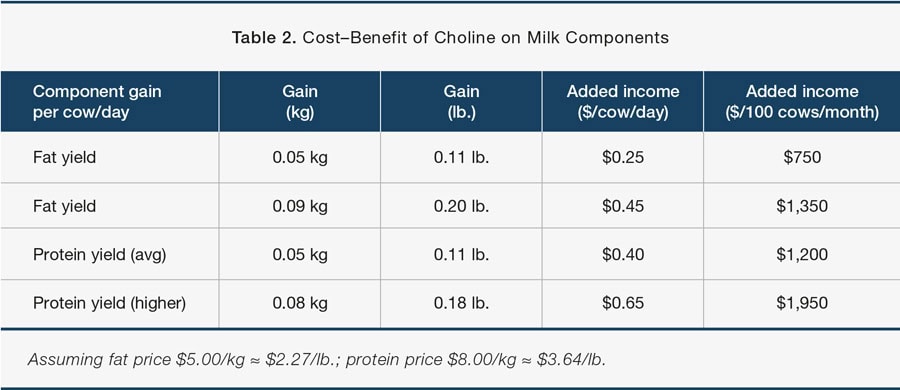
Choline does not change the percentages of fat, protein, or lactose in milk, but it can increase the total amount of fat and protein produced each day. Fat yield improved steadily when cows received 12–24 g per day, with the best response adding about 0.09 kg (≈0.2 lb.) more fat per cow per day. Protein yield also improved in the 13–20 g/day range, though results varied more between studies. The best responses were seen when choline was fed beyond 21 days in milk and with some commercial products. For producers, this means that while milk tests may not show higher percentages, choline helps ship more total fat and protein off the farm, directly increasing milk check value (Table 2).
 BODY CONDITION AND WEIGHT
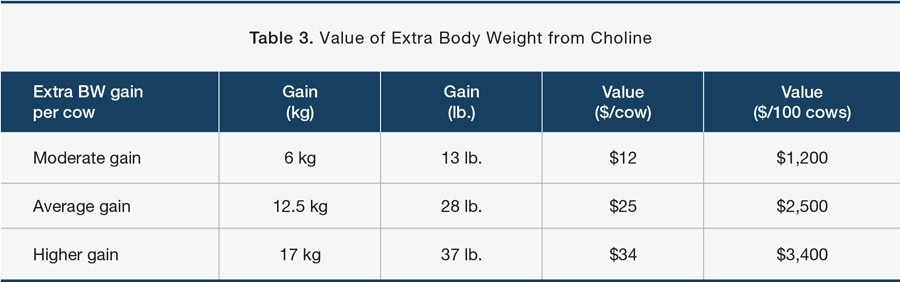
Rumen-protected choline (RPC) does not change body condition score (BCS), either before or after calving, which means cows are not gaining or losing visible condition from supplementation. However, overall body weight (BW) did increase, especially when cows received around 11 g/day, with an average gain of about 12.5 kg (≈27.5 lb.). This added weight is not from extra fat but reflects better nutrient use and more feed intake. In practical terms, cows maintained condition while carrying more body mass, a sign that RPC helps them cope with the transition period more efficiently (Table 3).
 TAKEAWAY
Feeding rumen-protected choline during the transition period helps the liver handle fat, improves feed intake, and boosts milk. The best results are seen at 13–14 g/day, with slightly higher levels (15–21 g/day) giving more fat-corrected milk and up to 24 g/day improving fat yield. Cows also gain body weight without losing condition, showing better nutrient use. For most farms, choline is a reliable investment, but the most profitable dose depends on milk price, feed costs, and product choice.
Reference
1. “Based on results obtained from Ghaffari, M. H., Rezaei-Ahvanooei, M. R., Piray, A. H., Bahrampour, J., Ma, T., & Bradford, B. J. (2025). Effects of rumen-protected choline supplementation on lactation performance of dairy cows: A systematic review and dose–response meta-analysis. Journal of Dairy Science, 108(9)